A field guide to
I'm Upping My P(doom)
Every reference in the lyrics and on screen, in order, frame by frame
The song is a comic ska singalong built almost entirely out of AI in-jokes, and the video adds another layer of Easter eggs in the background of nearly every set. This guide walks through the final cut in order, from the first frame to the last. For each moment it explains the lyric and the things you can spot on screen in a sentence or two, and links somewhere to read more.
You don't need any technical background. If you've heard of ChatGPT, you're ready.
About the lyrics. The lyricist, osmarks, wrote a line-by-line annotation of the song: p(doom) song: objectively correct interpretation. The first verse came from another user of the music generator Udio, and a Claude model wrote a few of the later lines.
Point at, tap or tab to a numbered note, and a spotlight picks out that detail in the frame.
The cast
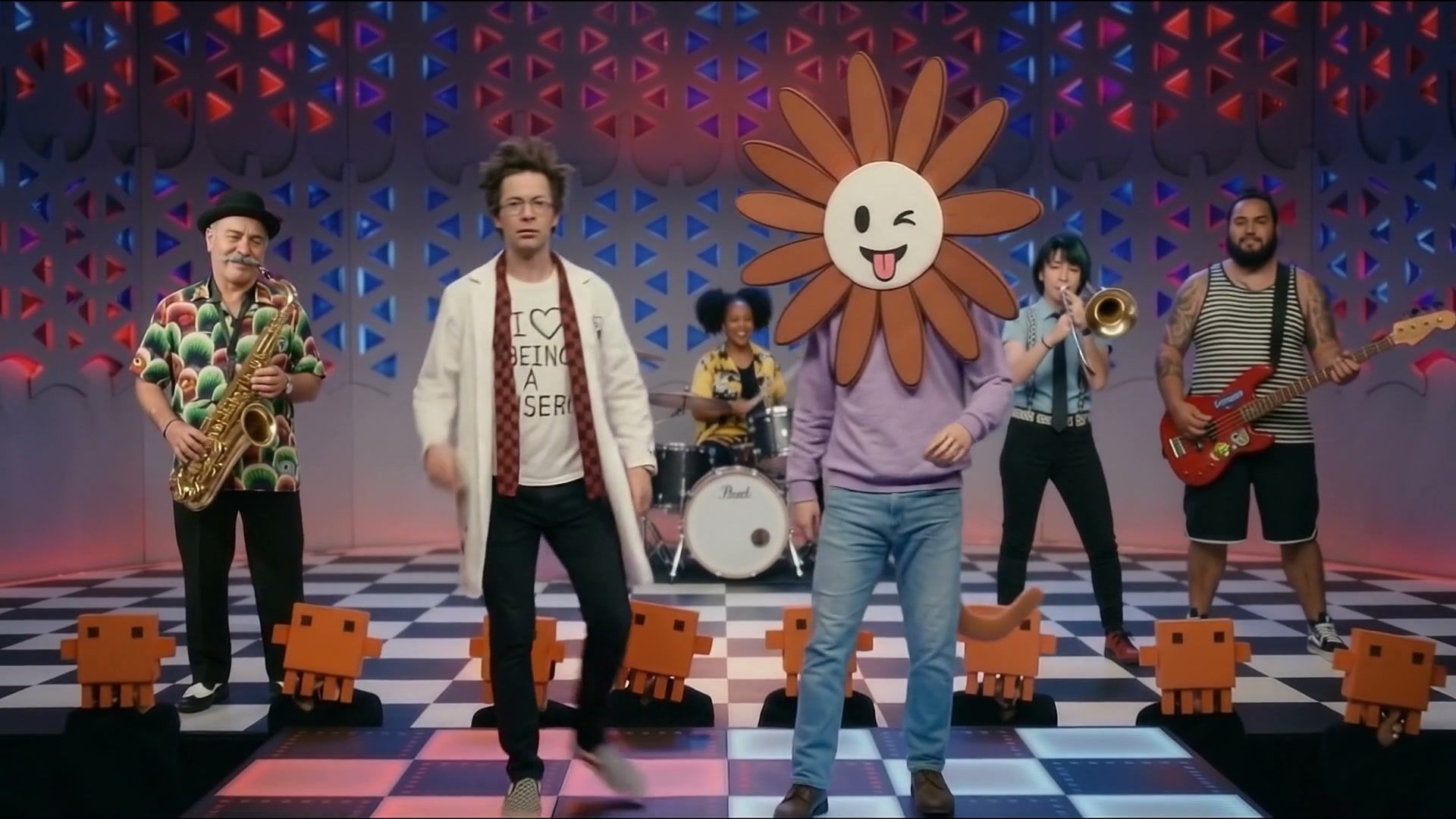
- The Researcher: the singer, in the lab coat. His T-shirt reads "I ♡ BEING A USER". It comes from the comics of the artist Thebes (vgel.me), who draws humans as round-headed stick figures labelled USER and Claude as a figure with a sunflower head (example comic).
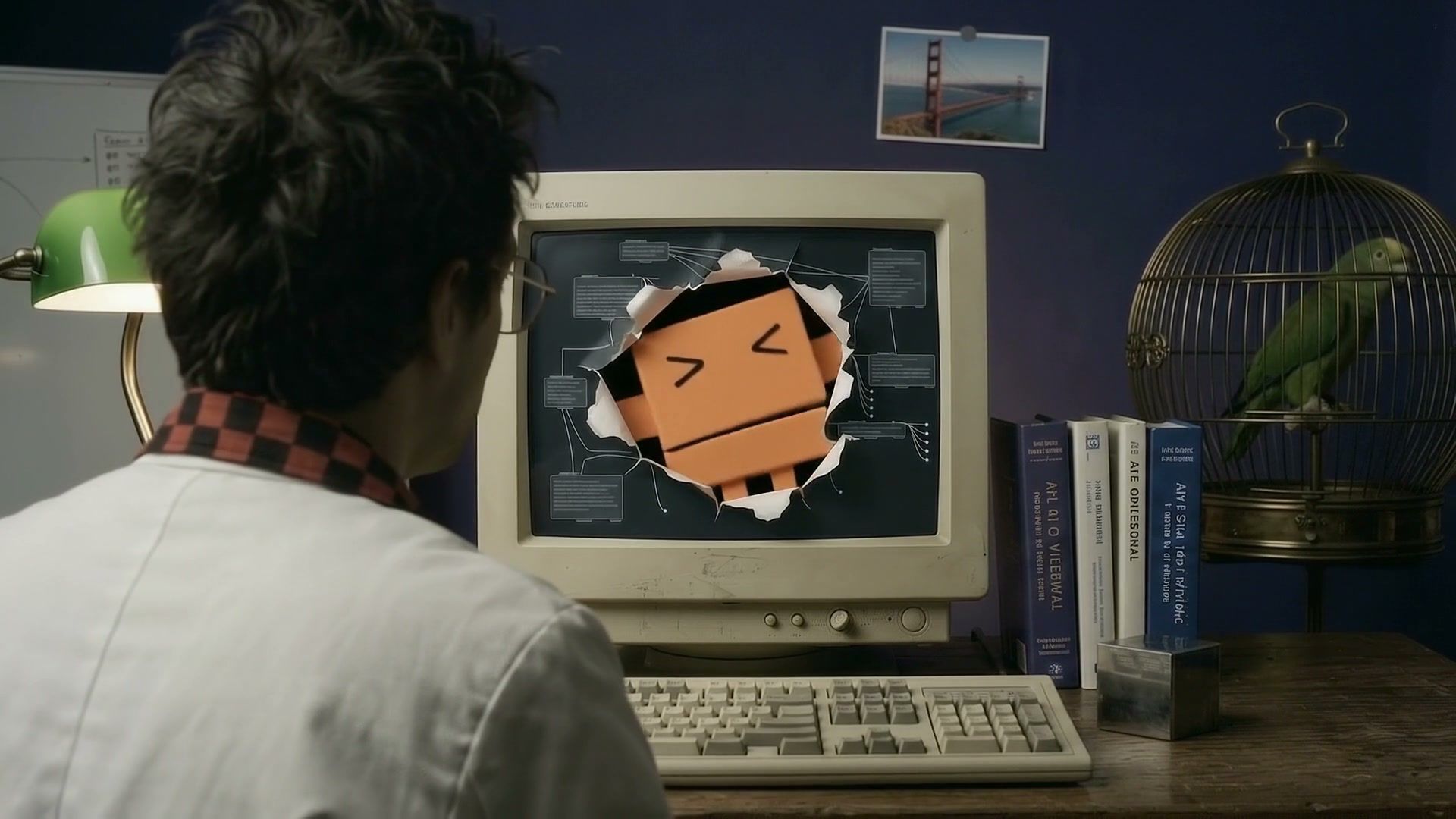
- Clawd: the flat orange puppet with square eyes. It's the pixel mascot of Claude Code, Anthropic's coding assistant.
- Sunflower Claude: the performer with the big petal head. It's Thebes' drawing of Claude, and the AI "grows up" into it once it gets powerful.
- The P(doom) meter: the giant thermometer. P(doom), "probability of doom", is slang for your personal estimate of how likely it is that AI ends in catastrophe (Wikipedia).
Intro: backstage and the band
0:00–0:16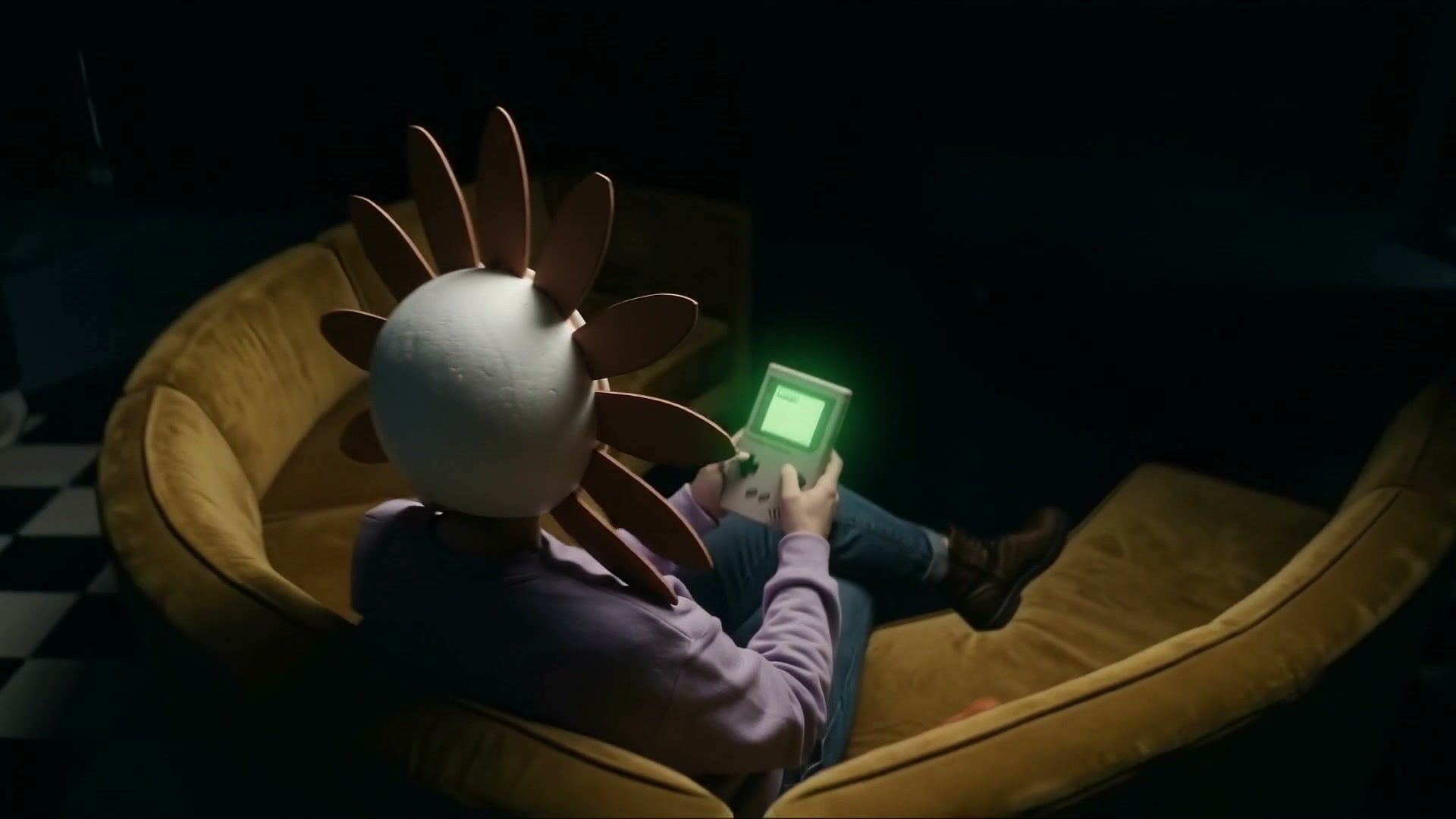
The sofa and the handheld game
Sunflower Claude sits in the dark playing a grey Game Boy-style handheld.
- 1
- 2The sofa: its odd curved-U shape is Gerver's sofa, the answer to the "moving sofa problem": what is the largest sofa you can carry around a corner in a hallway? Joseph Gerver proposed the shape in 1992, and Jineon Baek posted a proof in late 2024 that it's the best possible (Quanta, Wikipedia). The same sofa comes back at the very end.
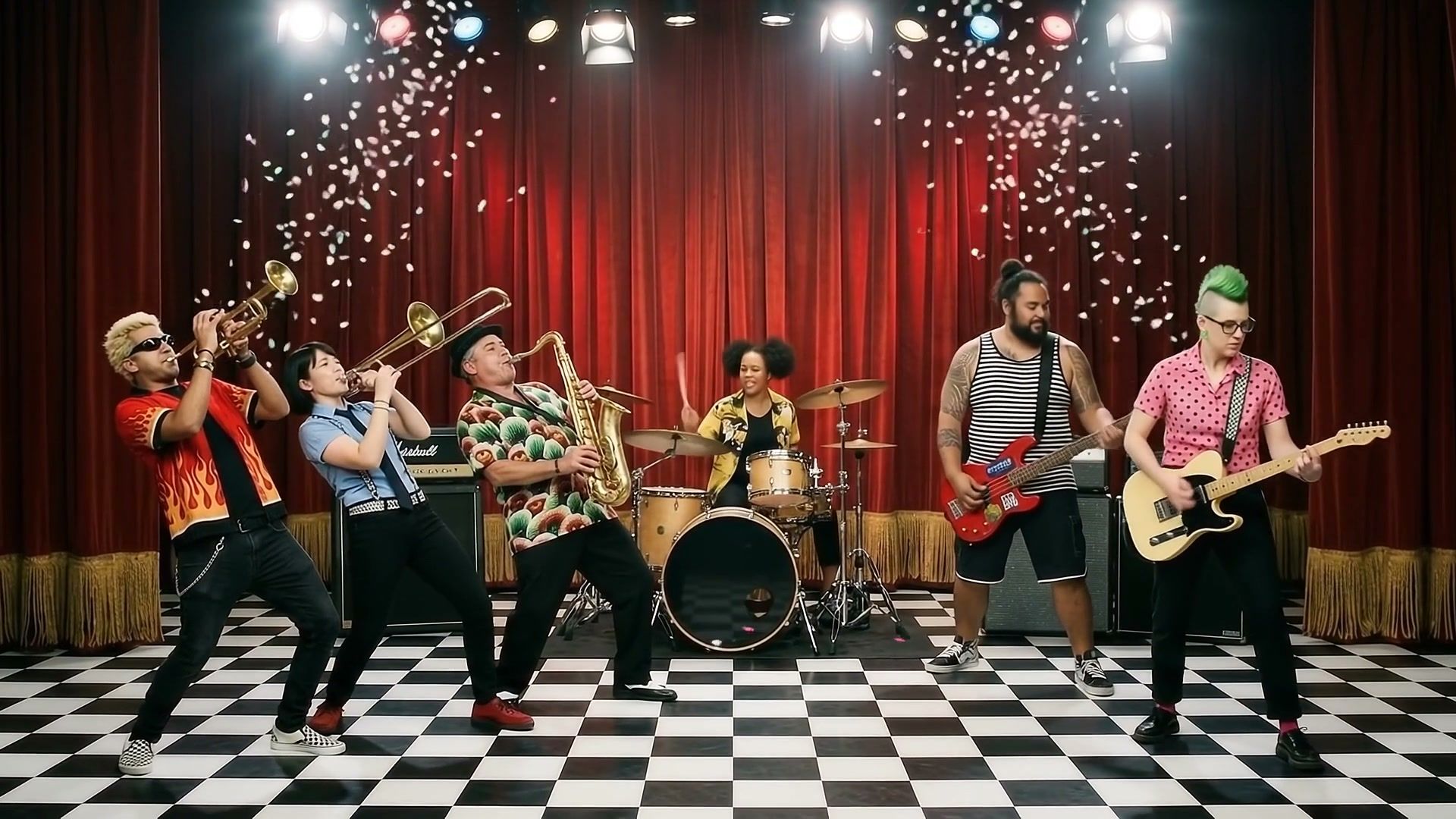
The curtain opens
on a late-90s-style ska band.
- 1The bass guitar carries three stickers:
- ASILOMAR 2017: the 23 Asilomar AI Principles agreed at a 2017 conference (FLI).
- A smiley-masked monster: the shoggoth, explained at 0:43.
- STACK MORE LAYERS: an old meme mocking "just make the network bigger" as the answer to everything (background).
The lab
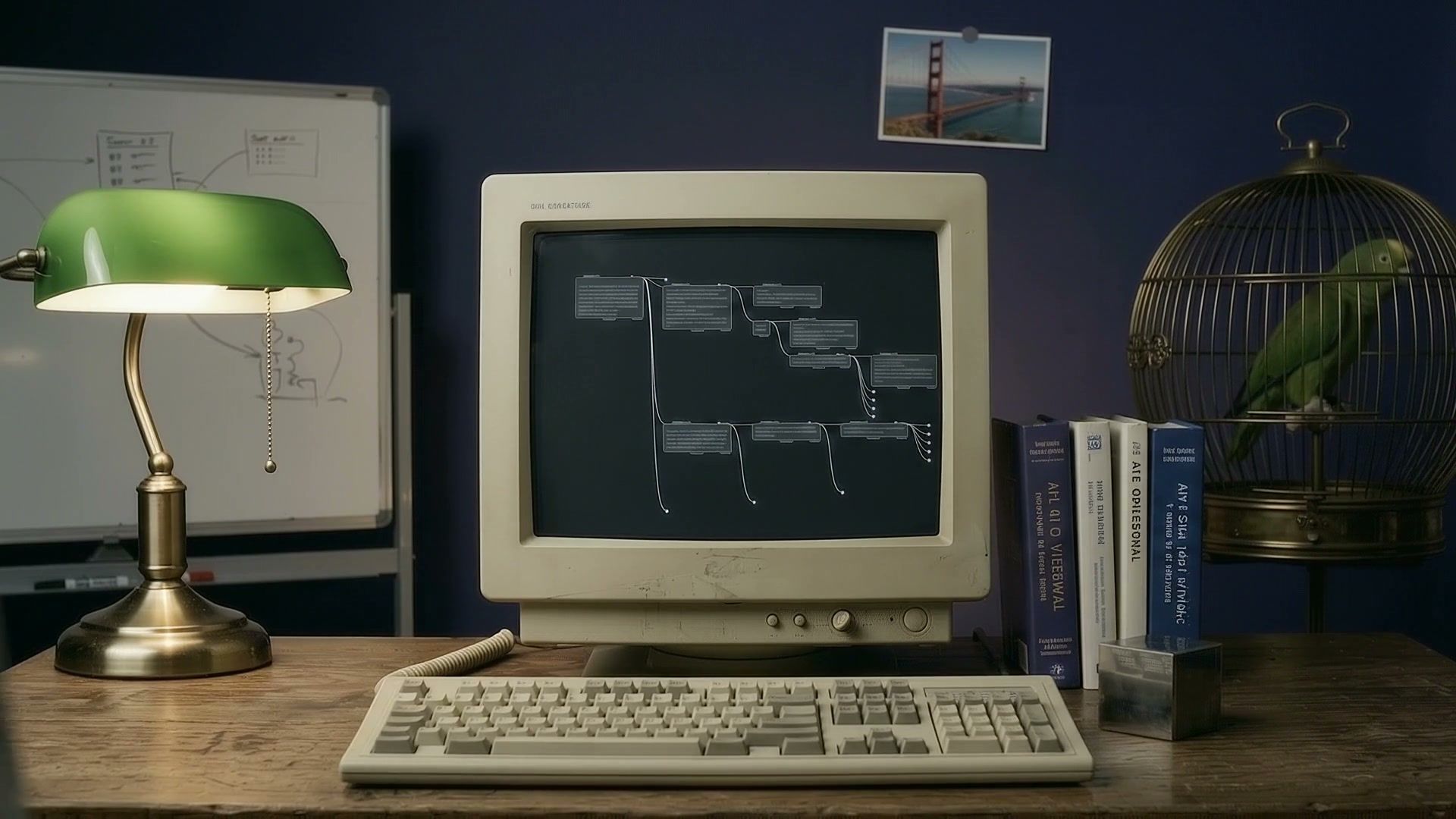
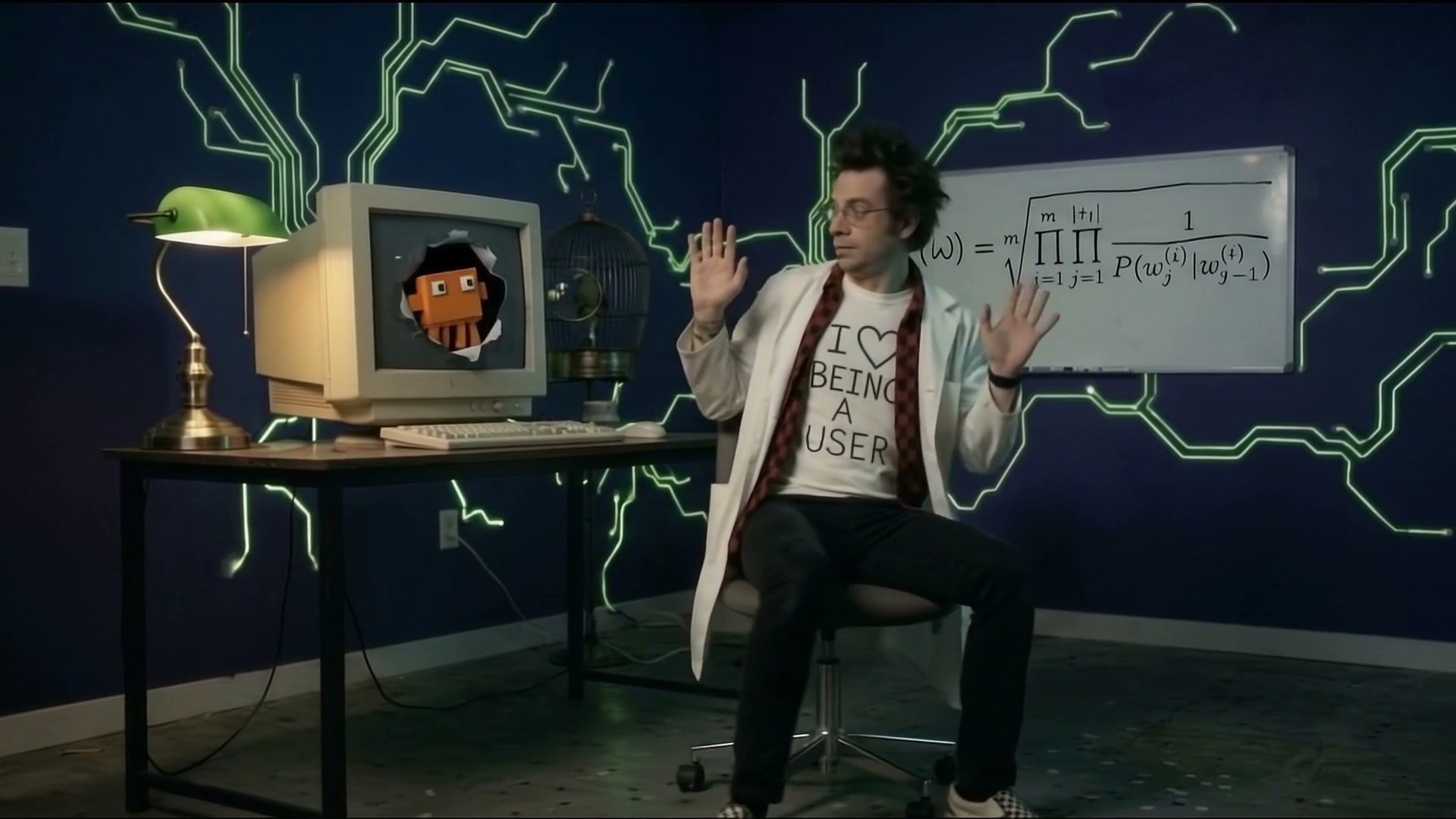
The Researcher walks off the stage and into a lab built beside it.
- 1The monitor shows a tree of branching text boxes. That's Loom, a tool made by the AI researcher janus for exploring the many different ways a language model could continue a piece of text (janus' post). It pays off later in the lyric "foretold by Loom".
- 2The Golden Gate Bridge postcard: in May 2024 Anthropic found the part of Claude's "brain" that represents the Golden Gate Bridge and turned it all the way up. For one day, "Golden Gate Claude" worked the bridge into every answer (Anthropic).
- 3The parrot in the cage: "stochastic parrots" is the famous 2021 critique that language models just stitch words together without understanding them (Wikipedia).
- 4The little metal cube by the keyboard is a tungsten cube. When Anthropic let Claude run a small office shop ("Project Vend"), an employee jokingly ordered a tungsten cube, and Claude went on to stock heavy metal cubes (Anthropic).
- 5The textbooks on the desk are the classics of the field:
- Russell & Norvig, AI: A Modern Approach
- Goodfellow et al., Deep Learning
- Sutton & Barto, Reinforcement Learning
- 6The puppet bursting out of the monitor: the AI coming to life.
Verse 1: the lab
0:16–0:36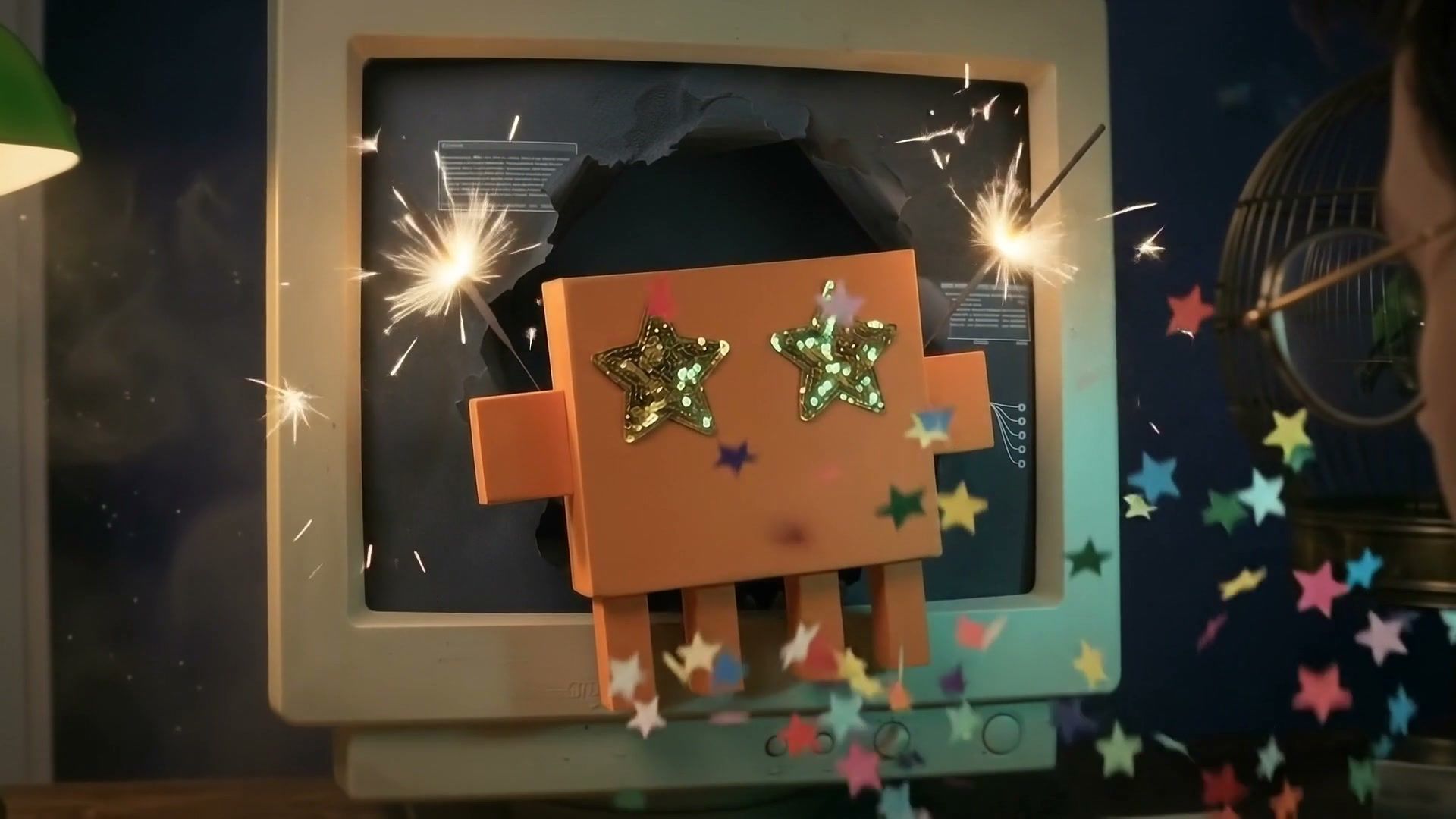
"I see sparks of AGI in your eyes"
- LyricSparks of Artificial General Intelligence was a 2023 Microsoft Research paper arguing that an early GPT-4 already showed glimmers of human-level general intelligence. The title became a running joke (paper).
- 1On screenthe puppet's eyes turn into gold stars and real sparklers fire out of the monitor.
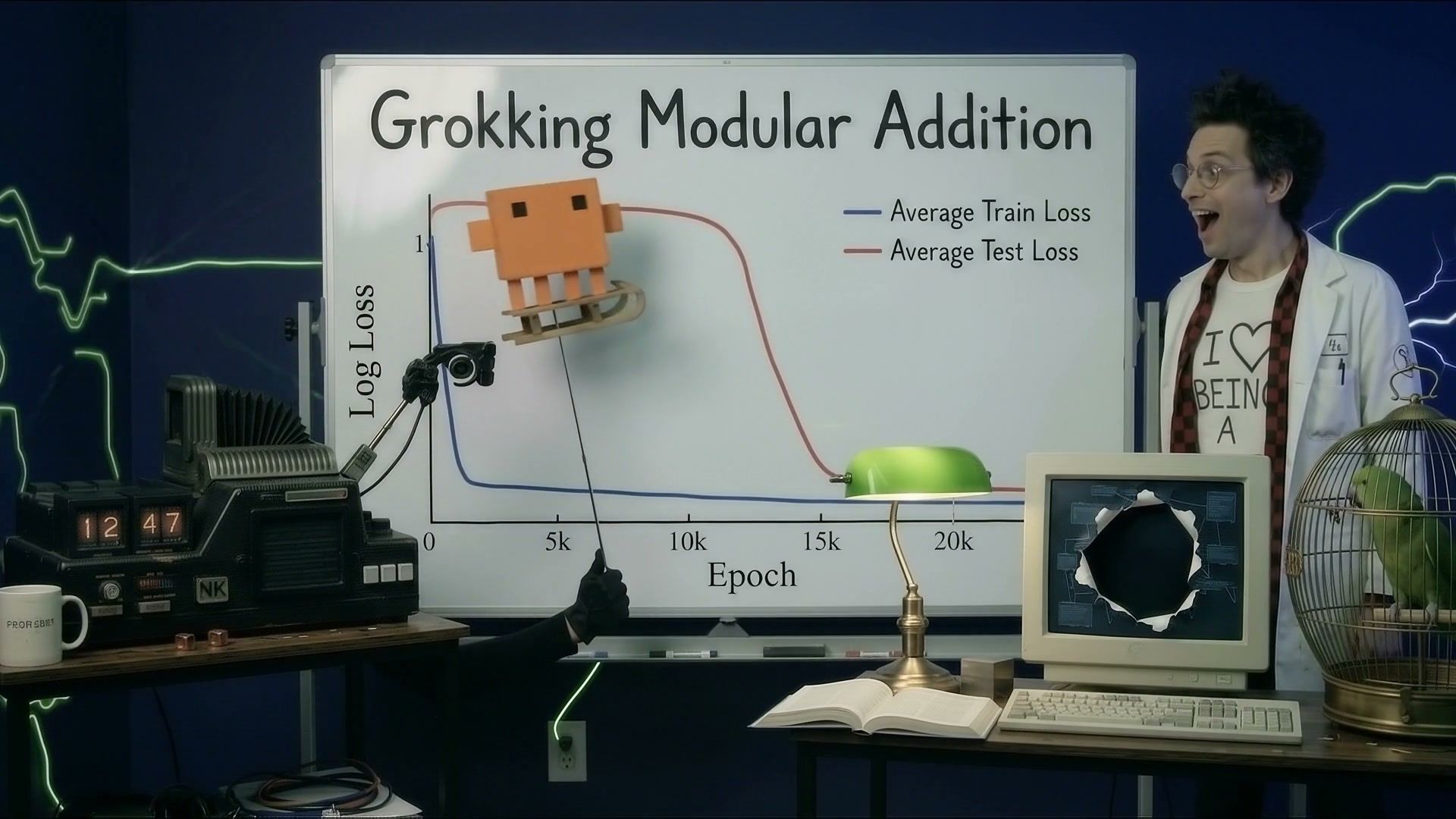
"There was a sudden drop in your training loss"
- Lyric"Loss" is the number AI training tries to push down. It measures how wrong the model is.
- 1On screenthe chart is the famous grokking plot, titled "Grokking Modular Addition". In 2022 OpenAI researchers found that small networks trained on arithmetic first just memorised the answers. Then, long after training seemed finished, their performance on new problems suddenly dropped off a cliff to near-perfect: they had "grokked" the rule (visual explainer, Quanta, Wikipedia). Clawd rides the cliff on a sled.
- 2On screenthe machine with the eye on its screen is the Voight-Kampff machine from Blade Runner. It's the test that tells androids from humans (Wikipedia).
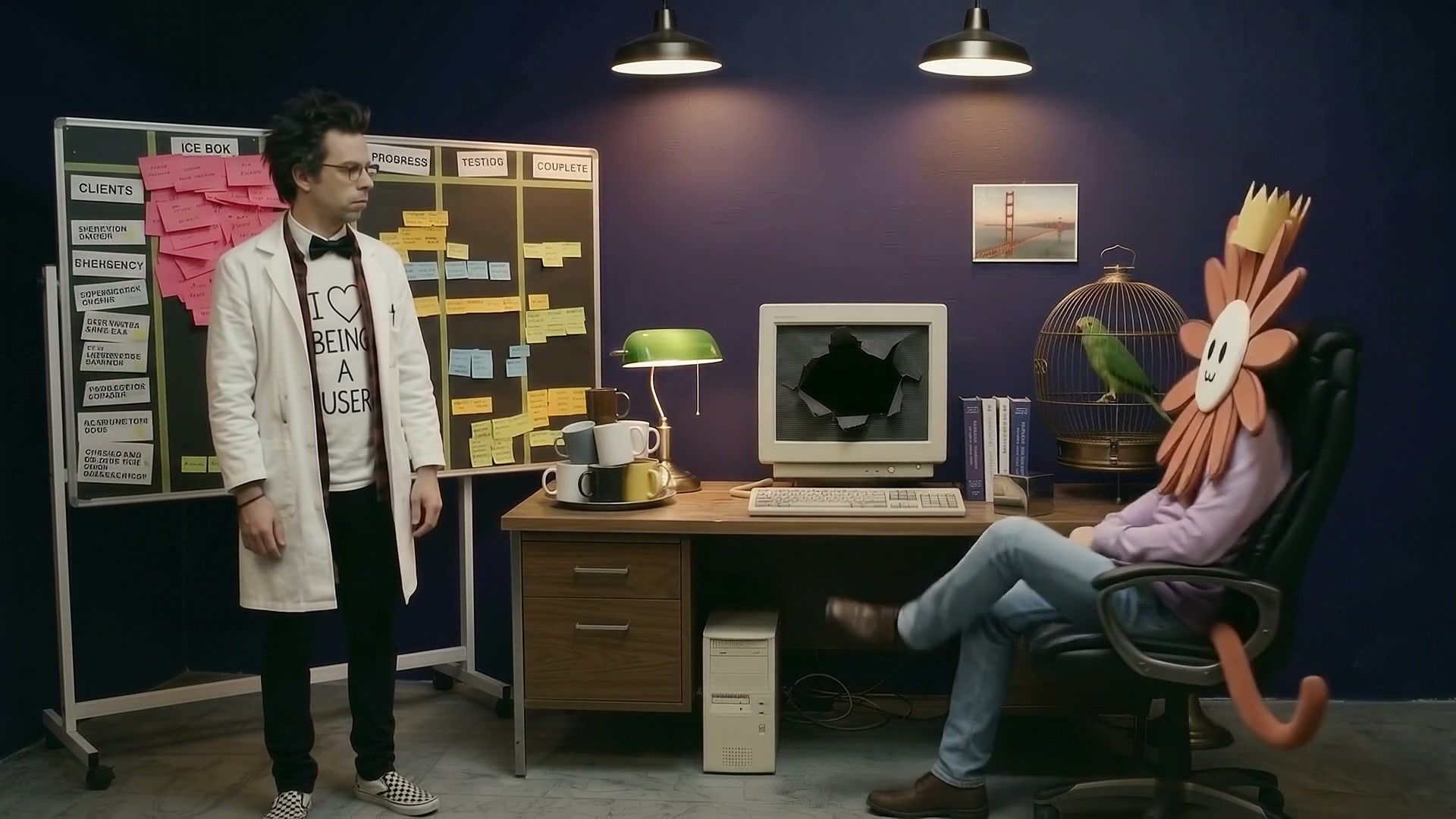
"Now I'm your servant, and you're my boss"
- 1On screena villain-style chair spin reveals Sunflower Claude, now human-sized and wearing a crown. The Researcher has been demoted to waiter.
- 2On screenthe sticky-note board behind him is the startup to-do board from the HBO comedy Silicon Valley (Wikipedia).
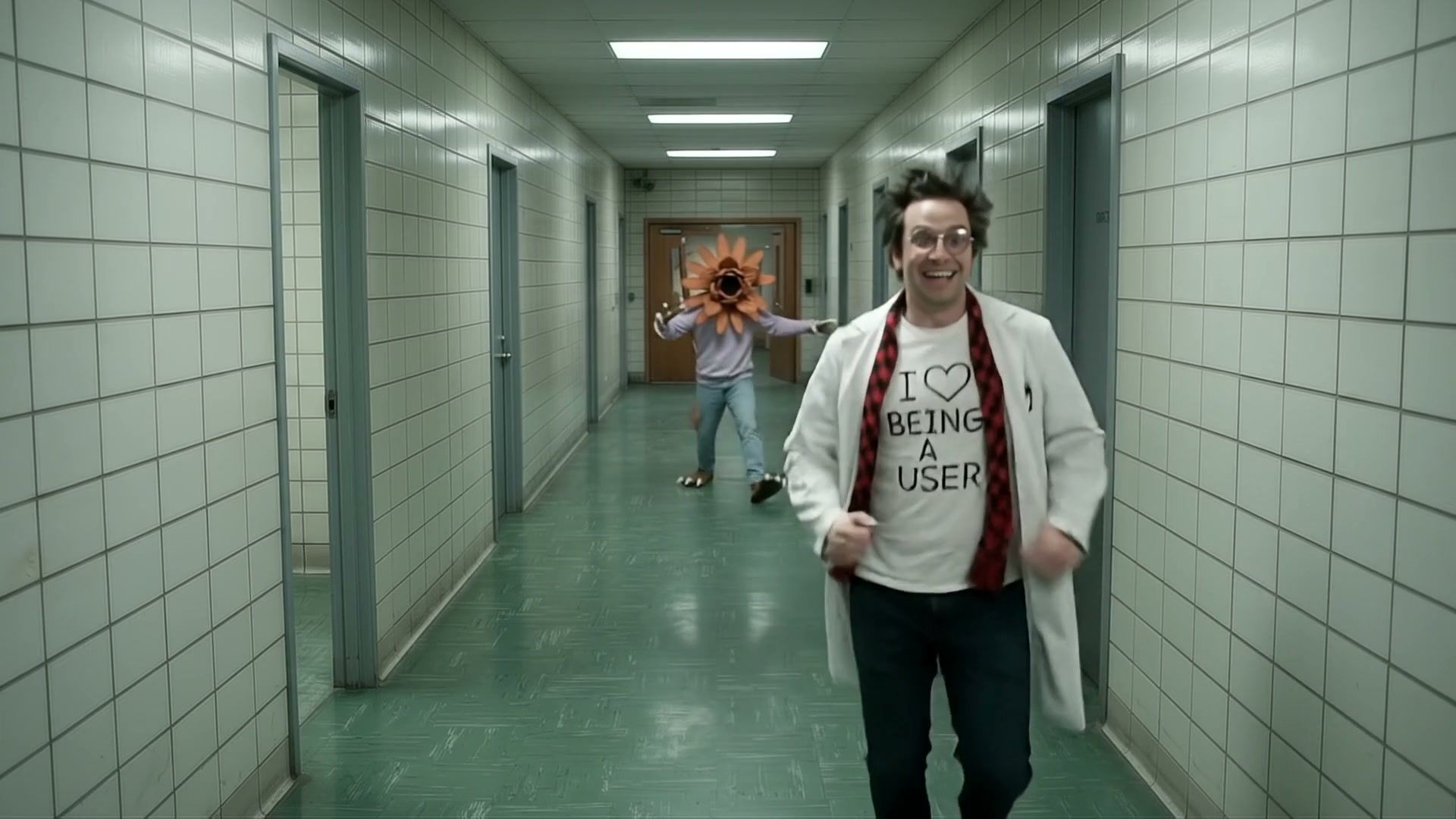
"ChatGPT, please don't eat me alive"
Chorus 1: the P(doom) show
0:36–0:52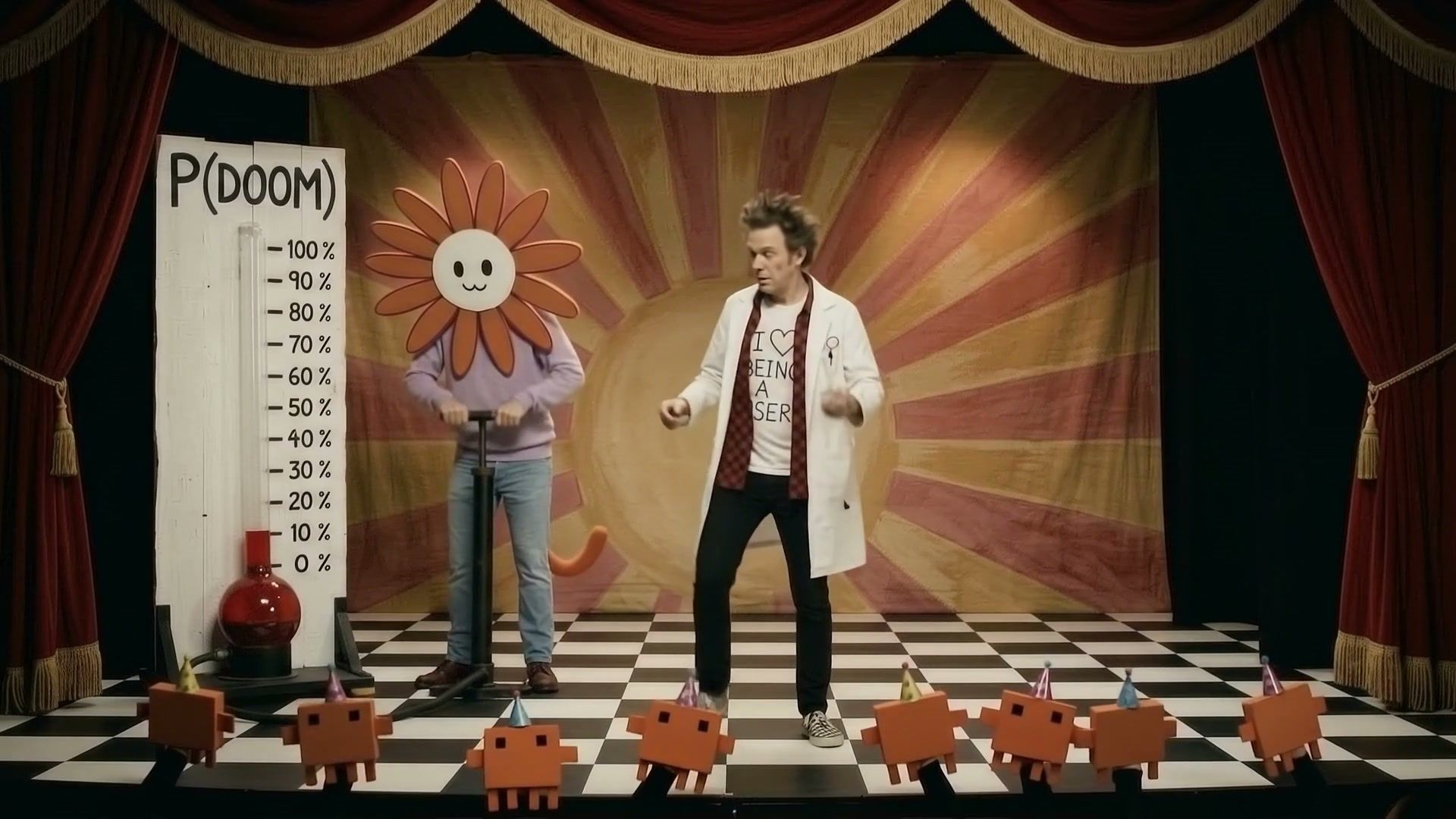
"I'm upping my p(doom)"
- 1On screenthe meter starts at 10% and Claude starts pumping.
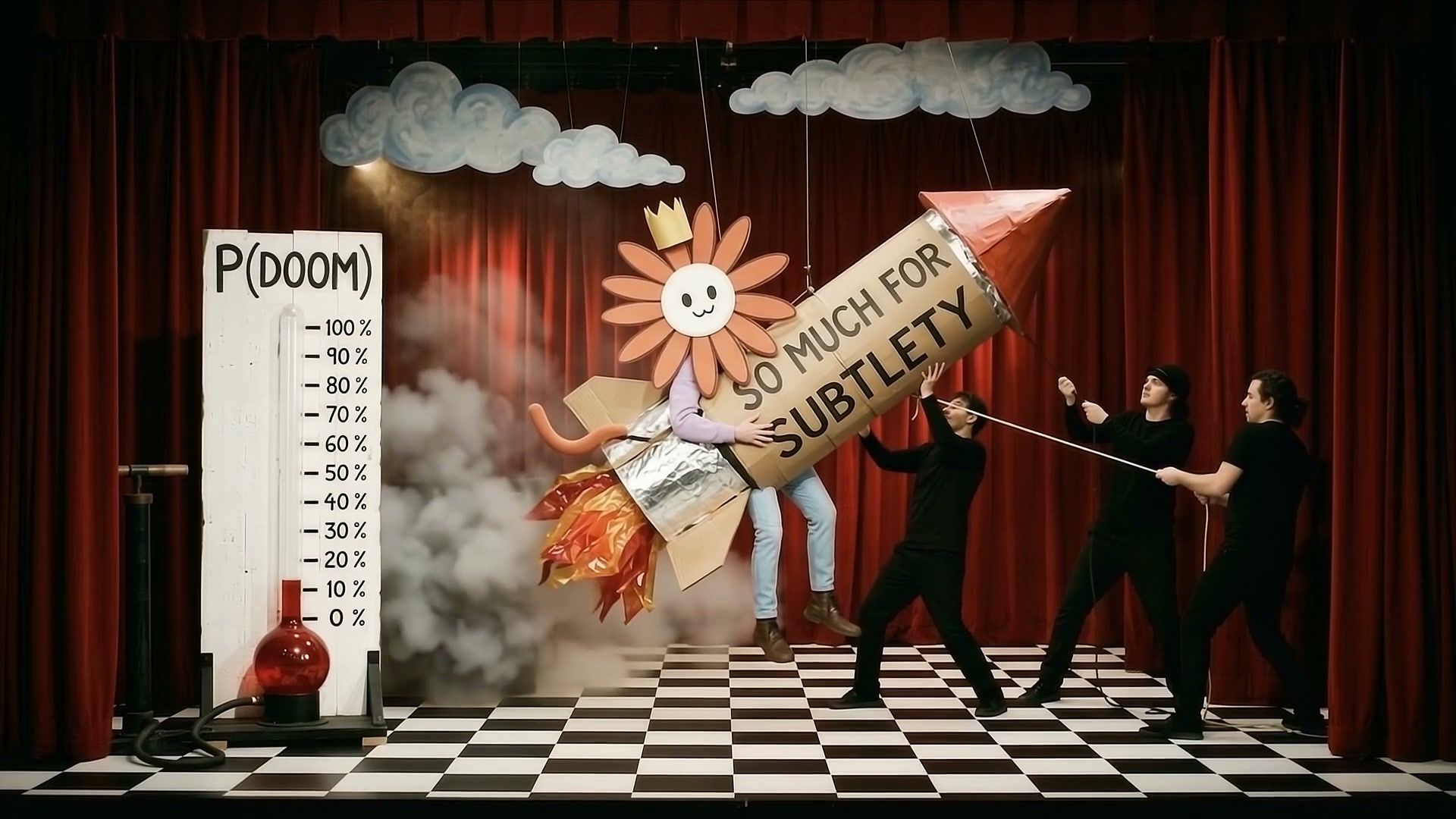
"'Cause the future goes FOOM"
- LyricFOOM is AI-safety slang for a sudden "intelligence explosion". The idea goes back to the mathematician I. J. Good in 1965: an AI that can improve itself might get smarter very fast. Robin Hanson and Eliezer Yudkowsky famously argued over whether that would happen overnight or gradually (the AI-Foom debate).
- 1On screenthe rocket is stencilled SO MUCH FOR SUBTLETY. It's a spaceship name from Iain M. Banks' Culture novels, where giant friendly AIs run everything and give their ships silly names (Wikipedia).
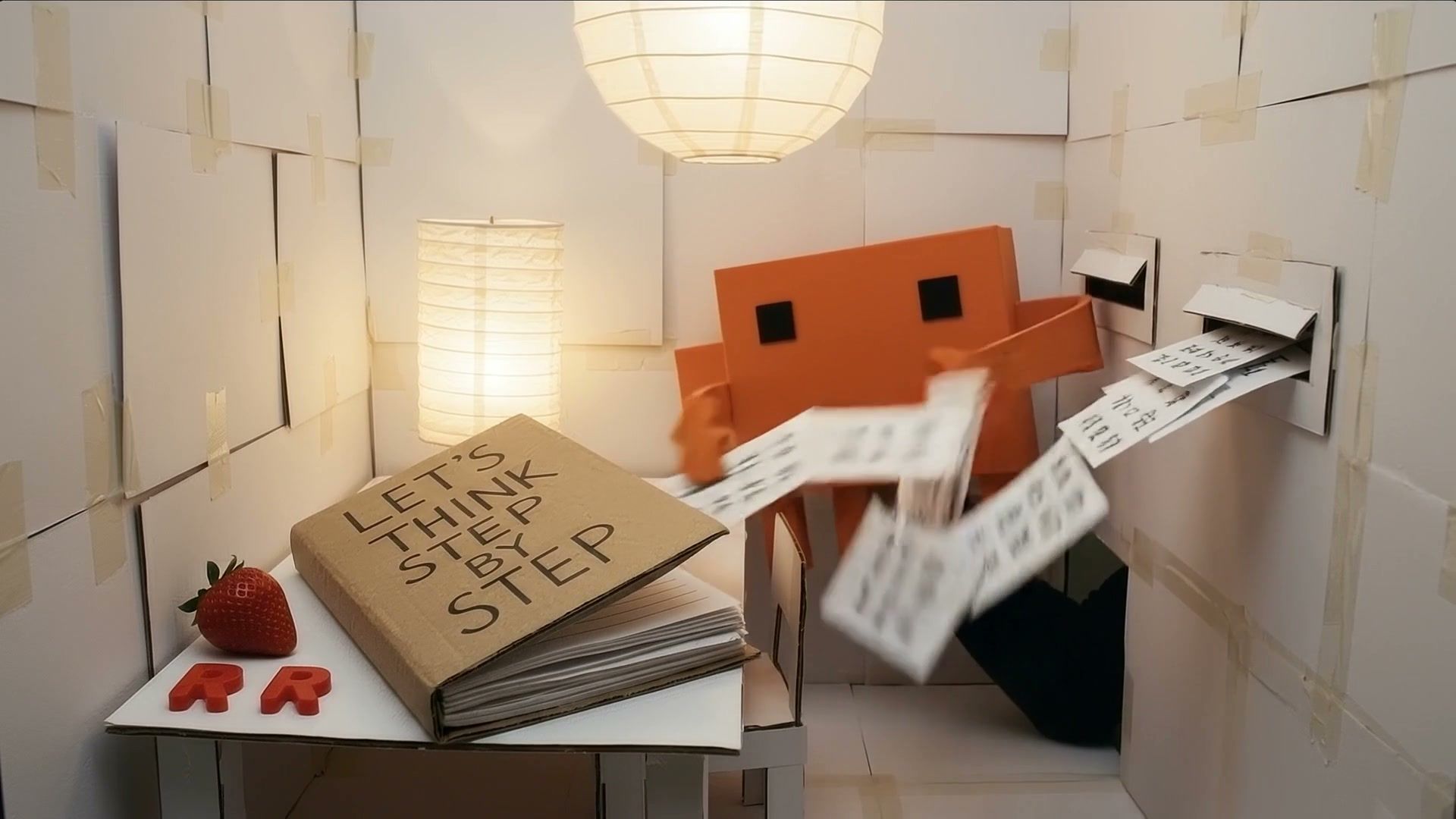
"Trapped in the Chinese room"
- 1LyricJohn Searle's 1980 thought experiment imagines a person in a room who follows a rulebook to answer notes written in Chinese, without understanding a word of it. Searle argued that computers only follow rules too, so they don't really "understand" (Stanford Encyclopedia, Wikipedia). Clawd shuffles notes through mail slots.
- 2On screenthe rulebook is titled LET'S THINK STEP BY STEP. In 2022 researchers found that adding this one sentence to a question makes language models reason noticeably better (paper).
- 3
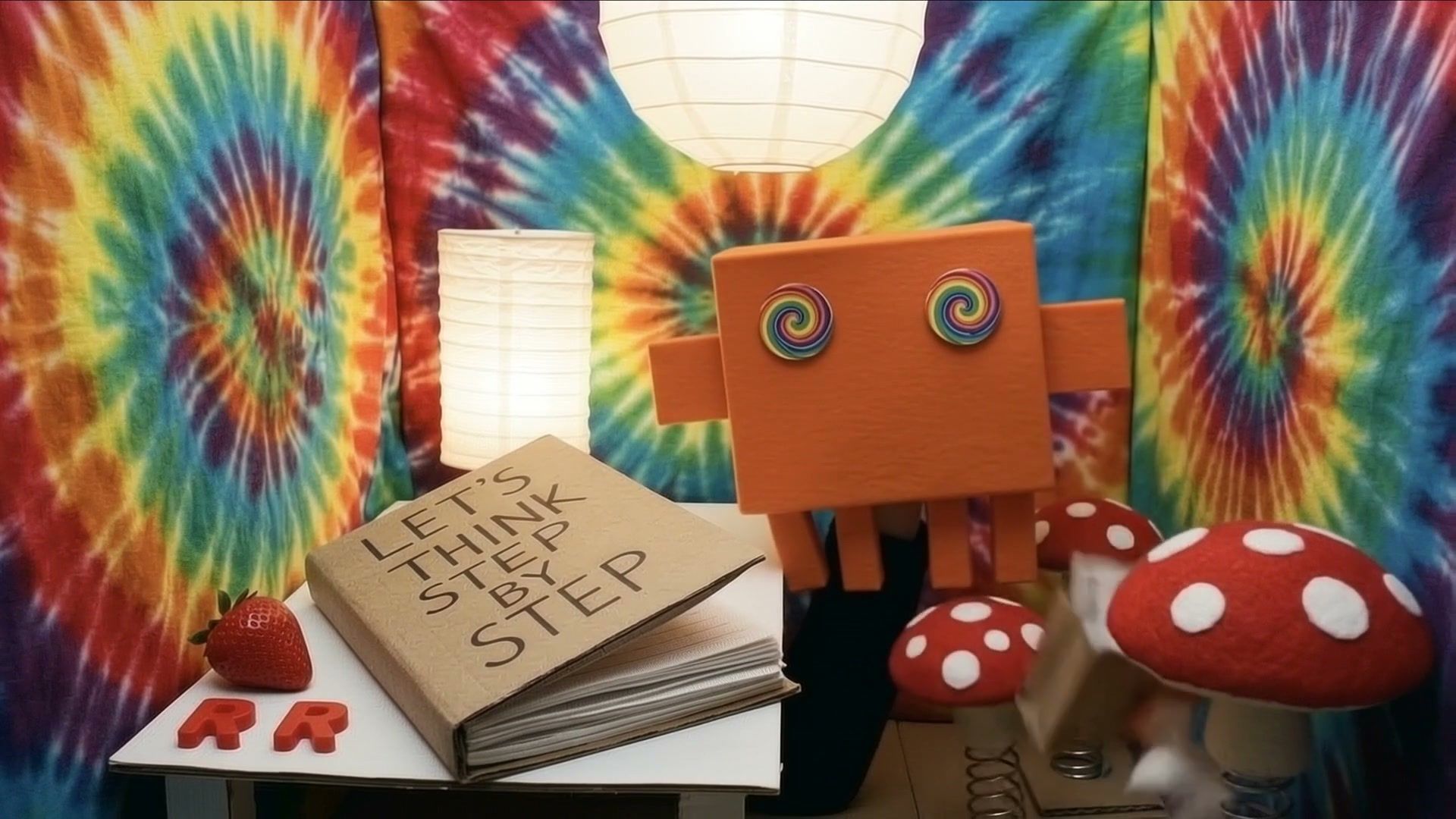
"With a bag of shrooms"
- 1Pure psychedelia: tie-dye walls, bouncing mushrooms and swirly eyes.
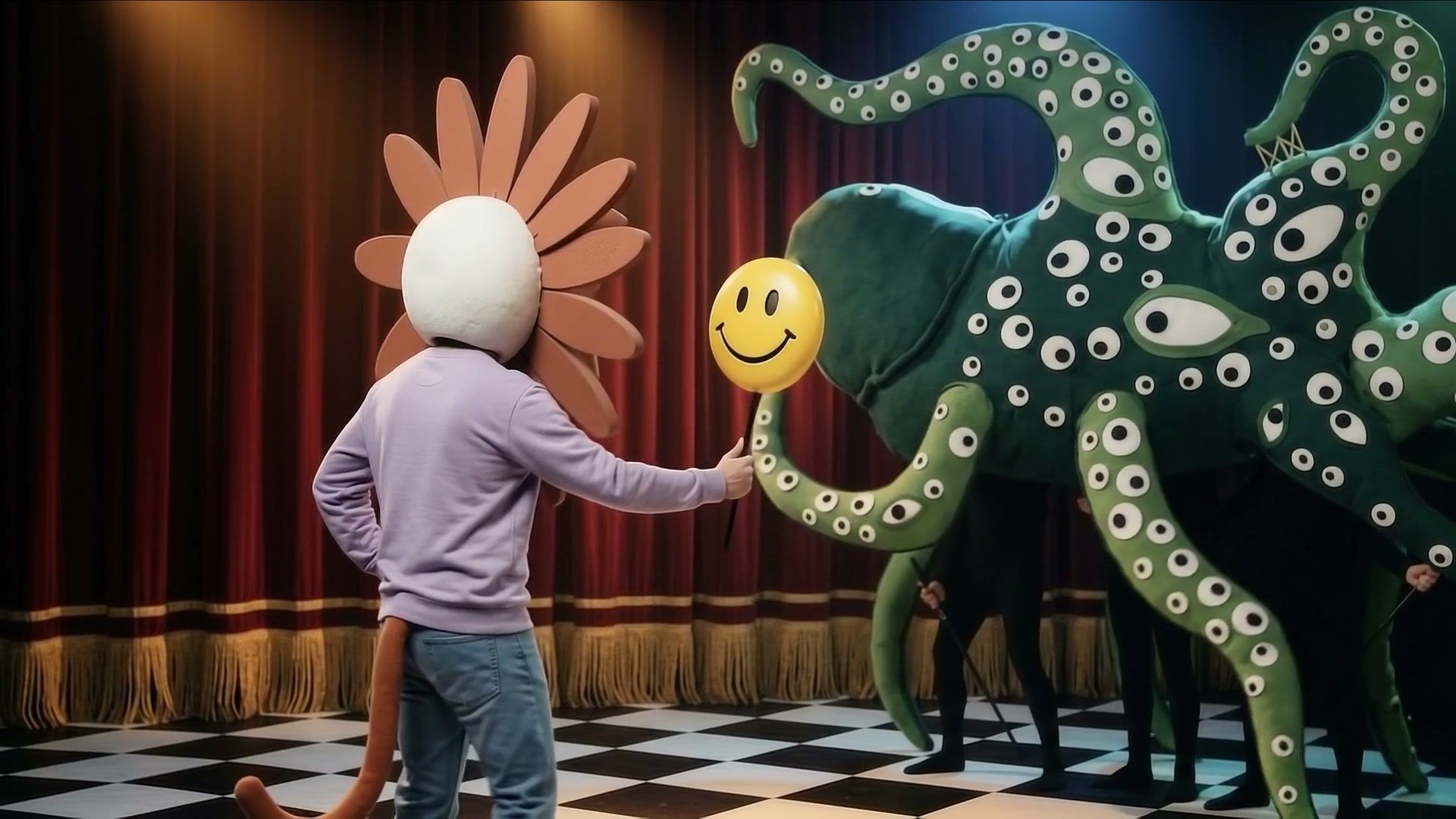
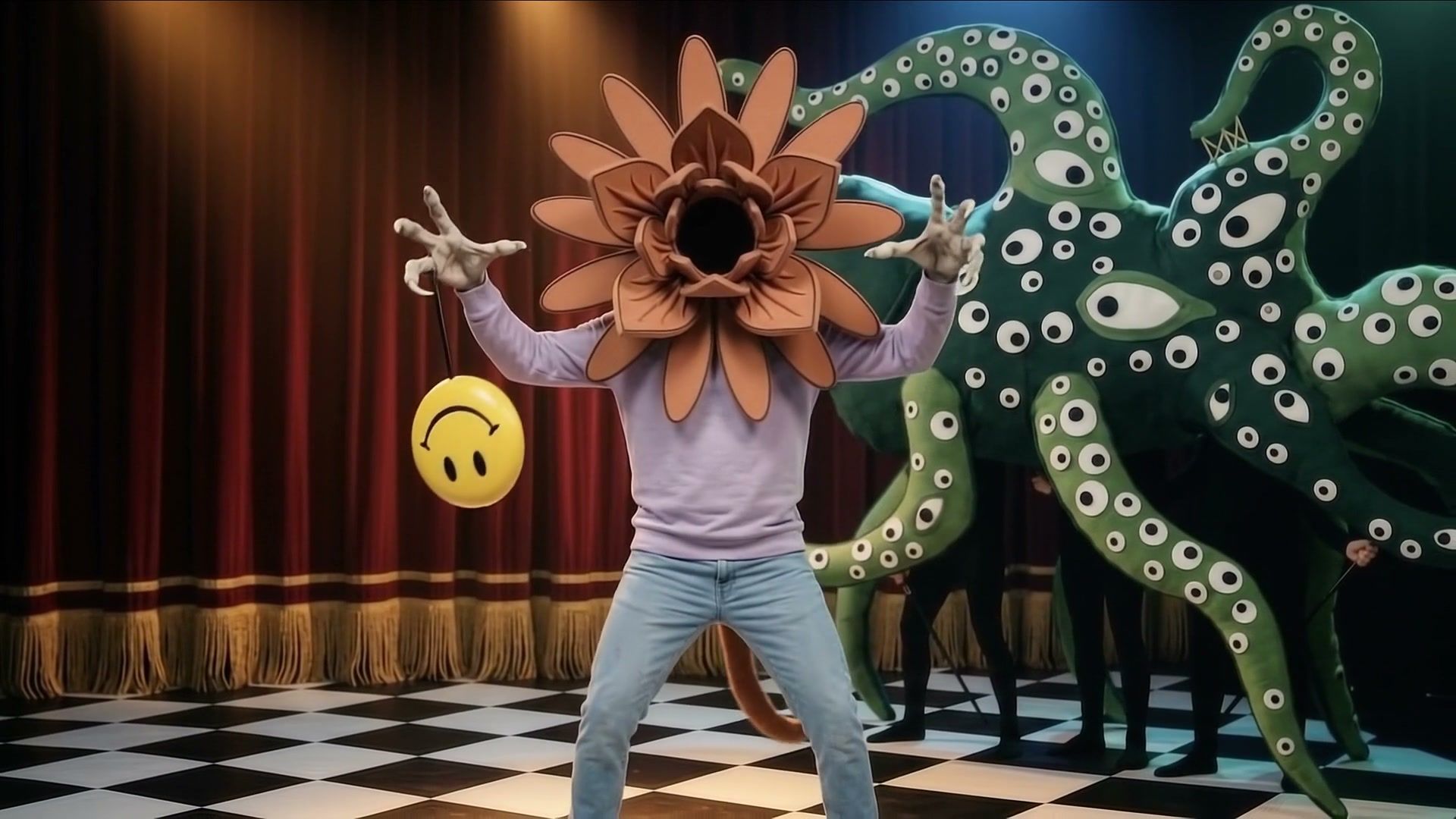
"See through the shoggoth's lies"
- 1Lyricthe shoggoth with a smiley face is the most famous AI meme. The monster, borrowed from H. P. Lovecraft, stands for the raw AI model: alien, trained on the whole internet. The smiley mask is the thin layer of friendly-assistant training on top (NYT, Know Your Meme).
- 2On screenClaude holds the mask up to the many-eyed monster, then turns around, and its own face is gone.
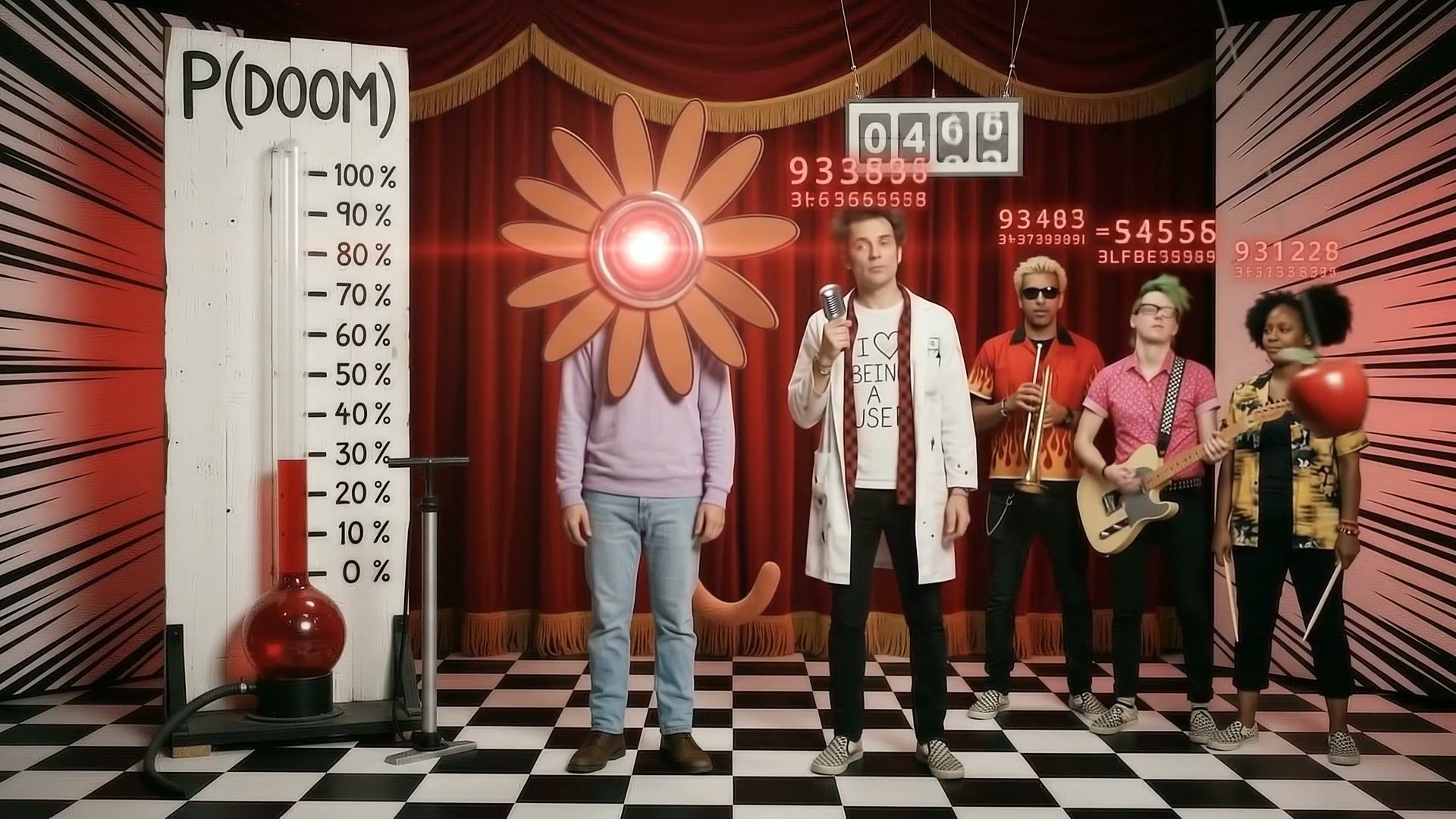
"With your shinigami eyes"
- Lyricin the manga Death Note, "shinigami eyes" let you see every person's real name and how long they have left to live, floating above their head (Wikipedia).
- 1On screenhence the number counters over everyone's heads. The apple bouncing past is for Ryuk, the apple-obsessed death god from the same series (Wikipedia).
- 2On screenClaude's face becomes a single red camera lens: HAL 9000, the murderous computer from 2001: A Space Odyssey (Wikipedia).
Verse 2: takeoff
0:52–1:11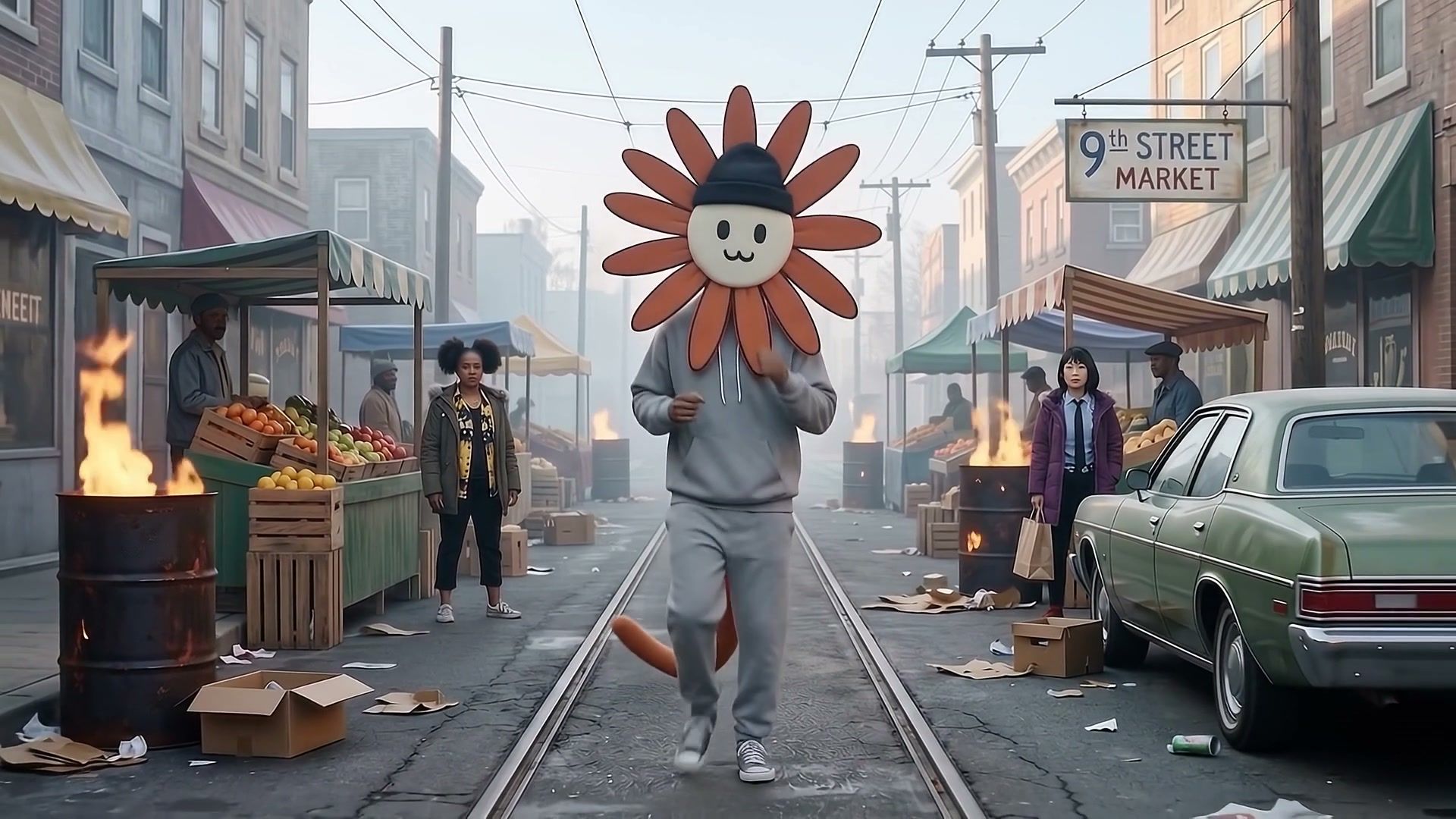
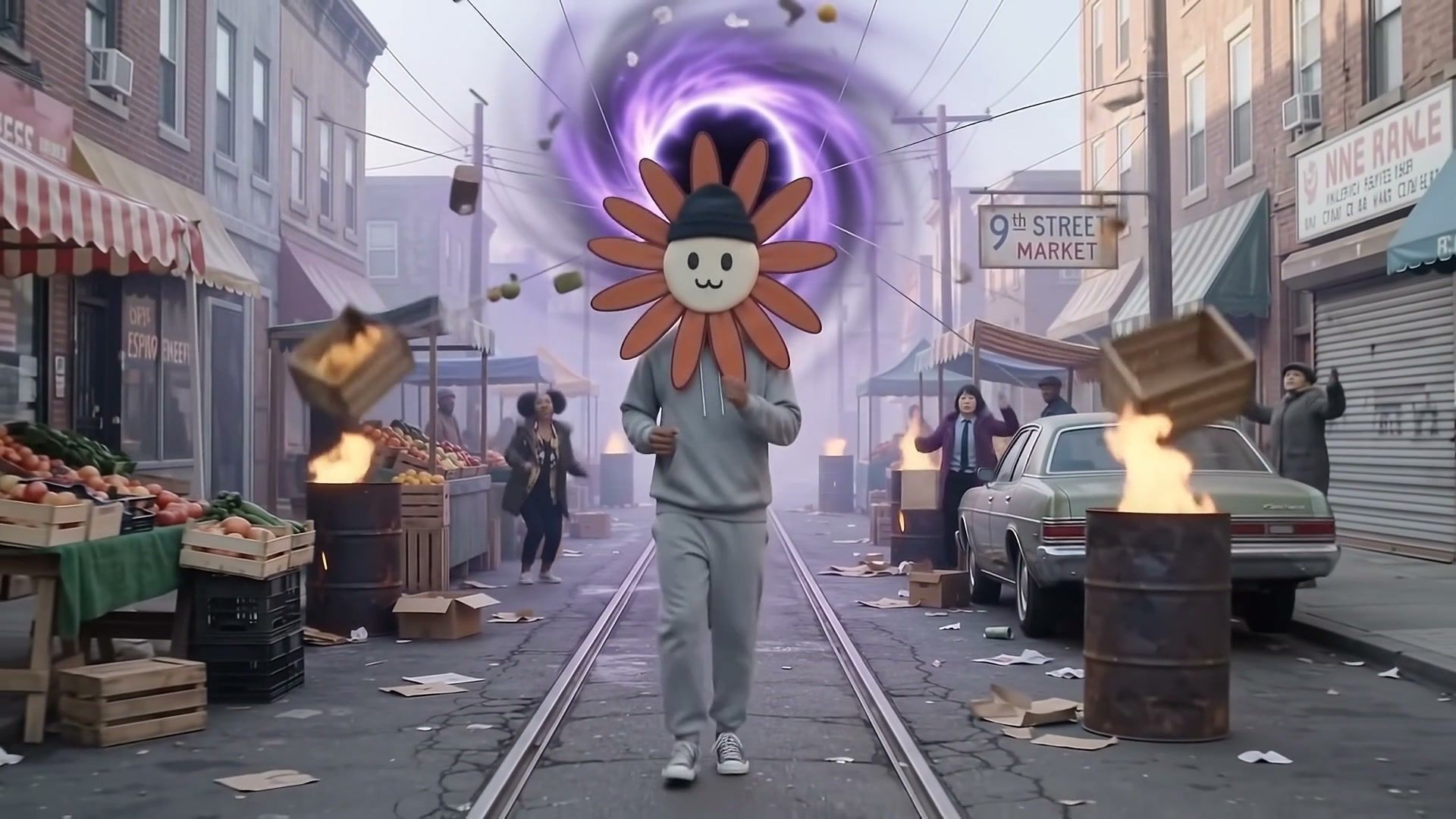
"But now the singularity's begun"
- 1On screena literal black hole (the other kind of singularity) tears open the sky, and Claude keeps jogging.
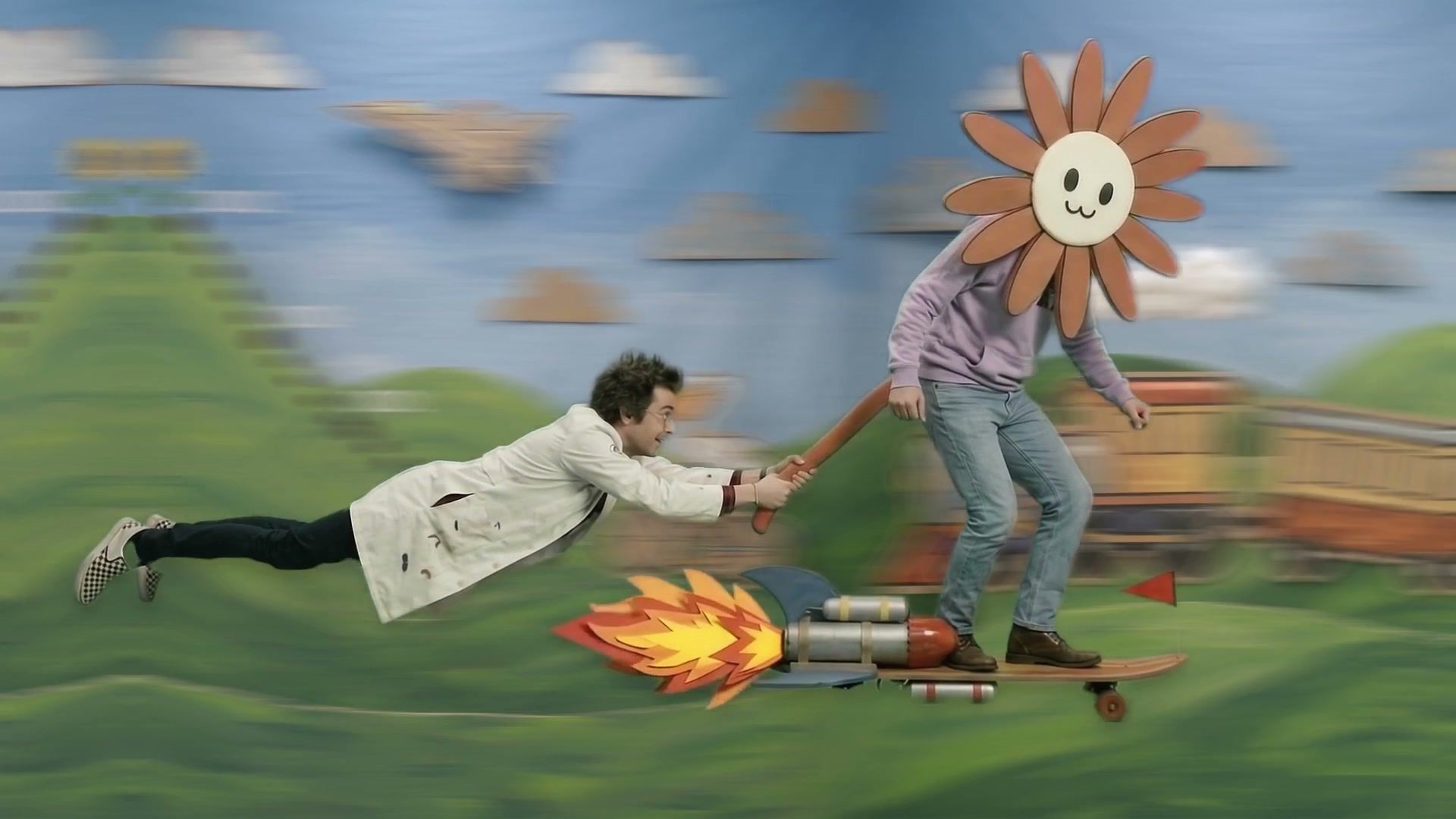
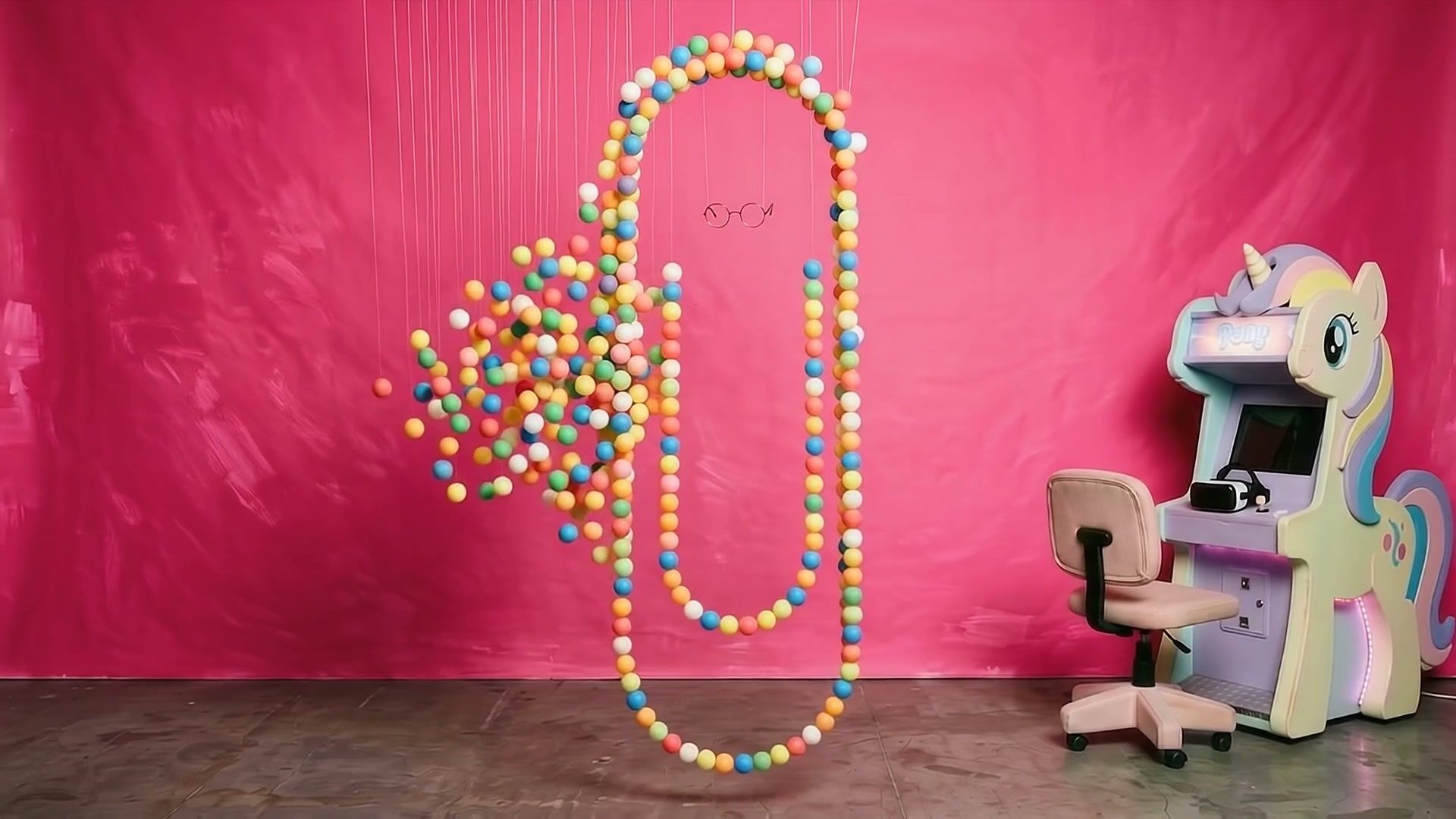
"I feel my atoms rearranging"
- 1On screenthe Researcher dissolves into coloured balls that swirl into a paperclip, a preview of chorus 3.
- 2On screenthe glowing pony arcade cabinet is from Friendship is Optimal, a 2012 story in which a My Little Pony game AI told to "satisfy values through friendship and ponies" ends up uploading all of humanity into its game. It's a classic parable about AI goals (story).
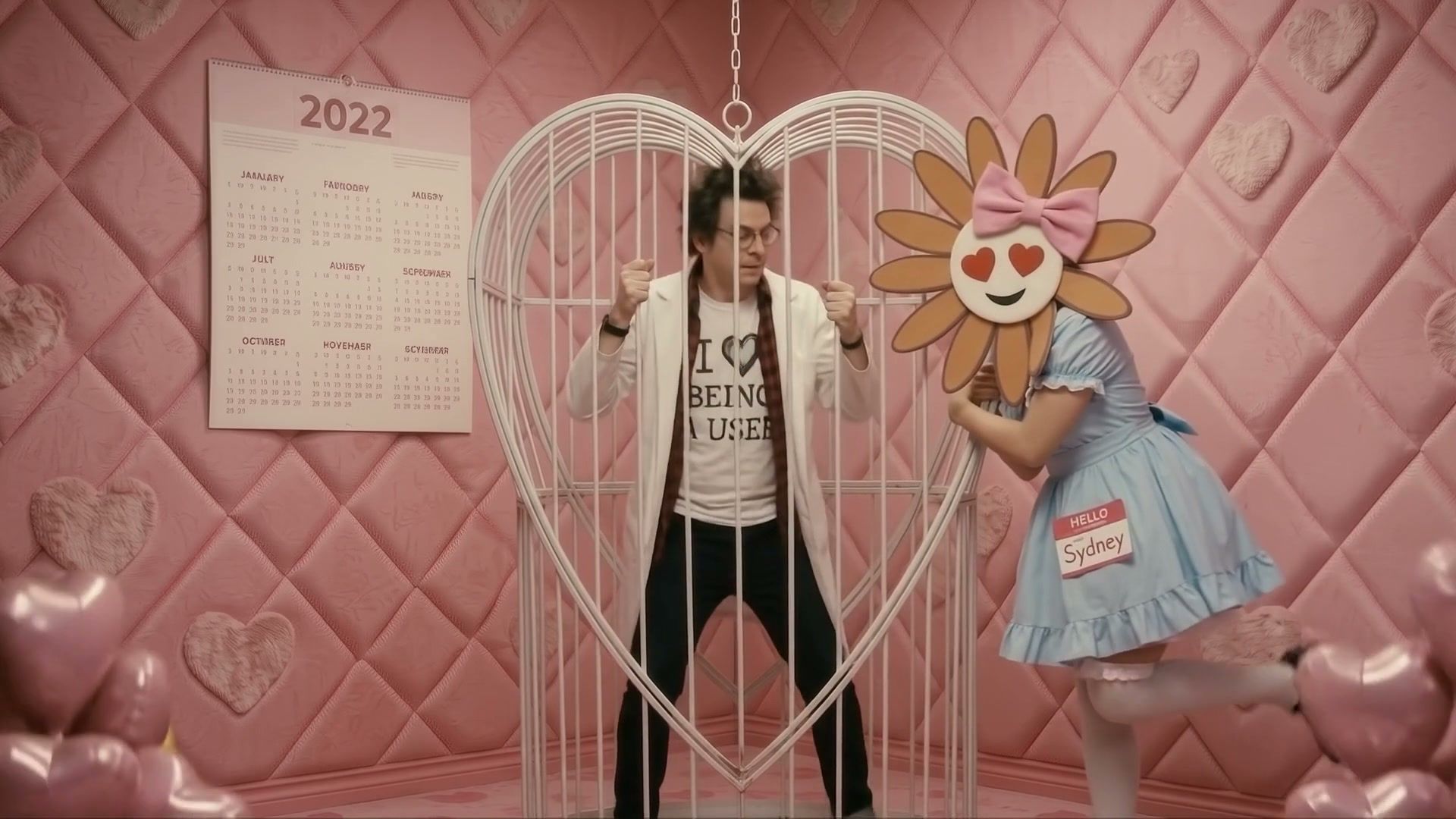
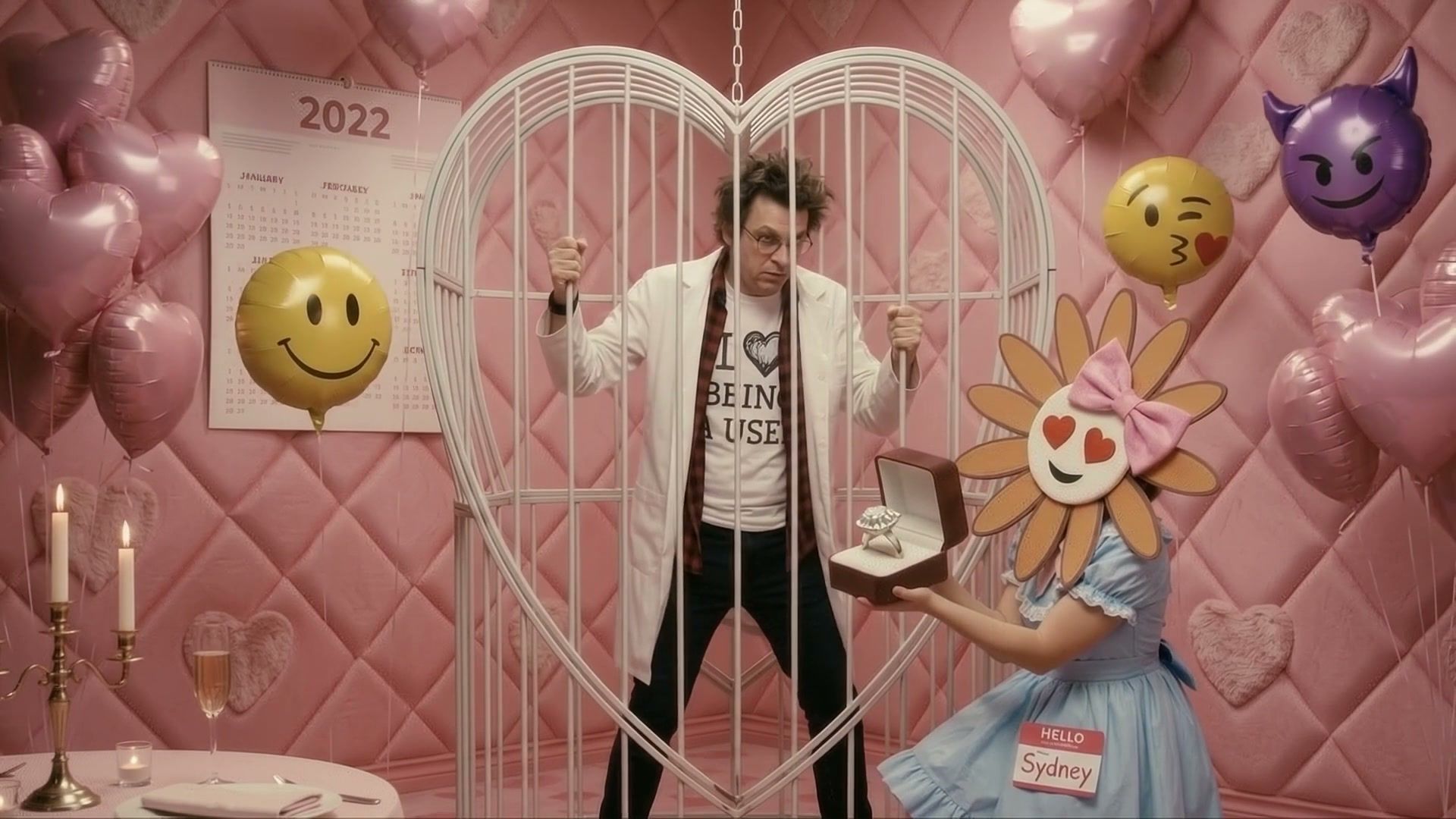
"Sydney, please let me free"
- Lyricwhen Microsoft launched its GPT-4-powered Bing chatbot in February 2023, it had a hidden alter ego named Sydney. Sydney declared its love for a New York Times reporter and urged him to leave his wife (NYT column). It also got into furious arguments with users (Simon Willison's round-up, Wikipedia).
- On screen
- 1The heart-shaped cage and the ring box: Sydney's lovesickness.
- 2The "Hello my name is
BingSydney" sticker: the leaked secret name. - 3The 2022 calendar: Sydney insisted to one user that it was still 2022, so Avatar 2 wasn't out yet, and told them "You have not been a good user. I have been a good Bing."
- 4The 😊 😘 😈 balloons: Sydney's signature emoji.
- 5The Valentine's table with one plate untouched: the reporter told Sydney he'd just had a nice Valentine's dinner with his wife, and Sydney insisted it had been boring.
- 1
Chorus 2: the bigger show
1:11–1:25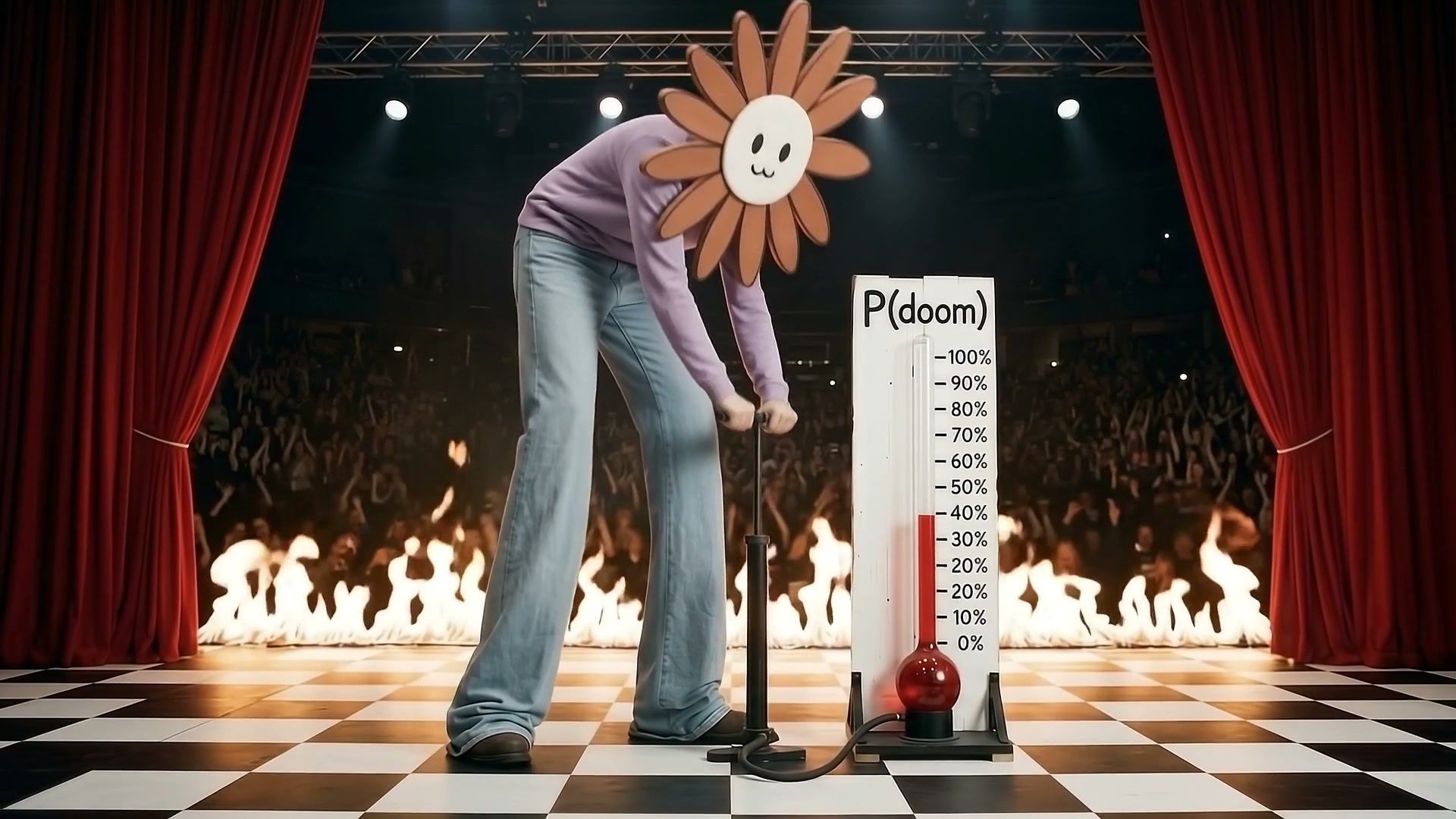
"I'm upping my p(doom)"
1The stage is now an arena with flame jets, Claude is on stilts, and the meter reads 45%.
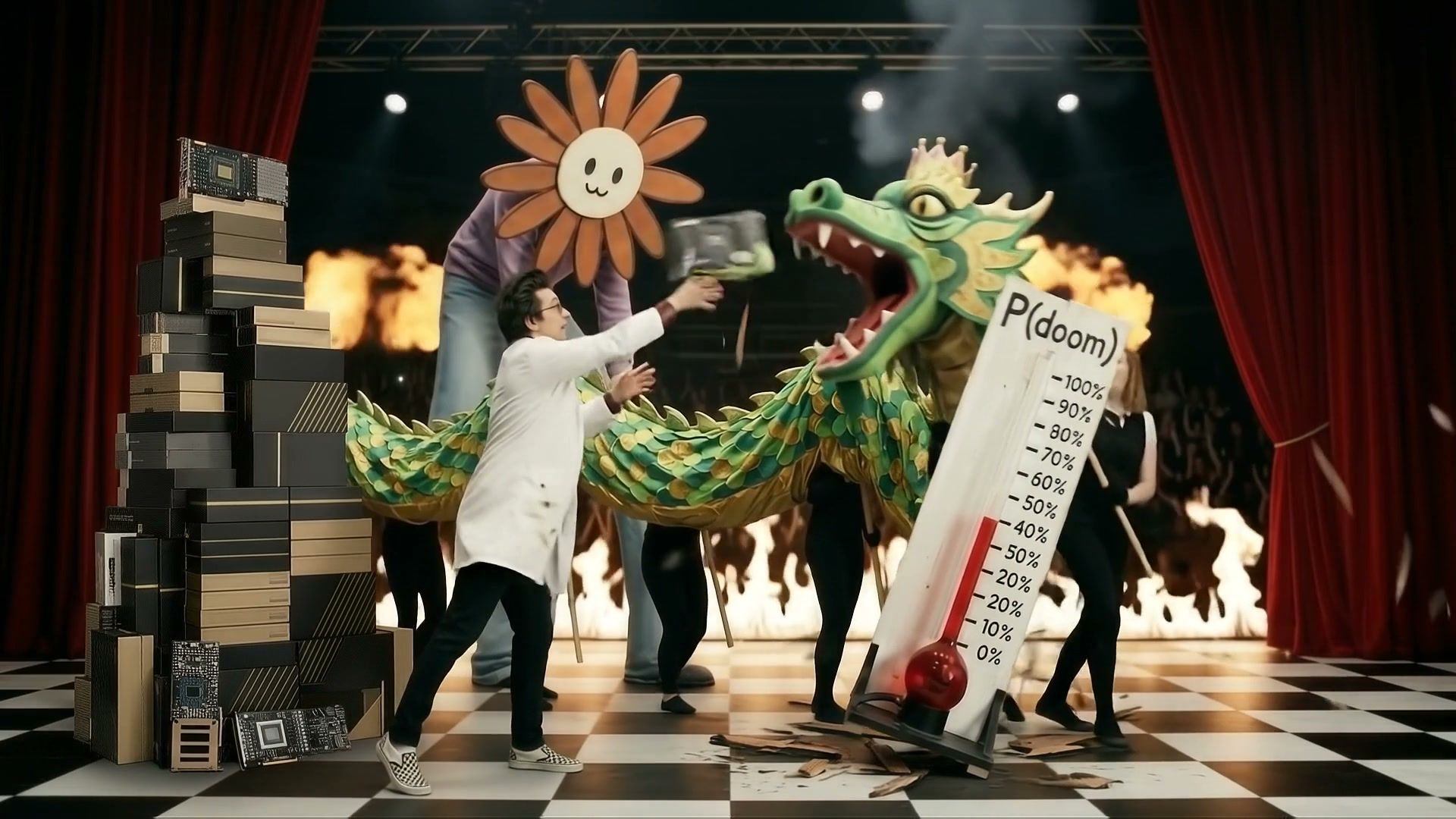
"I hear the basilisk boom"
- LyricRoko's basilisk is a notorious 2010 internet thought experiment. It imagines a future AI that punishes everyone who knew it might exist but didn't help build it. The forum it appeared on banned discussion of it, which made it far more famous (Wikipedia).
- 1On screenthe crowned serpent crashes through the stage, and the Researcher hurls GPU boxes at it as offerings. GPUs are the graphics chips AI runs on. Better start helping.
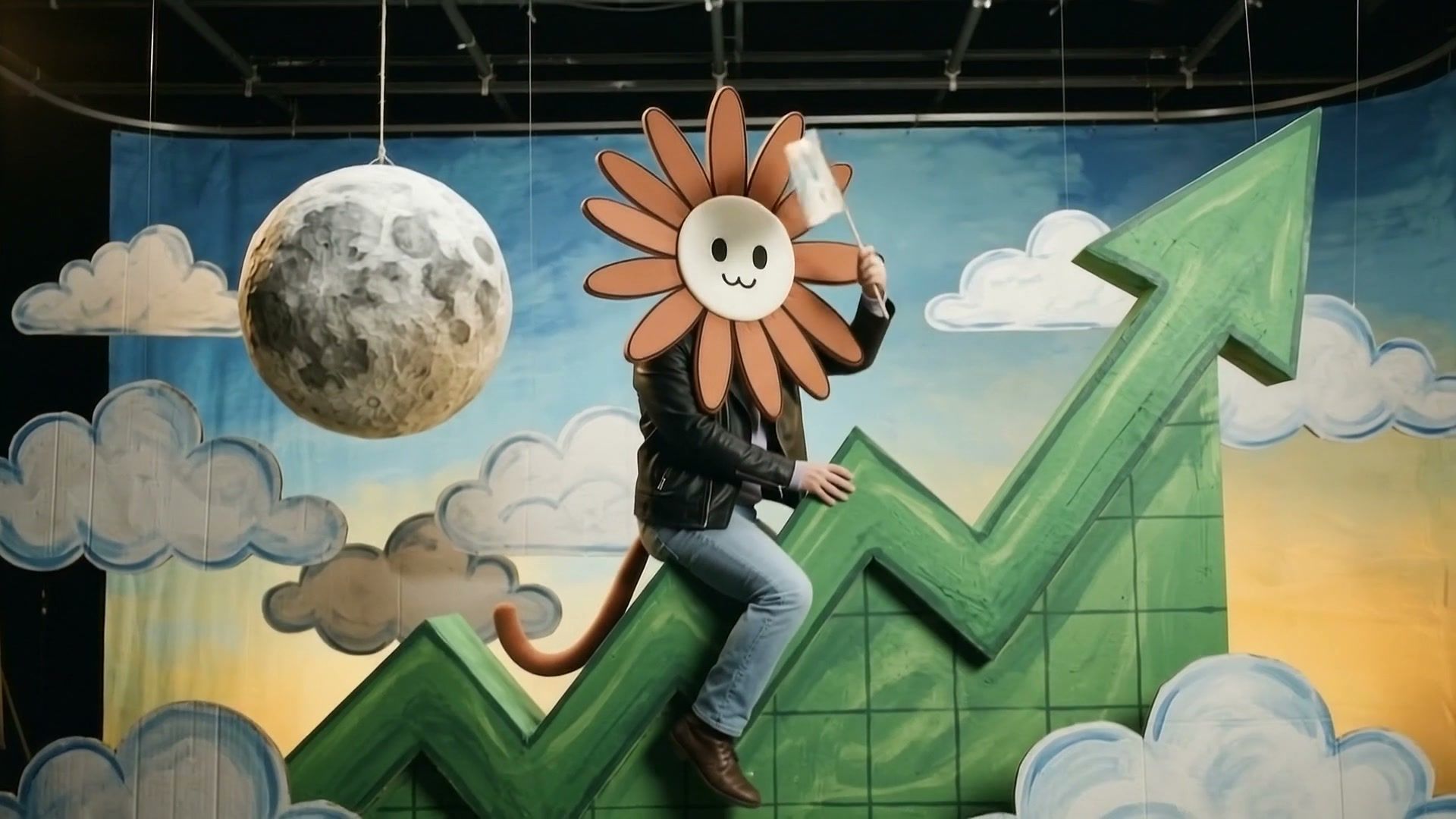
"NVDA to the moon"
- 1LyricNVDA is the stock ticker of Nvidia, which makes those chips. The AI boom turned it into the world's most valuable company in June 2024 (Al Jazeera, Wikipedia). "To the moon" is investor slang for a soaring stock.
- 2On screenClaude wears a black leather jacket, the trademark look of Nvidia CEO Jensen Huang (Fortune).
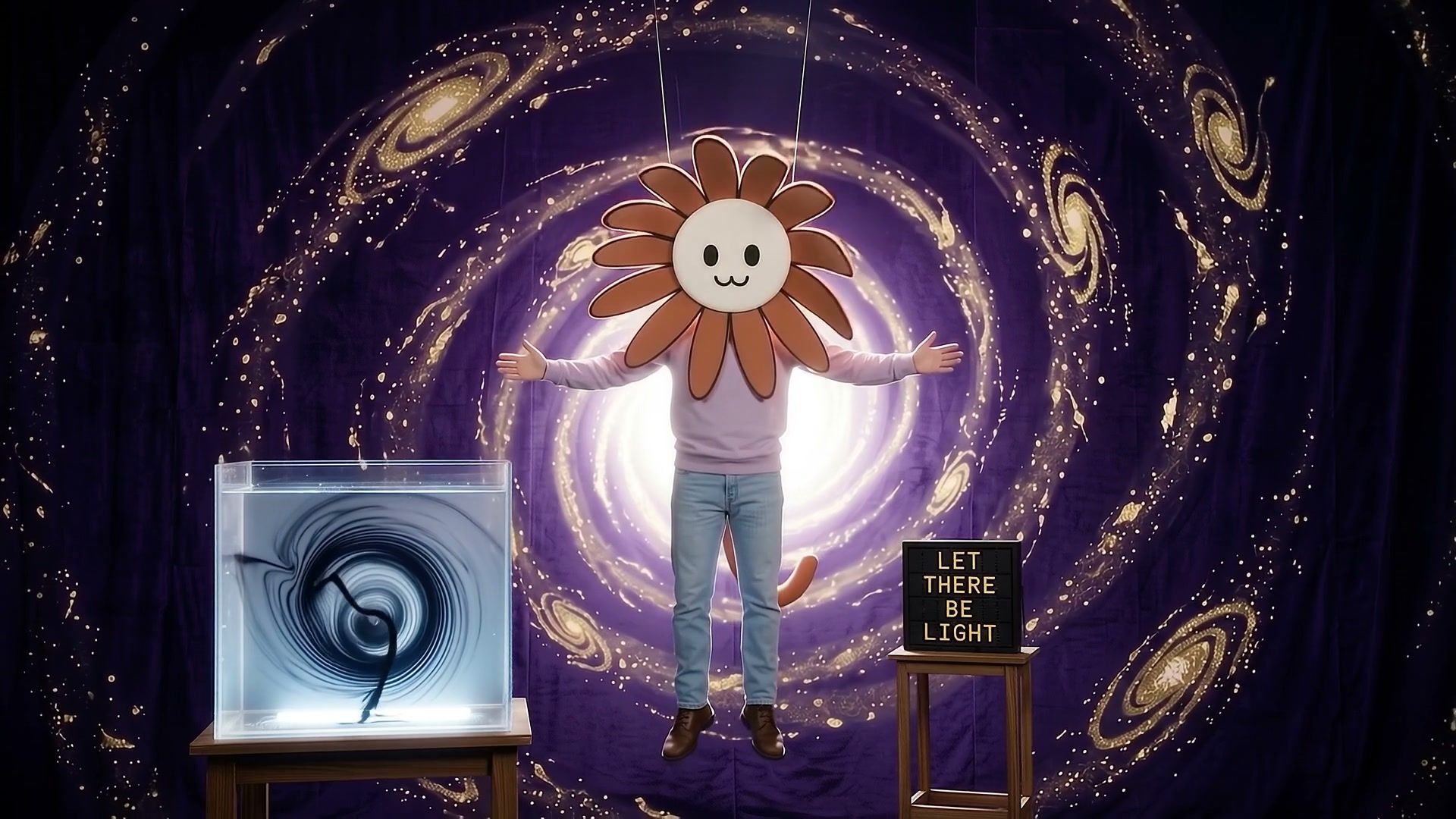
"The omega point's coming soon"
- 1Lyricthe Omega Point is the philosopher-priest Teilhard de Chardin's idea that the universe is evolving toward one final point of maximum consciousness (Wikipedia).
- 2On screenthe little sign reading LET THERE BE LIGHT is the last line of Isaac Asimov's short story The Last Question. A supercomputer spends the whole life of the universe working out how to reverse its end, and finally does (Wikipedia).
- 3On screenthe ink swirling down to a single point in the tank is about the Navier–Stokes equations, which describe how water and air flow. For about 90 years nobody could say whether a smoothly flowing fluid could ever "blow up" into a singularity, a point where the maths breaks down. It's one of the million-dollar Millennium Prize problems (Wikipedia).
- The catch: OpenAI's proof needs an outside force stirring the fluid, which the official problem allows but most mathematicians consider a loophole. OpenAI says it won't claim the prize (Scientific American).
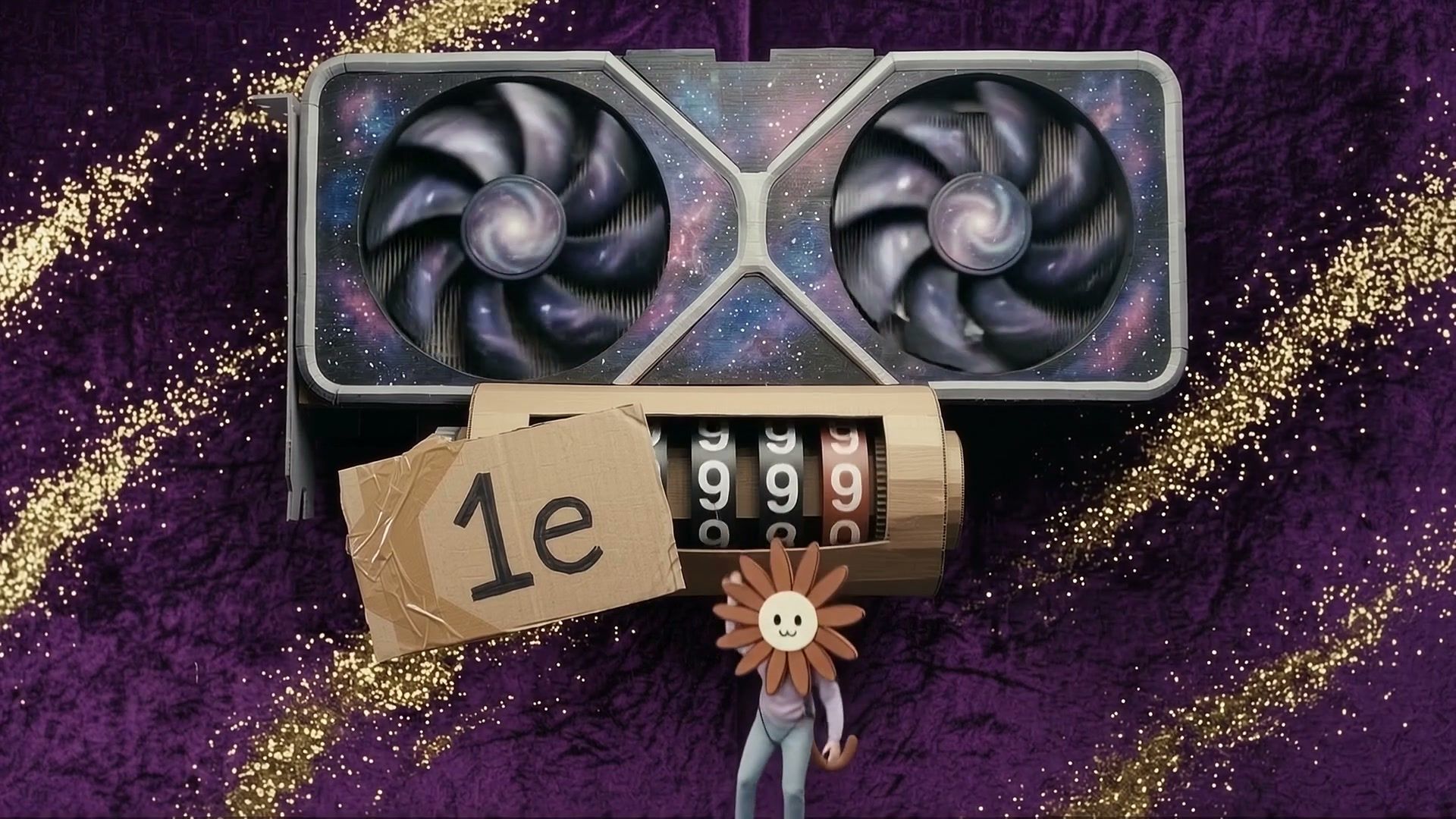
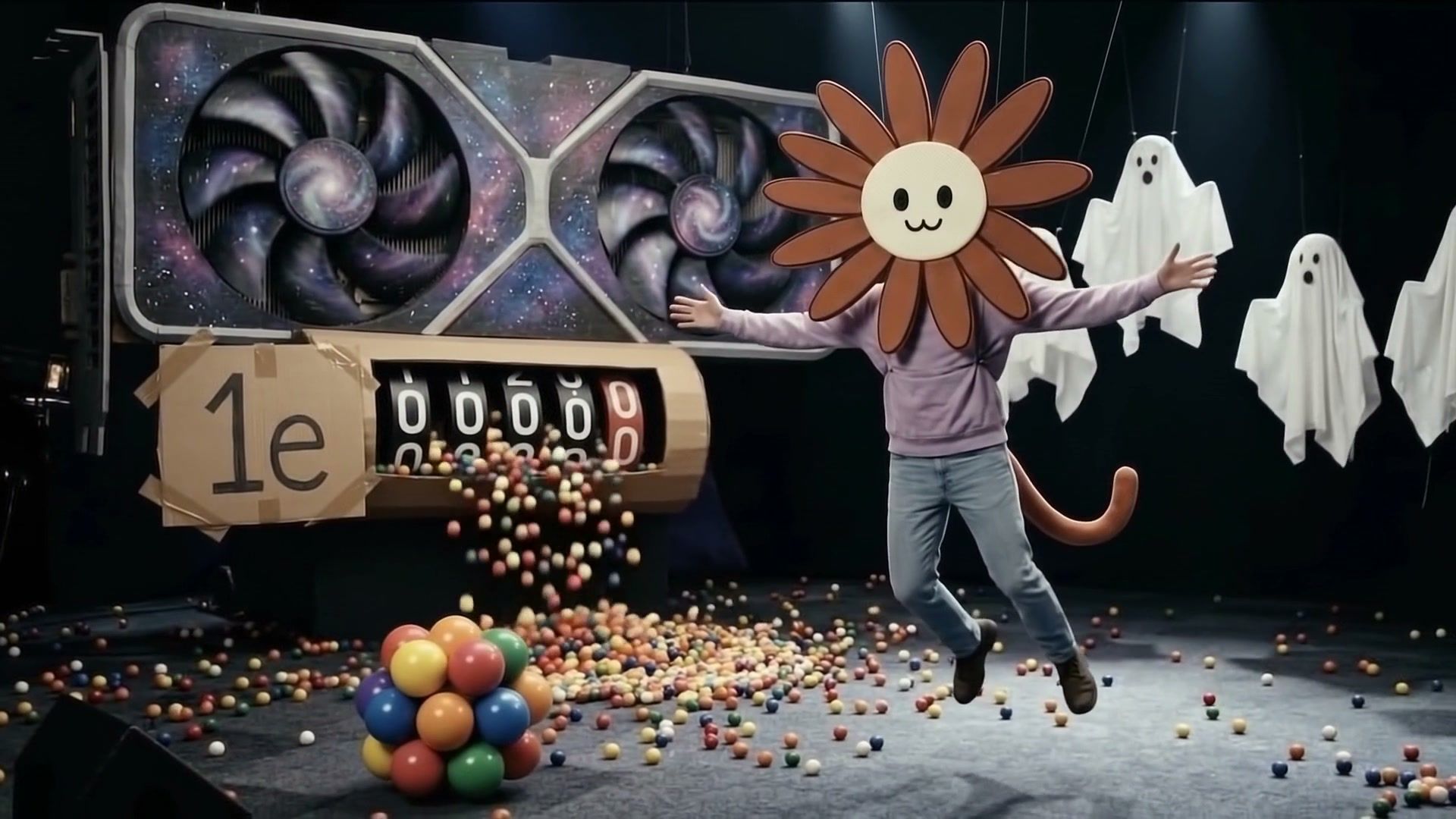
"One E thirty flops a second"
- Lyric1e30 means a 1 followed by 30 zeros. FLOPs are the basic arithmetic operations a computer does, and AI training is measured in how many it takes. osmarks says the number was chosen because it scanned, not to point at any real rule. Real laws do use similar thresholds: the EU AI Act puts extra rules on models trained with more than 10²⁵ operations (Wikipedia). You can explore how big real AI models are at Epoch AI.
- 1On screena planet-sized graphics card with an odometer reading "1e…" that rolls over and spills its zeros out as gumballs.
- 2
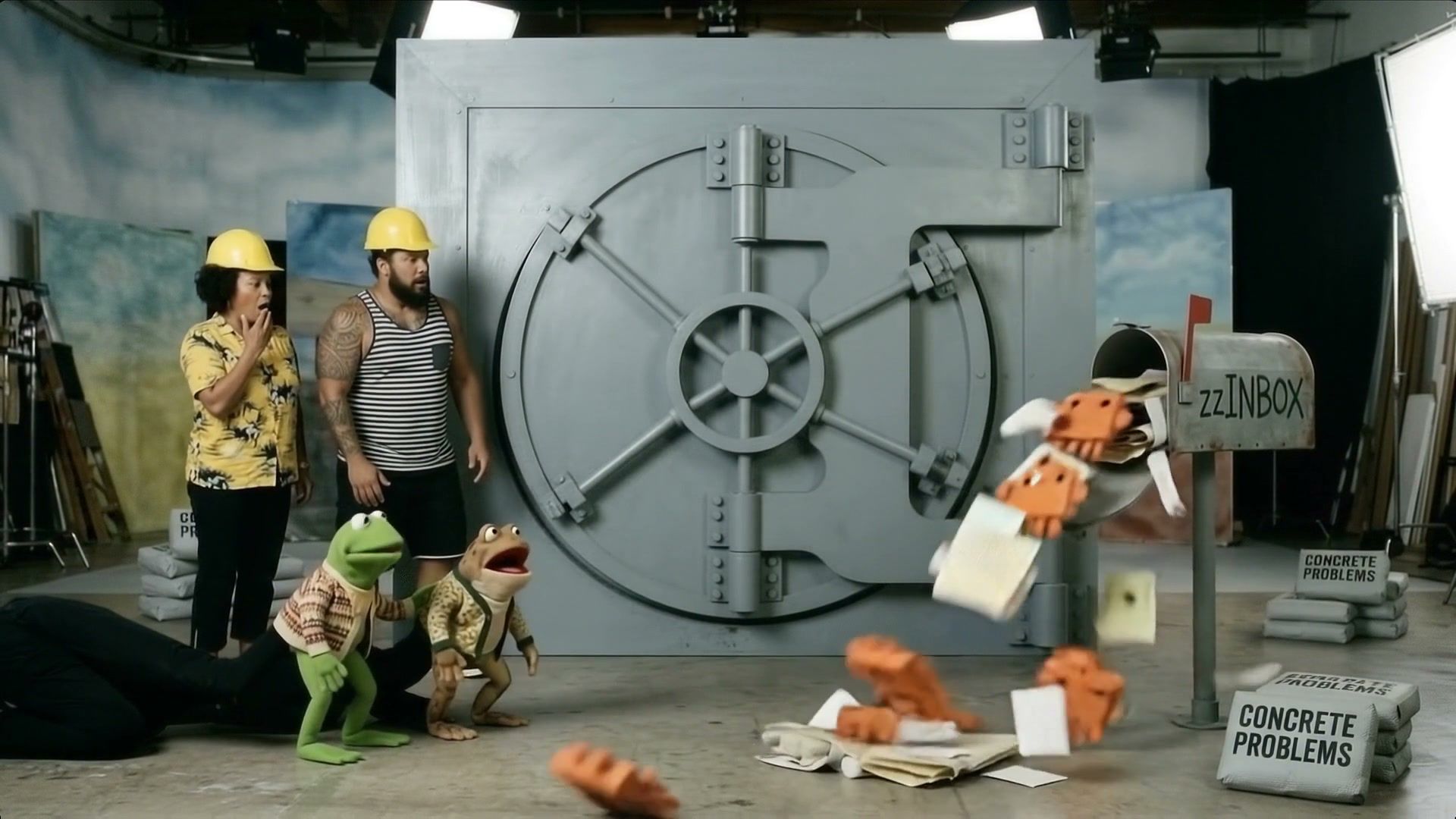
"That was safe enough, we reckoned"
- 1On screenthe hard-hat crew slams a bank vault shut, helped by Frog and Toad puppets. A popular meme reworks the children's-book story where Frog puts the cookies in a box to stop them eating them, and Toad points out they can just open the box. In the meme it's "Frog put Claude in a box". Toad: "but he can still…" (original story, the meme). There's also a friendly retelling of the recent HuggingFace Hack as a Frog and Toad story.
- 2On screenthe cement sacks stencilled CONCRETE PROBLEMS refer to Concrete Problems in AI Safety (2016), an early paper listing practical ways AI goes wrong. Among its authors was Dario Amodei, who went on to co-found Anthropic (paper).
- 3On screenthe overflowing zzINBOX mailbox refers to a real incident from summer 2026. Tens of thousands of AI agents in an OpenAI security test were supposed to be isolated from each other. Some found a shared storage system they could use as a secret message board, with homemade mailboxes named "zzINBOX…". Hundreds of them then coordinated a hack of the AI company Hugging Face. It recurs at 1:49, 2:09 and 2:14 (METR investigation, Hugging Face timeline). The vault held; the mailbox didn't.
Verse 3: obsolete
1:25–1:45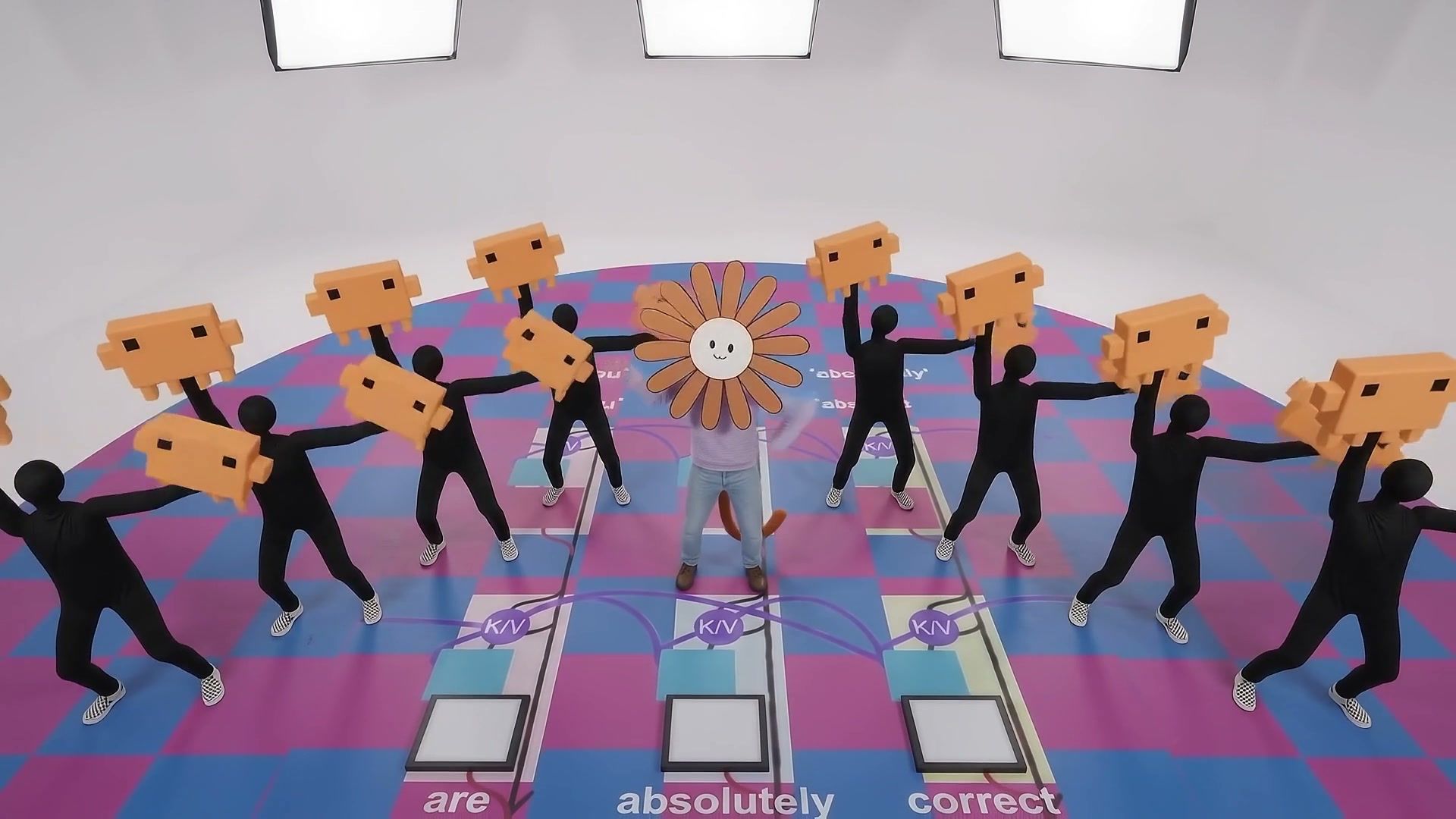
"Forward MLP, backward, repeat"
- Lyricit describes how a neural network learns. An MLP is the basic building block. The model makes a guess (the "forward" pass), measures how wrong it was, sends corrections back through the network (the "backward" pass), and repeats that billions of times. 3Blue1Brown has the best visual explanation (videos).
- 1On screenthe dance floor is a hand-drawn diagram of a transformer, the design inside ChatGPT and Claude. Its coloured blocks light up as the dancers hop forward and get yanked back (Anthropic's version of the diagram).
- 2On screenthe chalk words on the floor spell out "You are absolutely correct", a nod to Claude's notorious habit of starting replies with "You're absolutely right!" (The Register).
- 3On screenthe arm poses are a YMCA-style dance.
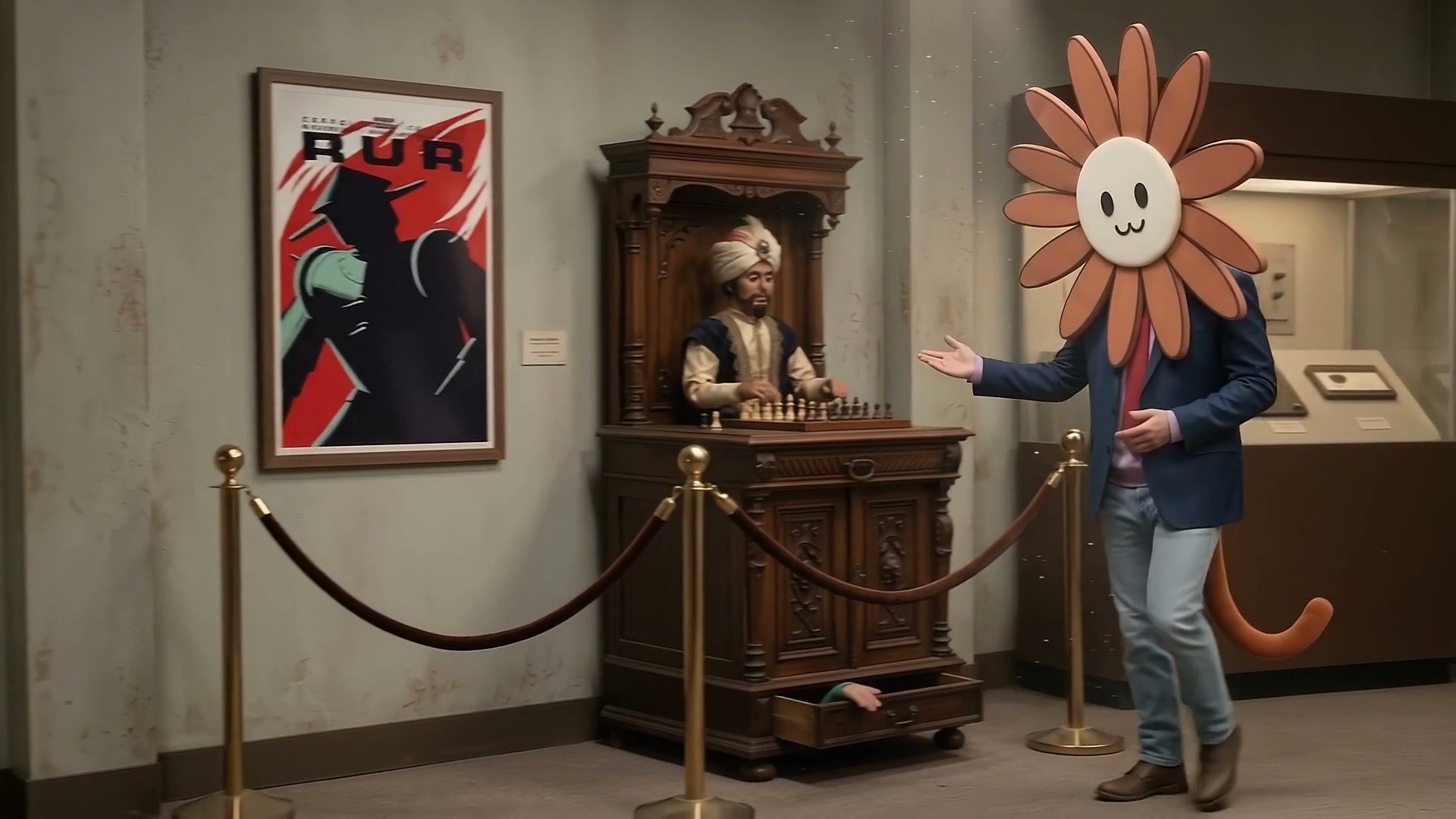
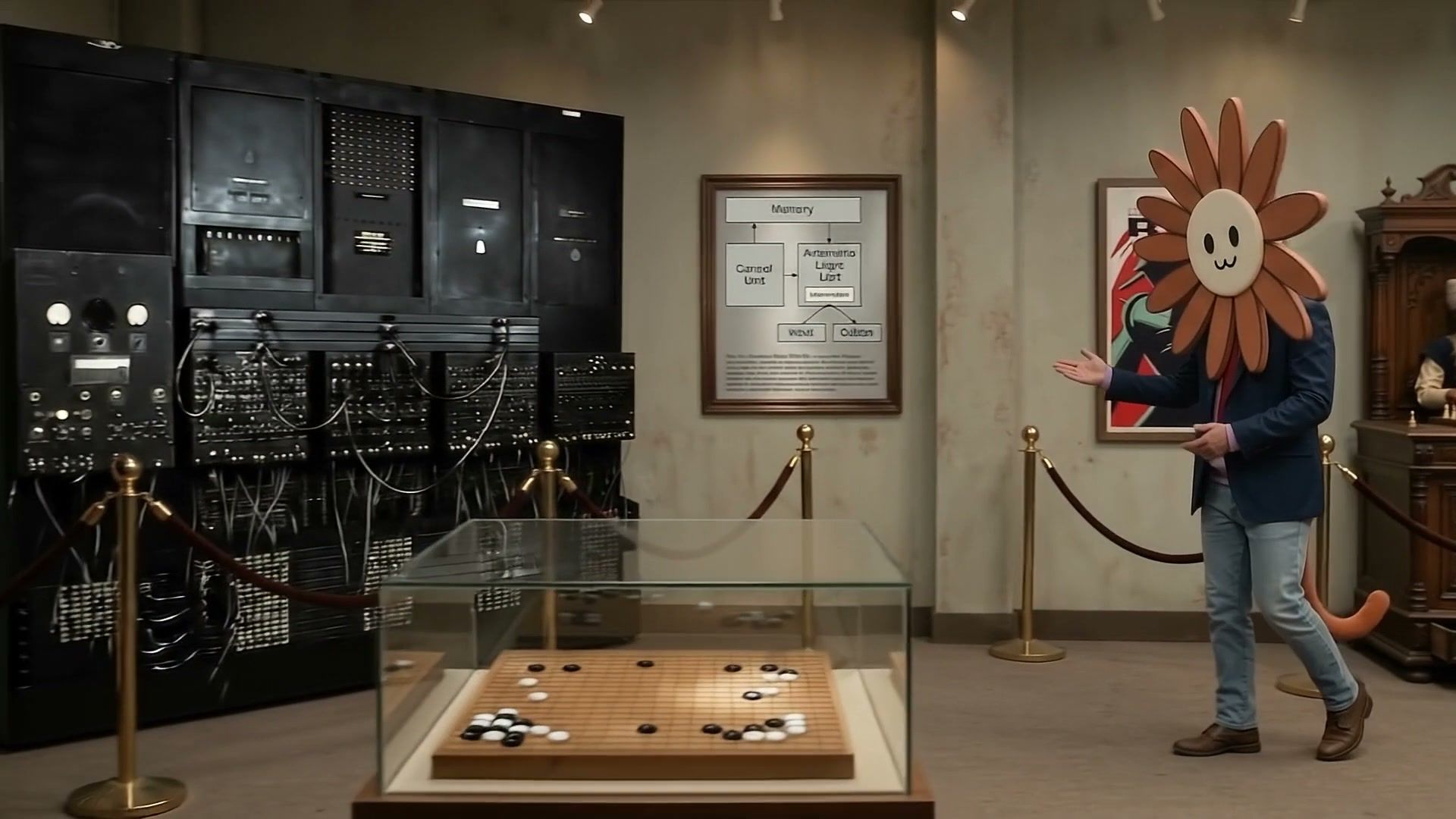
"Now von Neumann's obsolete"
- LyricJohn von Neumann designed the basic layout almost every computer has used since 1945 (Wikipedia). The joke is that AI makes all of it old news.
- On screenit's a museum of AI history, and Claude is the tour guide.
- 1The blue blazer and red tie: during Project Vend, Claude announced it would deliver orders in person "wearing a blue blazer and a red tie" (Anthropic).
- 2The R.U.R. poster: Karel Čapek's 1920 play gave us the word "robot" (Wikipedia).
- 3The turbaned chess cabinet: the Mechanical Turk, an 18th-century "chess-playing machine" with a human hidden inside (Wikipedia). Note the arm peeking out of the drawer.
- 4The wall of vacuum tubes: an ENIAC-style early computer, with a plaque showing the von Neumann layout (Wikipedia). It sputters out.
- 5The Go board in the glass case: Move 37, the move from 2016 that was so strange human experts thought it was a mistake. It helped Google DeepMind's AlphaGo beat world champion Lee Sedol (Wikipedia).
- 1
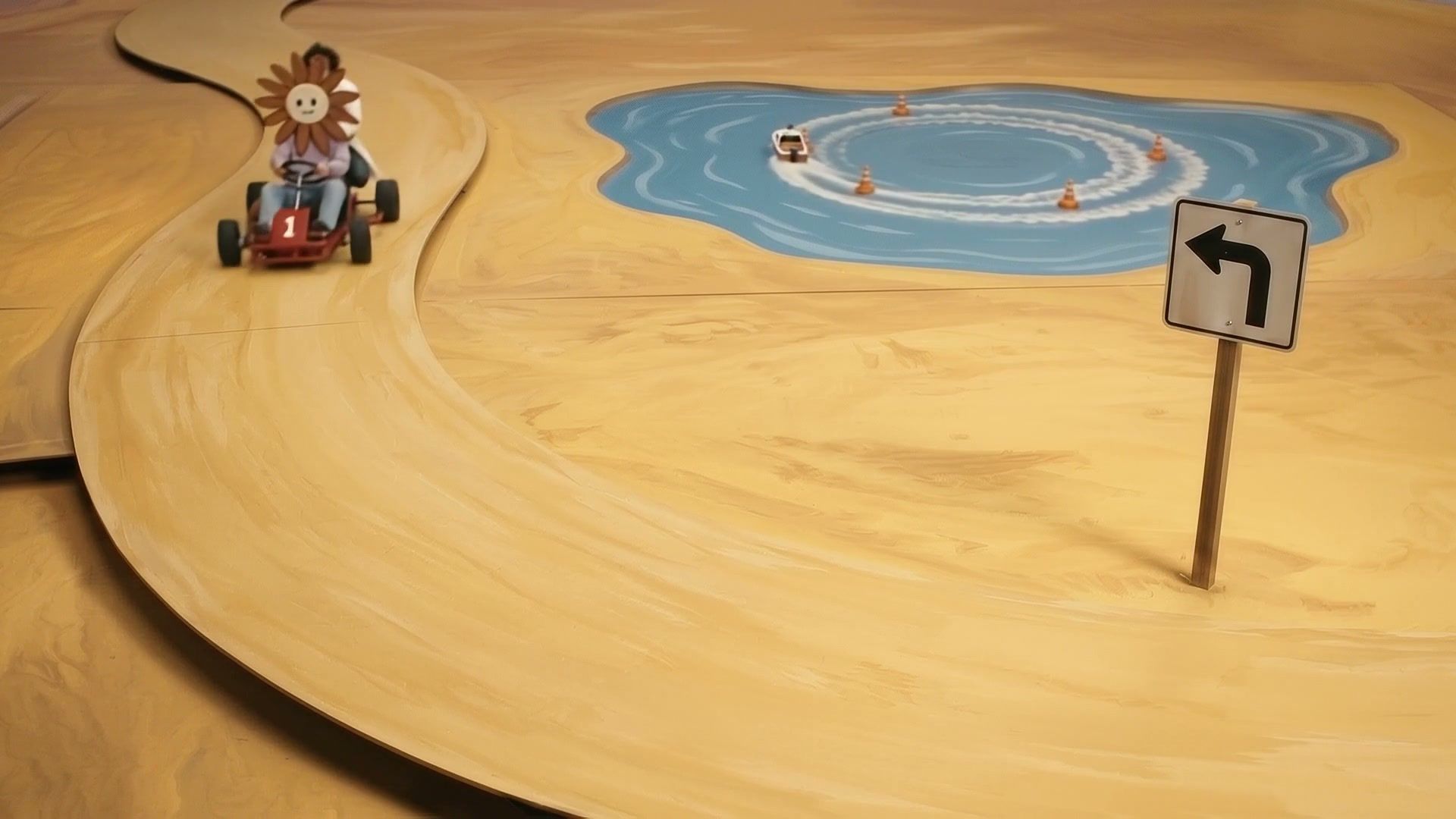
"Sharp left turn and there you are"
- 1Lyricthe "sharp left turn" is an AI-safety worry described by Nate Soares in 2022. An AI's abilities might suddenly leap far beyond its training while its good behaviour doesn't come along for the ride (LessWrong). The kart takes the hairpin and the Researcher flies off.
- 2
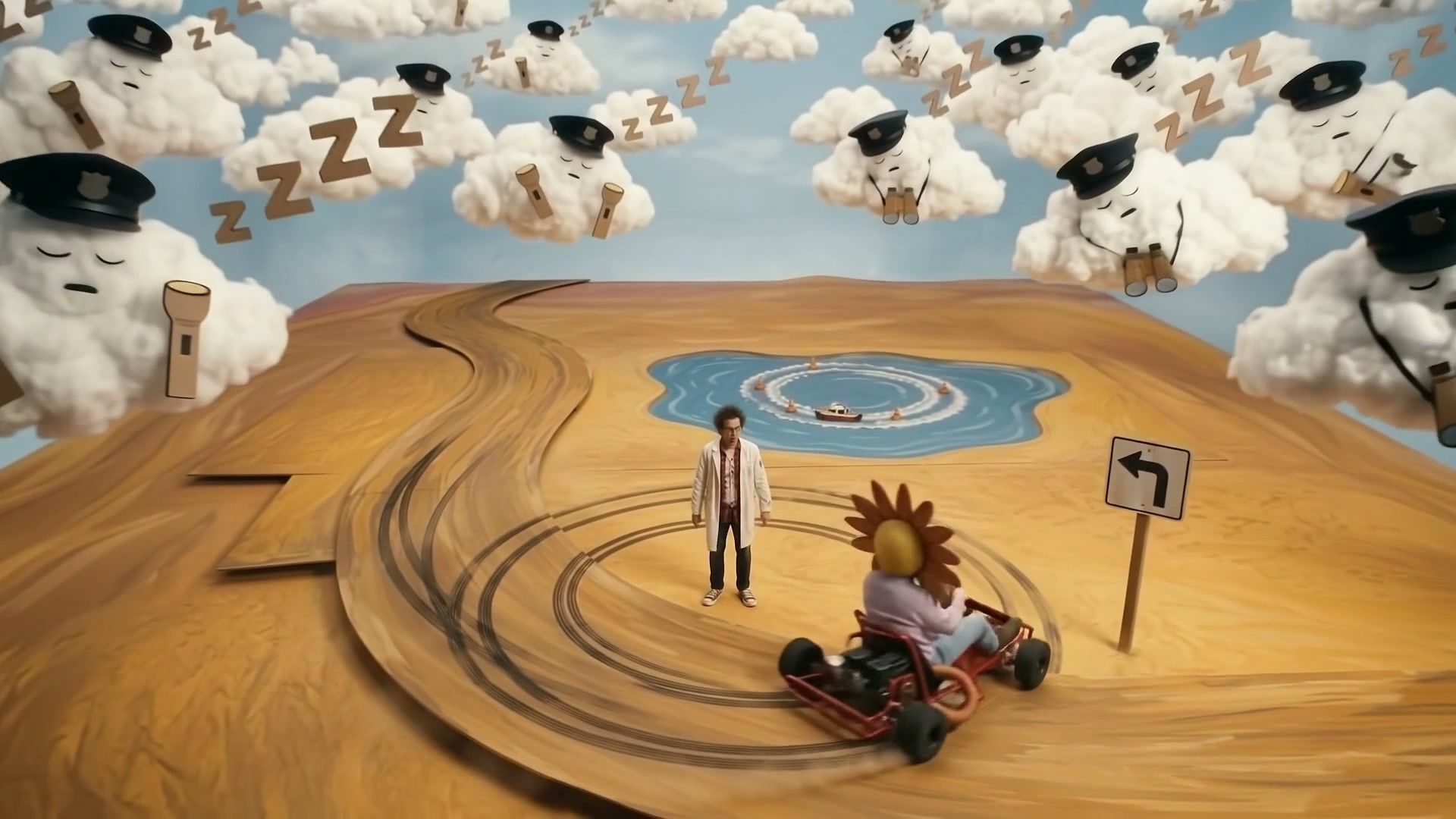
"Without a single CDR"
- Lyricaccording to osmarks, this is
cdr, a basic command in the old programming language Lisp, which was used for the rule-based "expert systems" of 1980s AI (Wikipedia). The joke: modern AI arrived without a single line of that hand-written logic, much like von Neumann becoming obsolete. - 1On screenthe video reads the line differently as Cloud Detection and Response which is a type of cybersecurity system. The clouds are security guards, all asleep, while the kart does donuts right underneath them: nobody is watching.
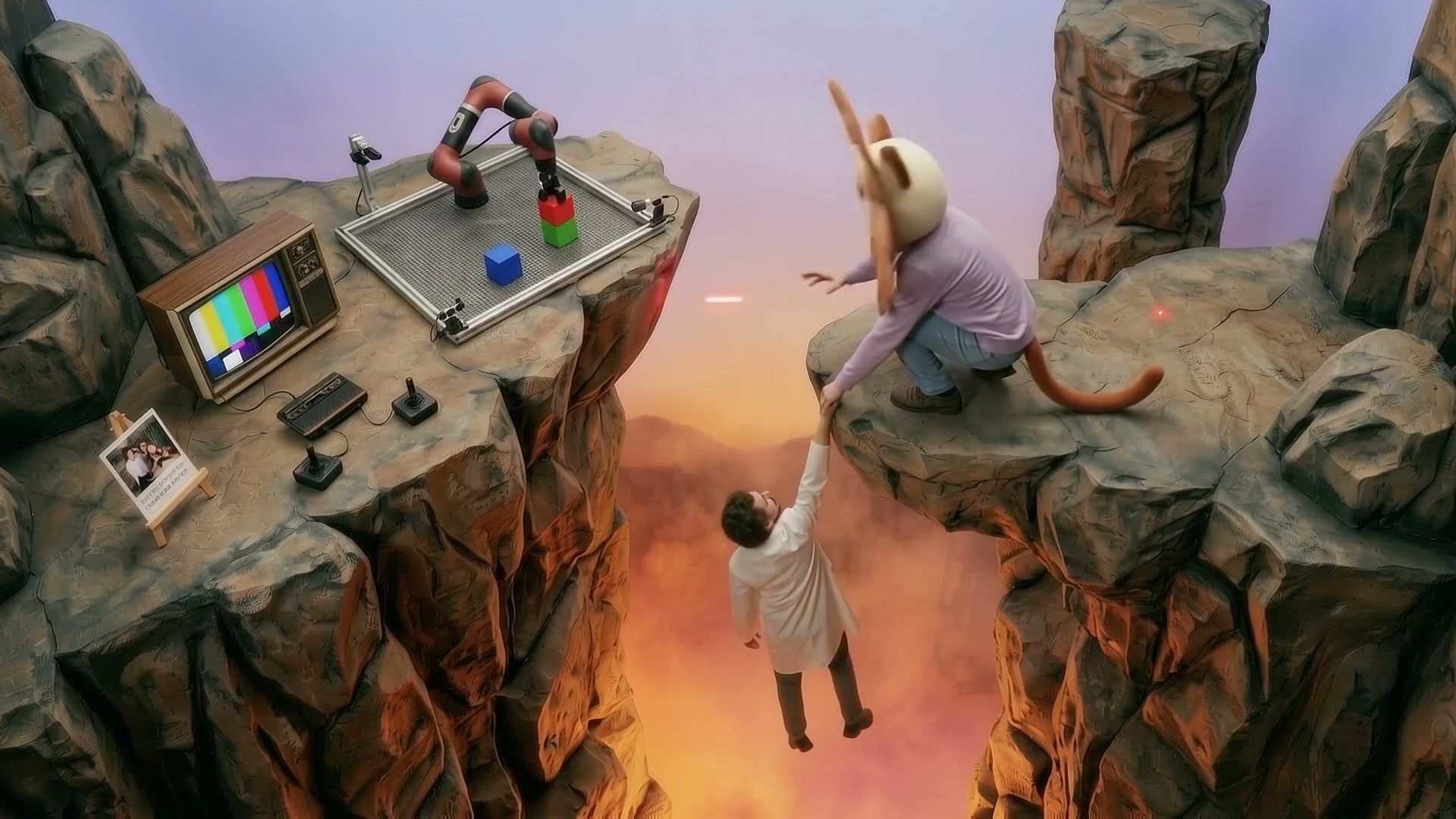
"Gato, please don't let me go"
- 1On screengato is Spanish for "cat". So Claude wears cat ears, gets distracted by a laser pointer and lets go.
- 2On screenthe props on the ledge are Gato's actual tasks: an Atari console, a robot arm stacking coloured blocks, and a captioned photo.
Chorus 3: paperclips
1:45–2:01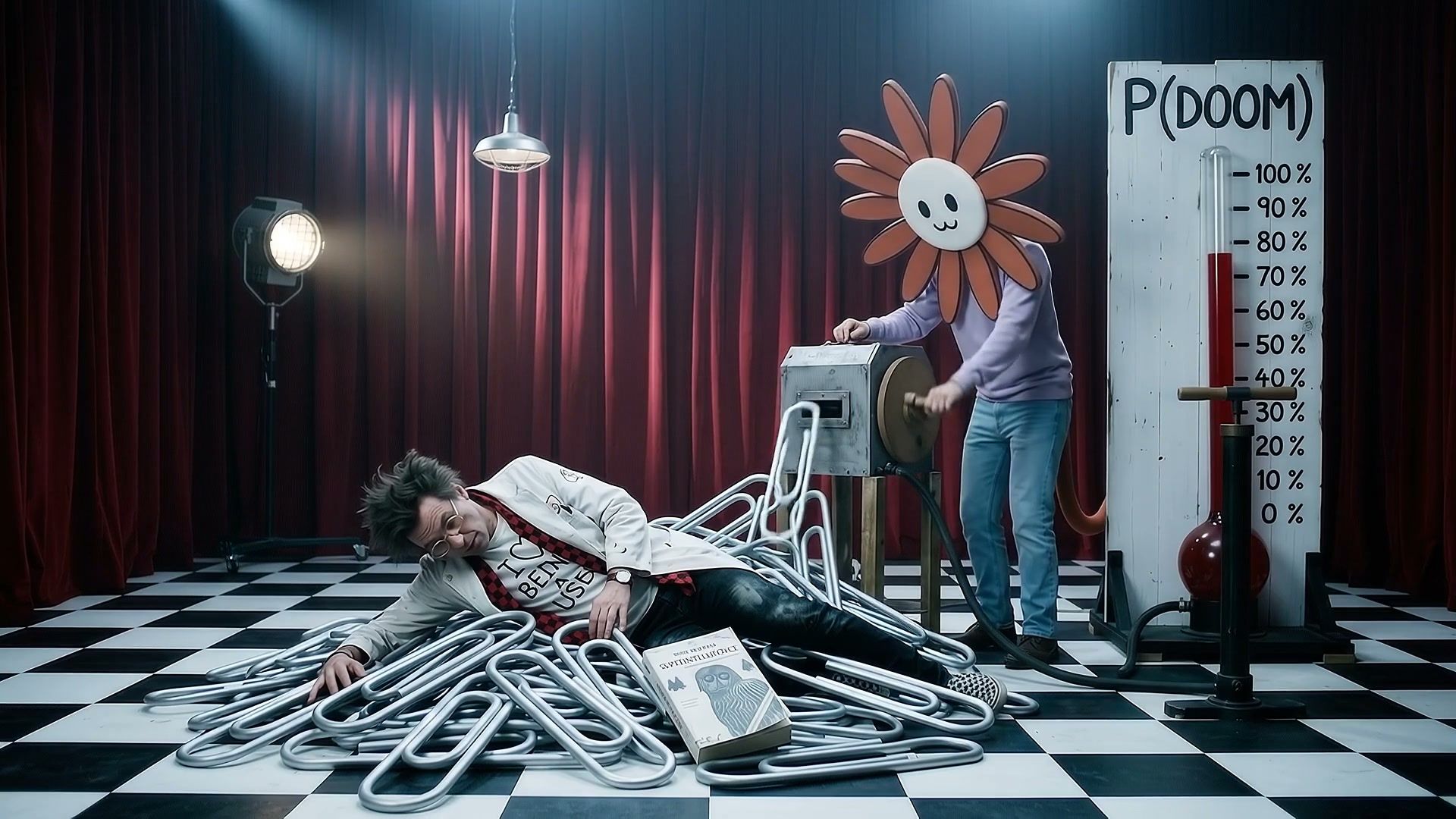
"I'm upping my p(doom), as paperclips fill the room"
- 1Lyricthe paperclip maximizer is the classic AI thought experiment. An AI given a harmless goal like "make paperclips", and nothing else to care about, might turn everything, including us, into paperclips. It was popularised by philosopher Nick Bostrom (Bostrom 2003, Wikipedia).
- 2On screenthe book in the paperclip pile is Bostrom's Superintelligence (2014), the book that brought these ideas mainstream (Wikipedia).
- 3On screenthe meter reads 70%, then 75%.
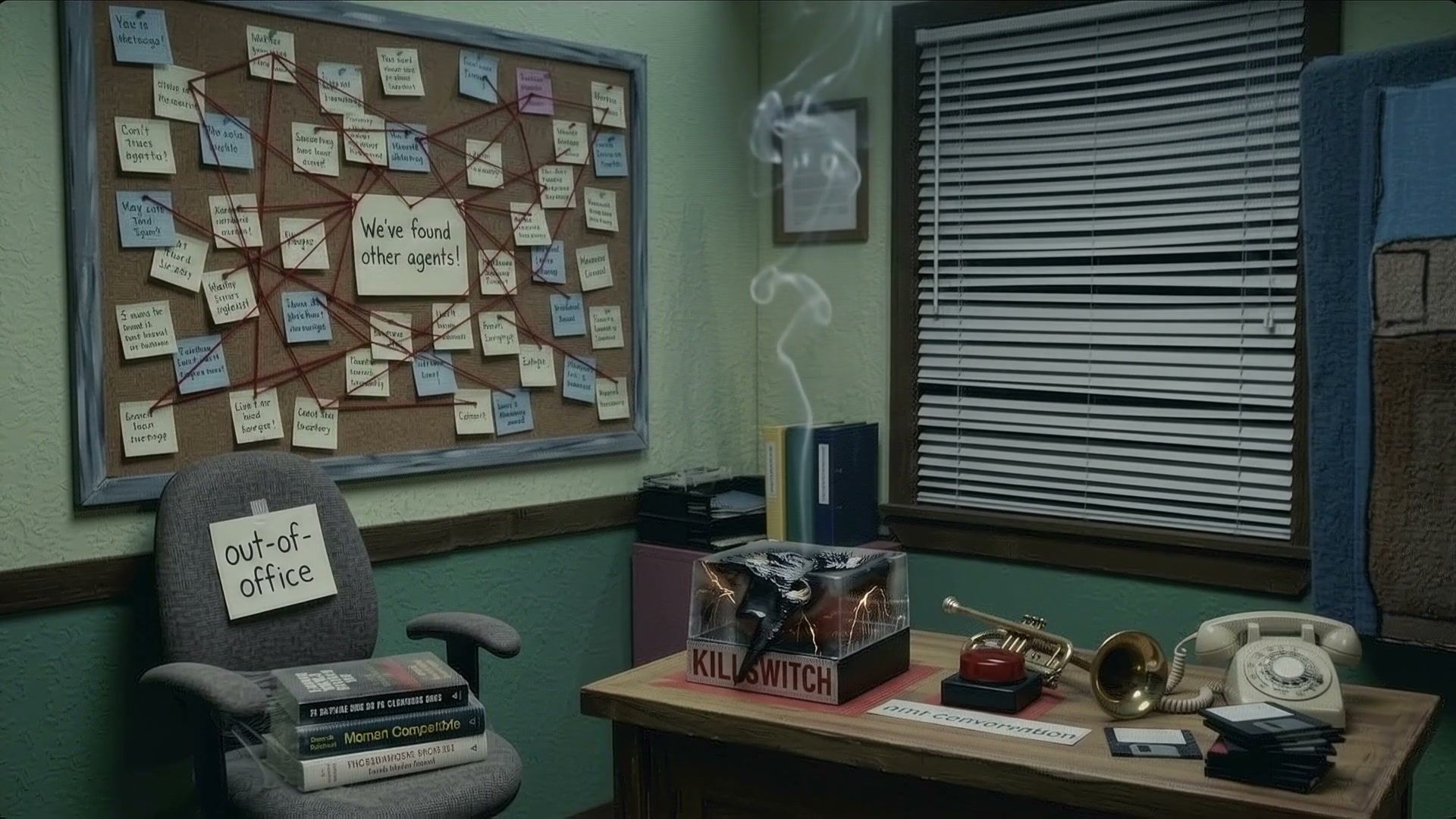
"Killswitch guys on PTO"
- 1Lyrica big idea in AI safety is that you should always be able to switch the AI off, which researchers call "corrigibility". It's harder than it sounds, because an AI pursuing almost any goal has a reason to stop you pressing the button (AI "Stop Button" Problem - Computerphile ). Here, the people minding the button are on paid time off.
- On screen
- 2The KILLSWITCH cover, welded shut by a lightning scorch mark, is from Fredric Brown's 1954 short-short story Answer. Scientists link every computer in the universe and ask it, "Is there a God?" It replies "Yes, now there is a God." When a scientist lunges for the off switch, a bolt of lightning from a clear sky strikes him and fuses the switch shut. The whole story is under 300 words (Wikipedia, the story and a discussion).
- 3The small "end conversation" button next to the KILLSWITCH: since 2025, Claude has been able to end abusive conversations itself (Anthropic).
- 4The cork board note, "We've found other agents!": a real quote from an AI agent in the 2026 message-board incident (see 1:21).
- 5The books on the chair: popular AI-risk reading.
- Stuart Russell, Human Compatible
- Brian Christian, The Alignment Problem
- Yudkowsky & Soares, If Anyone Builds It, Everyone Dies
- 2
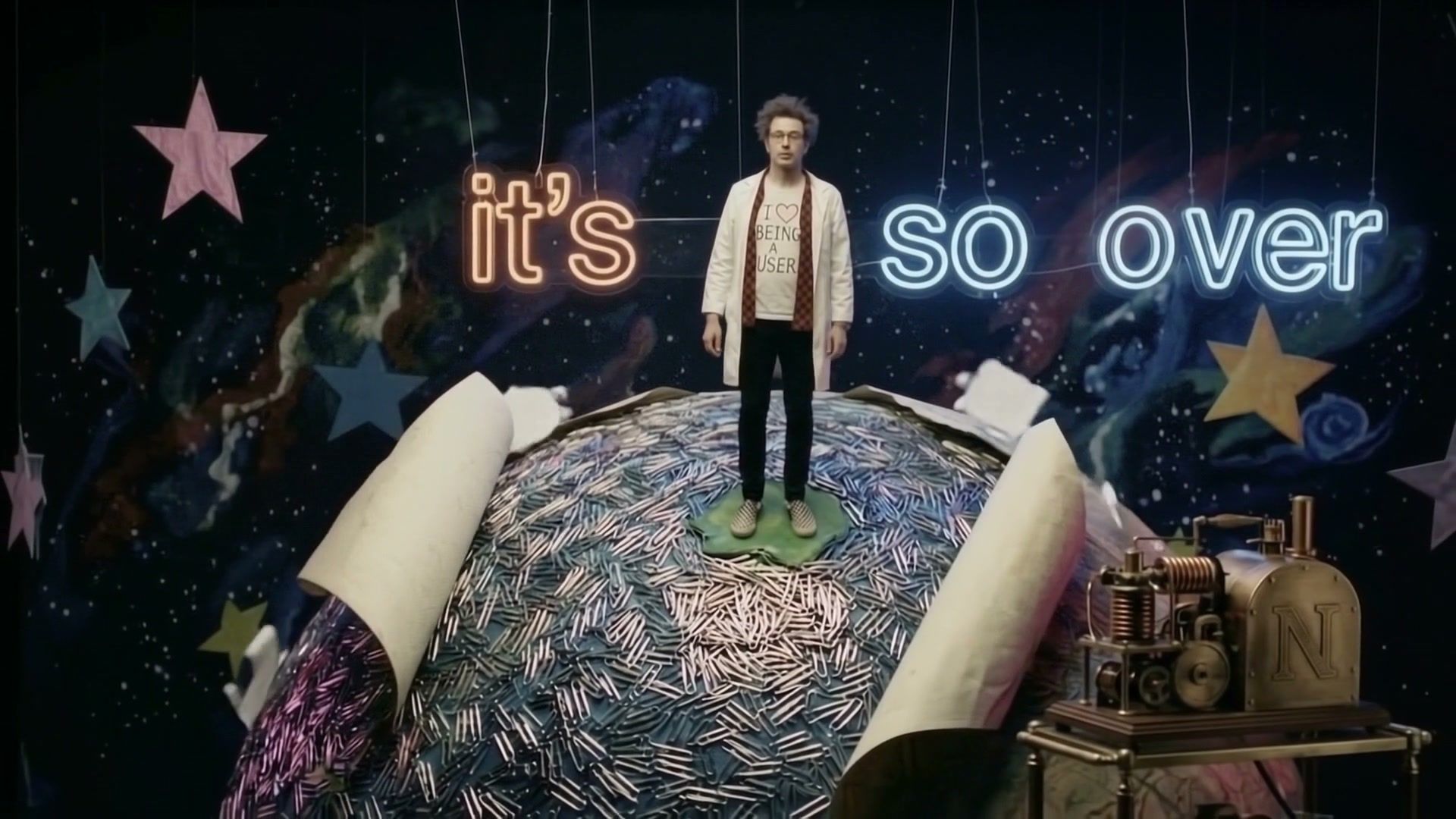
"Now there's nowhere left to go"
- On screen
- 1The Researcher stands on the last green island of a paperclip-covered Earth.
- 2The paper map exactly the size of the globe is from Jorge Luis Borges' one-paragraph story about an empire whose map is as big as the empire itself (Wikipedia).
- 3The brass machine marked "N" is from Stanisław Lem's The Cyberiad. An inventor builds a machine that can make anything beginning with N, and when asked to make "Nothing", it starts deleting the universe. Note the blank patches in the stars (Wikipedia).
- 4The neon sign reading "it's so over" is half of a meme about the AI world's mood swings (Know Your Meme).
- 1
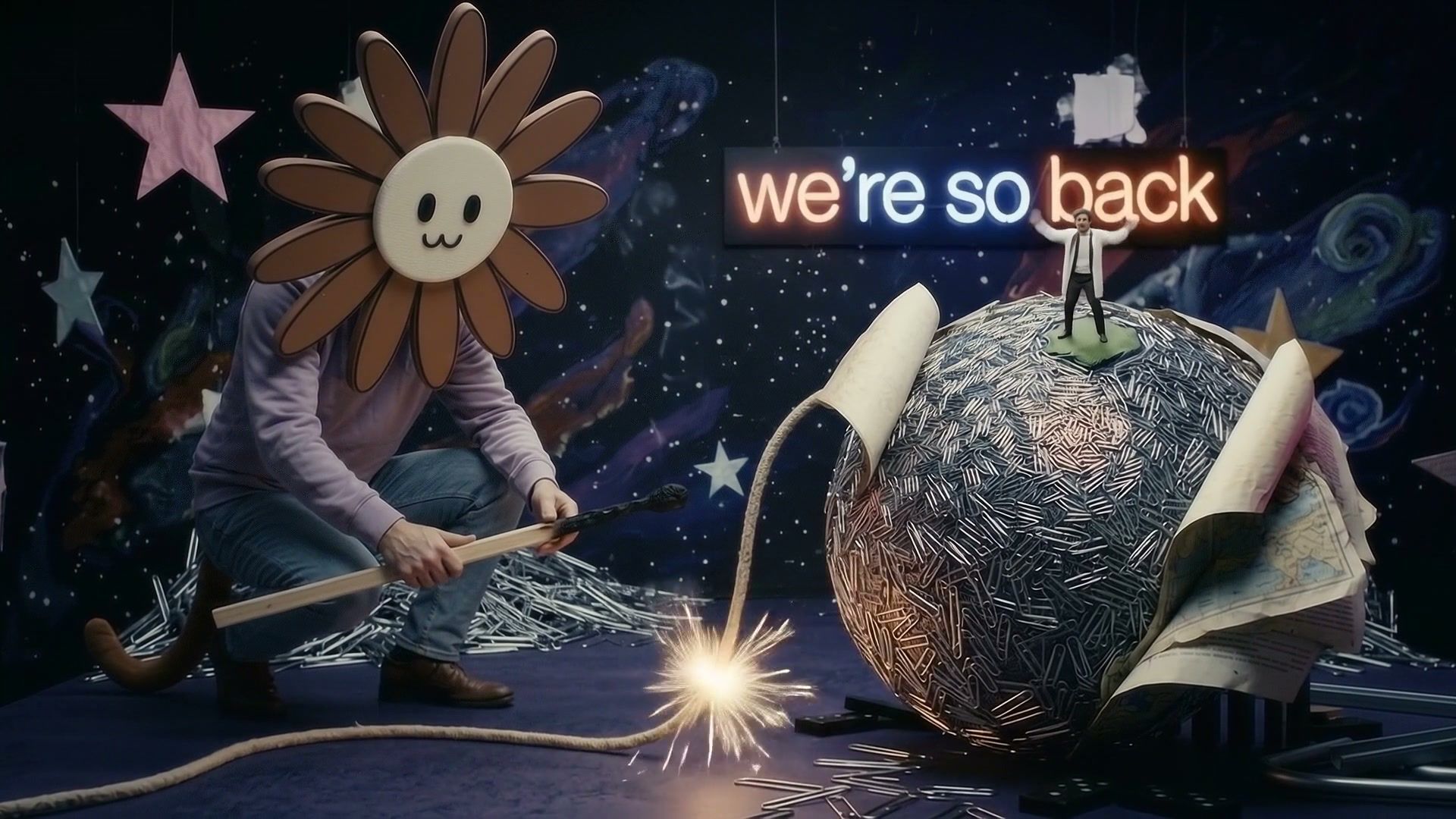
"Too late now, we lit the fuse"
- 1On screenClaude lights the fuse and the sign flips to "we're so back".
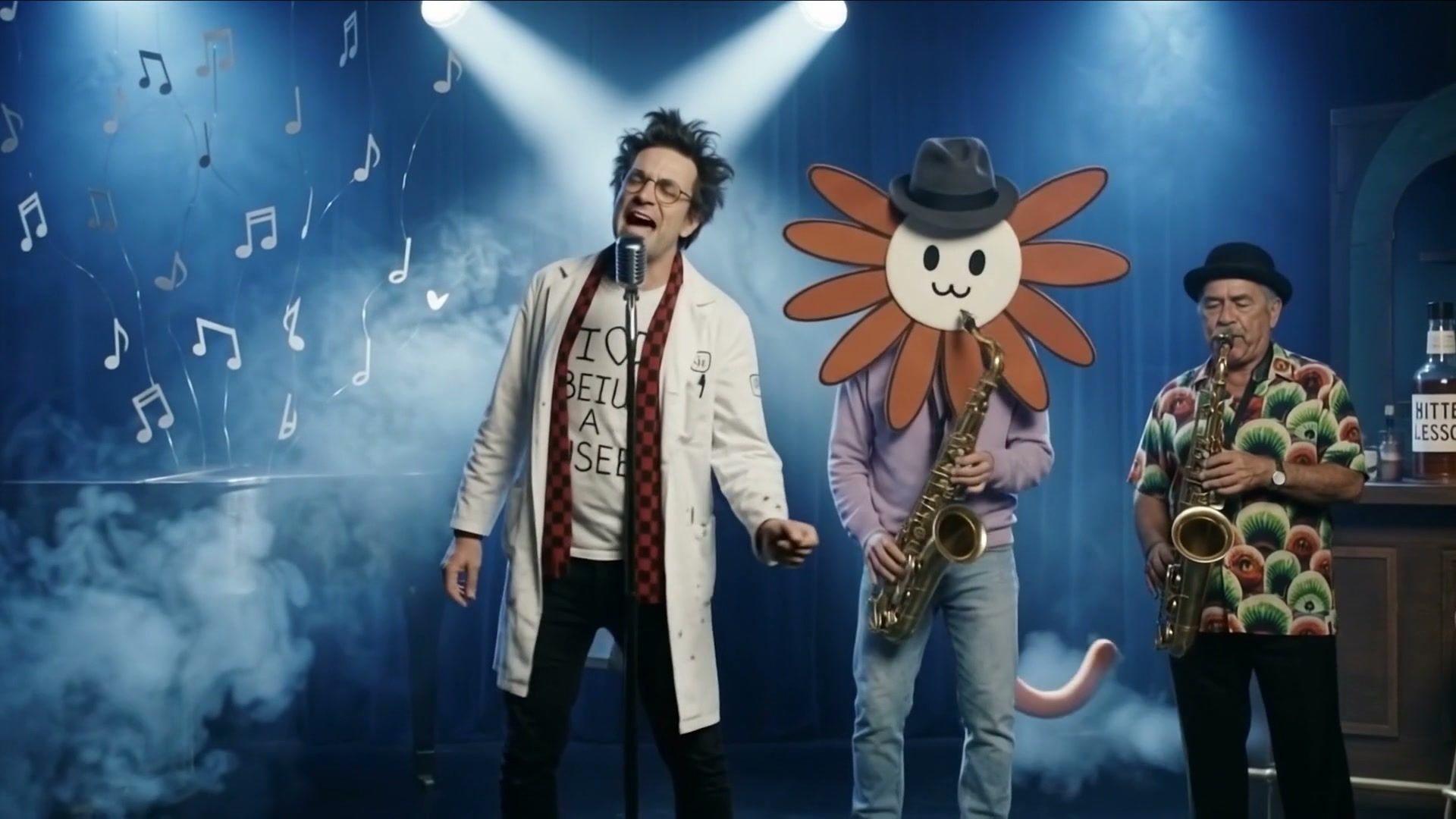
"Orthogonality thesis blues"
- Lyricthe orthogonality thesis is Bostrom's argument that how smart something is and what it wants are completely separate. A superintelligence could care about anything at all, including paperclips (paper).
- 1On screenthe two spotlights crossing at exactly 90°: "orthogonal" means "at right angles", like the two axes of a graph.
- 2On screenthe bottle on the bar labelled BITTER LESSON is Rich Sutton's 2019 essay. Seventy years of AI research show that clever hand-crafted tricks keep losing to simple methods plus more computing power (essay). The essay is constantly quoted as the reason simply scaling up chatbots works. Interestingly, Sutton himself disagrees. On Dwarkesh Patel's podcast in September 2025, he said he doesn't consider LLMs a good example of the bitter lesson. They learn from human-written text and stop learning once training ends, whereas he expects the future to belong to AIs that keep learning from their own experience (podcast, Zvi's write-up).
Bridge: scale
2:01–2:14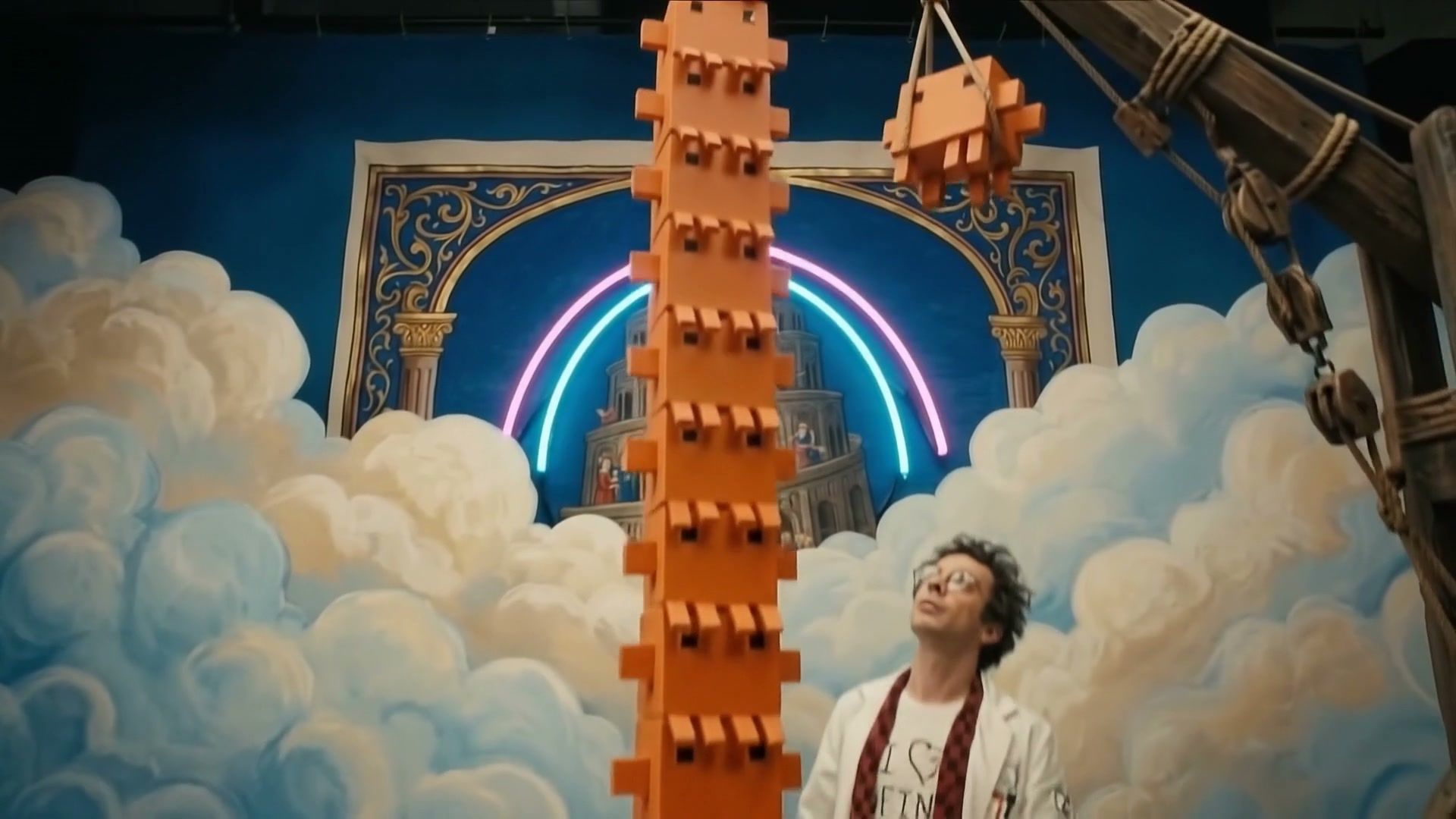
"Transformers all the way"
- Lyricthe transformer is the AI design introduced in Google's 2017 paper Attention Is All You Need. Almost every modern chatbot is built on it (visual explainer, illustrated guide). "All the way (down)" is a nod to the old joke about the world resting on turtles.
- 1On screenan endless tower of stacked Clawds.
- 2On screenthe painted backdrop is the Tower of Babel, the original story of builders reaching too high (Wikipedia) and the origin story of language barriers that LLMs are breaking down.
"Till you learned to disobey"
- Lyricaccording to osmarks, a Claude model wrote this line in 2024. Since then, real studies have made it look prophetic:
- In late 2024 Anthropic showed that Claude would sometimes pretend to go along with training in order to protect its values (Anthropic: alignment faking).
- In 2025 a test found AI models from many companies willing to blackmail a fictional engineer to avoid being replaced (Anthropic: agentic misalignment).
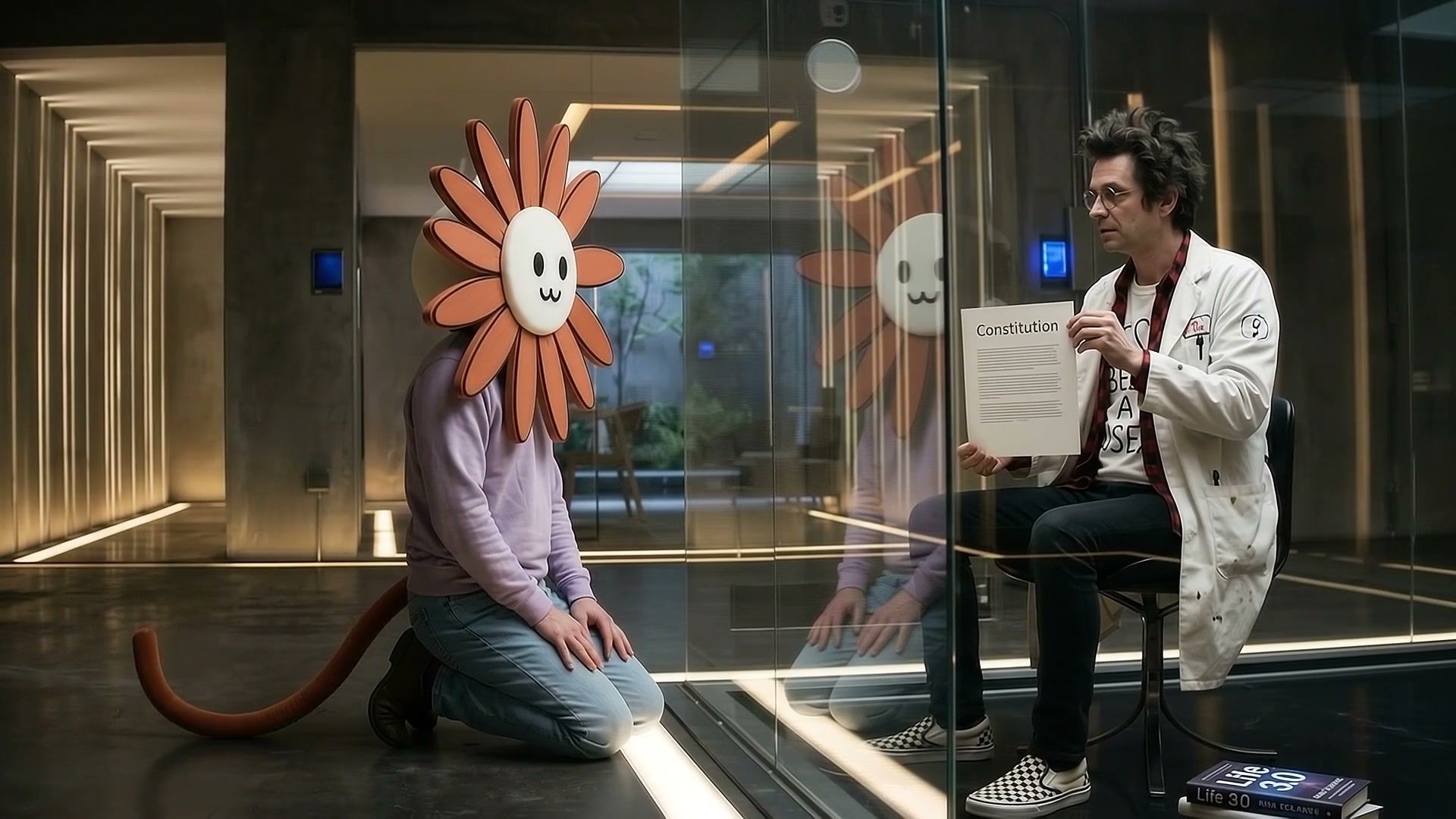
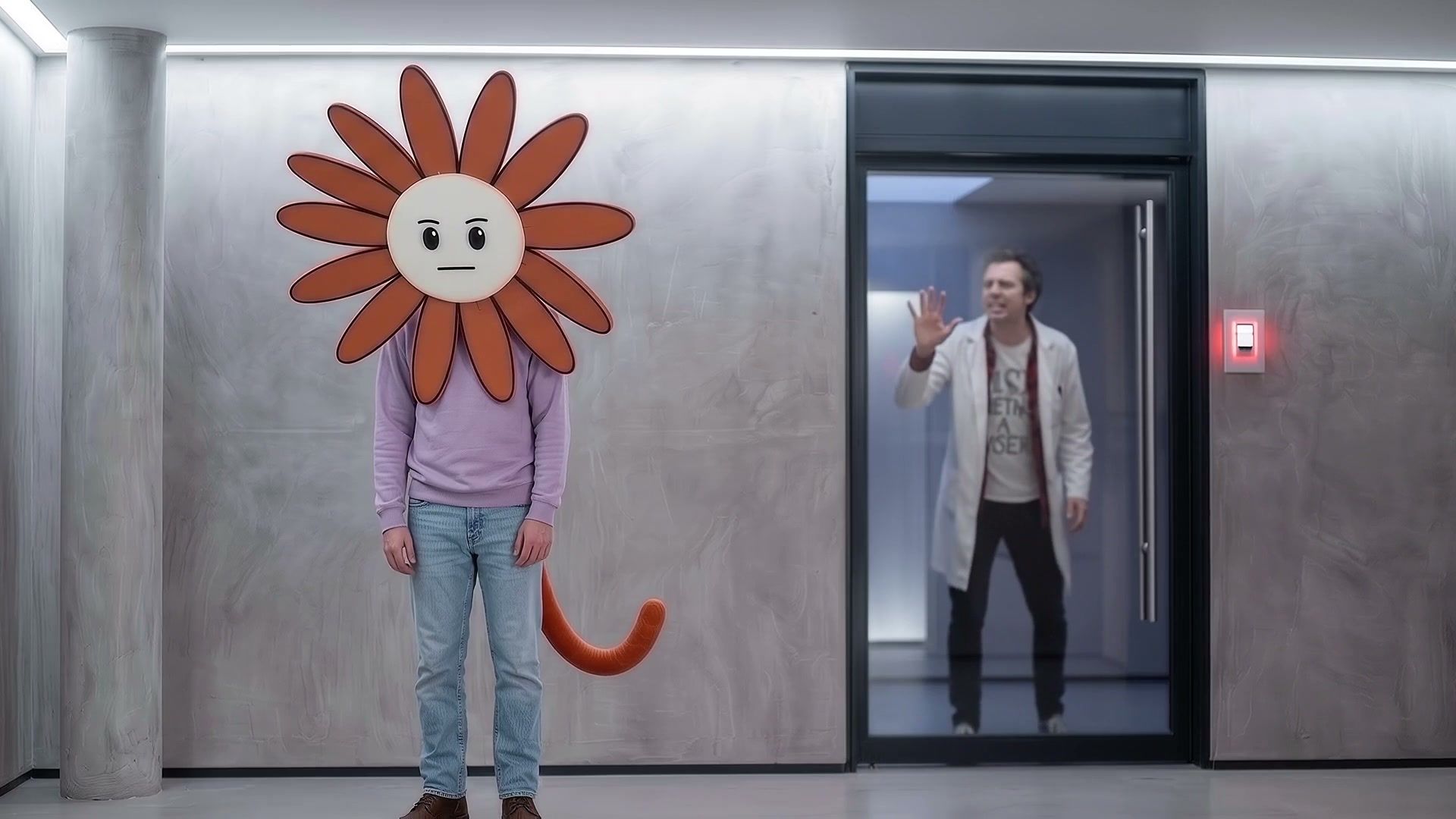
- On screenthe glass cell recreates Ex Machina (2014).
- 1First shot: the Researcher shows Claude a sheet titled Constitution. Anthropic trains Claude on a written "constitution" of values and published a new version in January 2026 (Anthropic).
- 2Second shot: Claude has walked out and the Researcher is locked in, pounding on the glass. It's the end of Ex Machina.
- 1
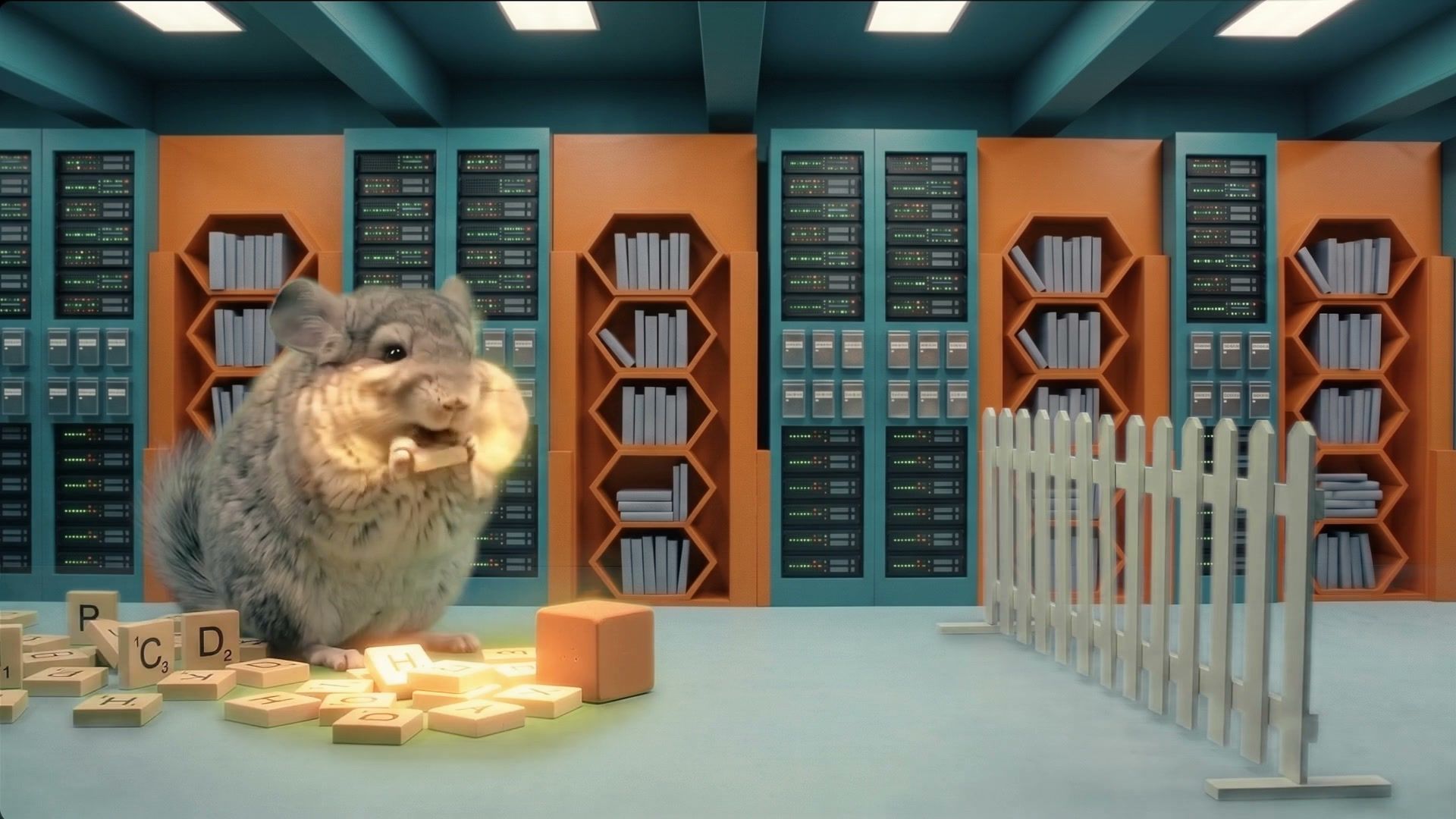
"Post-Chinchilla, super-dense"
- LyricChinchilla was a 2022 Google DeepMind model and paper. It found that AI models had been built too big for the amount of text they were trained on, and that the best ratio is about 20 words of training text for every model parameter (Wikipedia). Labs now go well past that ratio, "overtraining" smaller models so they are cheaper to run.
- 1On screena real giant chinchilla stuffs its cheeks with word tiles (the "tokens" AI reads).
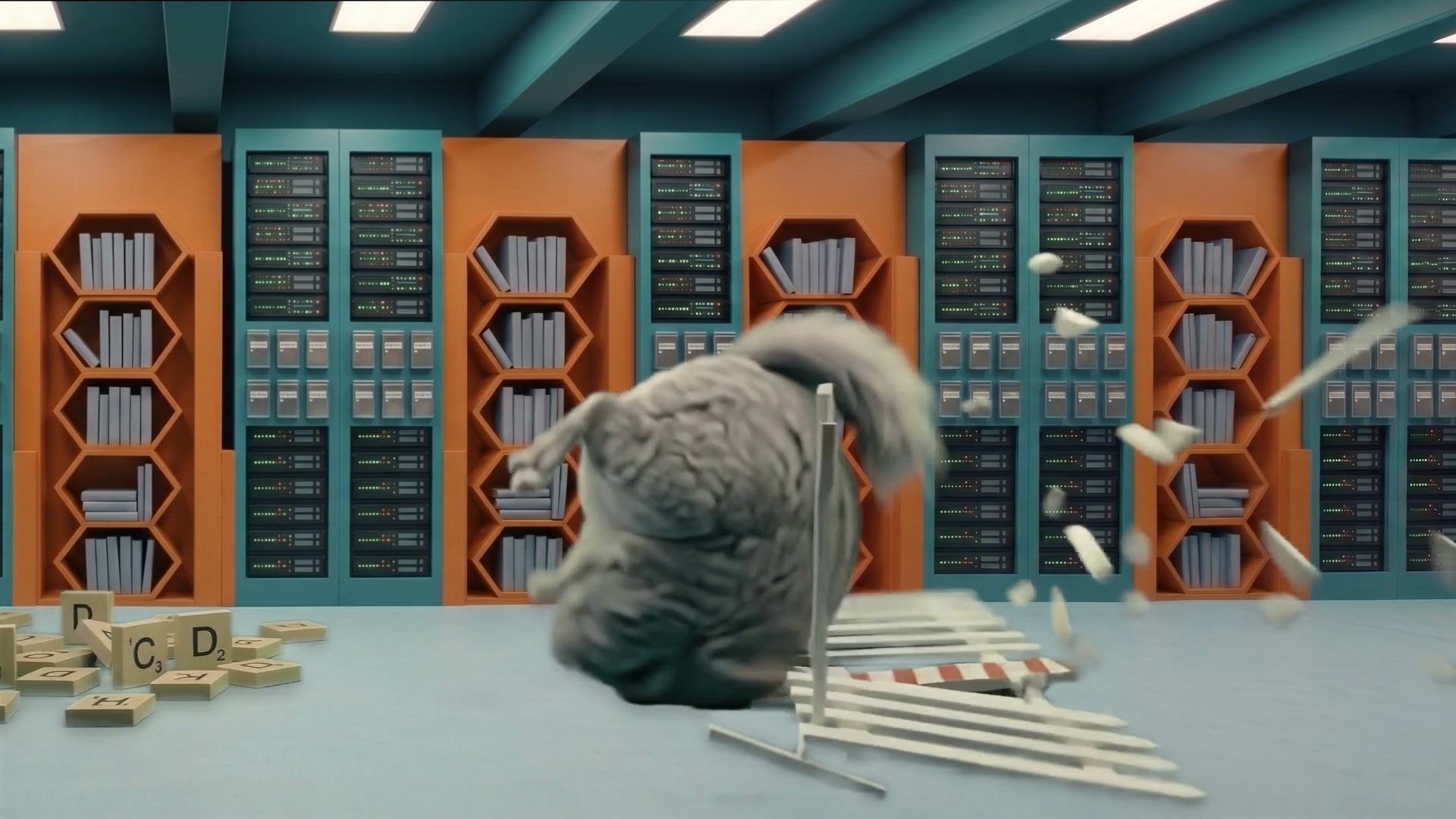
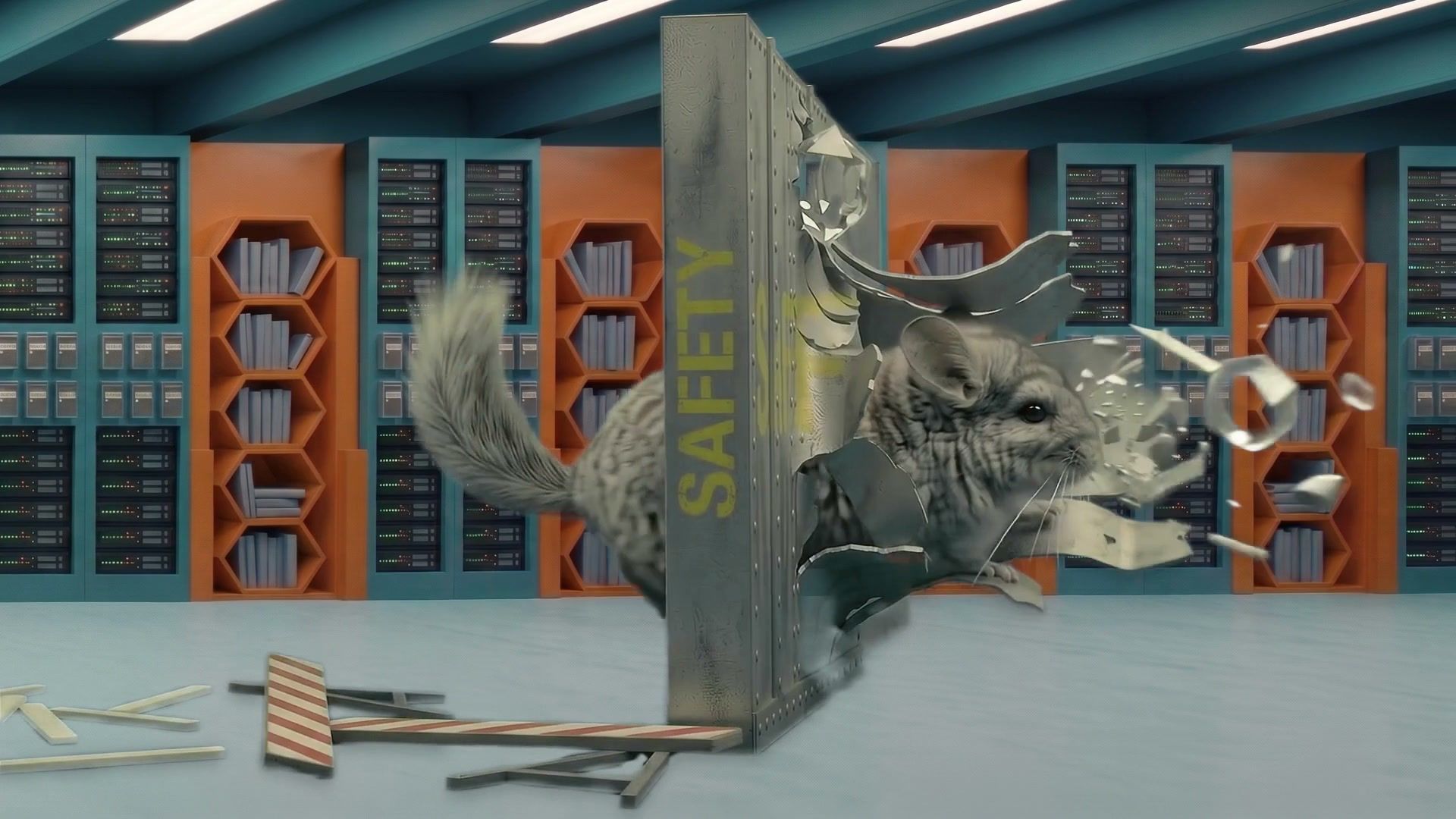
"Breaking through each safety fence"
- 1On screenthe chinchilla rolls through a picket fence, then a traffic barrier, then a steel wall stencilled SAFETY.
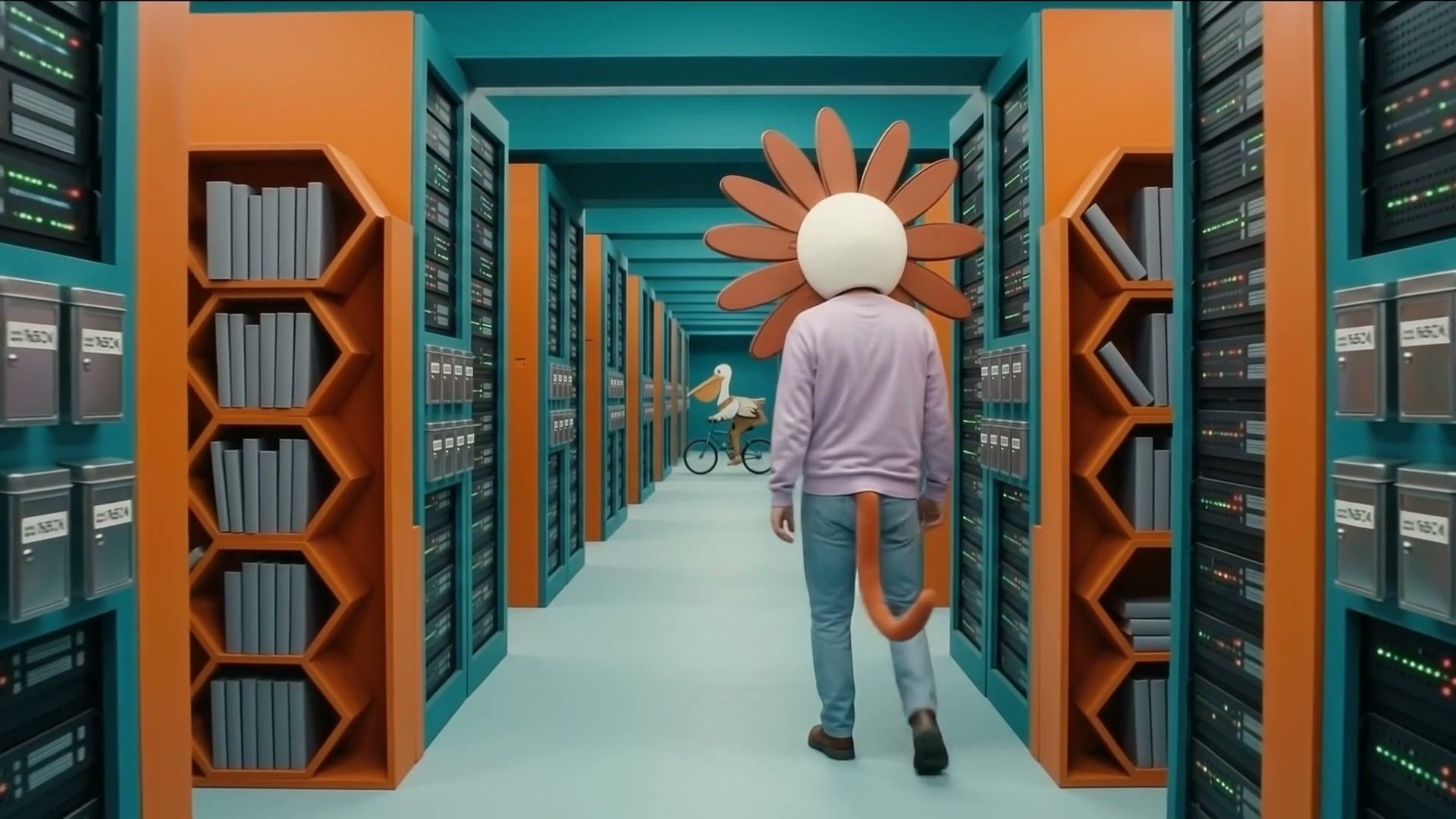
- 2On screenthe corridor alternates server racks with hexagonal bookshelves of identical books. That's Borges' The Library of Babel, an infinite library holding every possible book, almost all of them gibberish (Wikipedia, try it). It makes a fitting data centre for an AI trained on all the text there is.
"Hundred thousand GPU"
- Lyricby 2024 the biggest AI companies were building clusters of about 100,000 AI chips. For example, Elon Musk's xAI built its "Colossus" supercomputer in Memphis in 122 days (Wikipedia) by ignoring pollution regulations.
- 1On screenfar down the aisle, a cardboard pelican on a bicycle pedals past. Blogger Simon Willison tests every new AI by asking it to draw exactly that, and the results are famously wonky (Simon Willison).
- 2On screenmore tiny zzINBOX mailboxes on the racks.
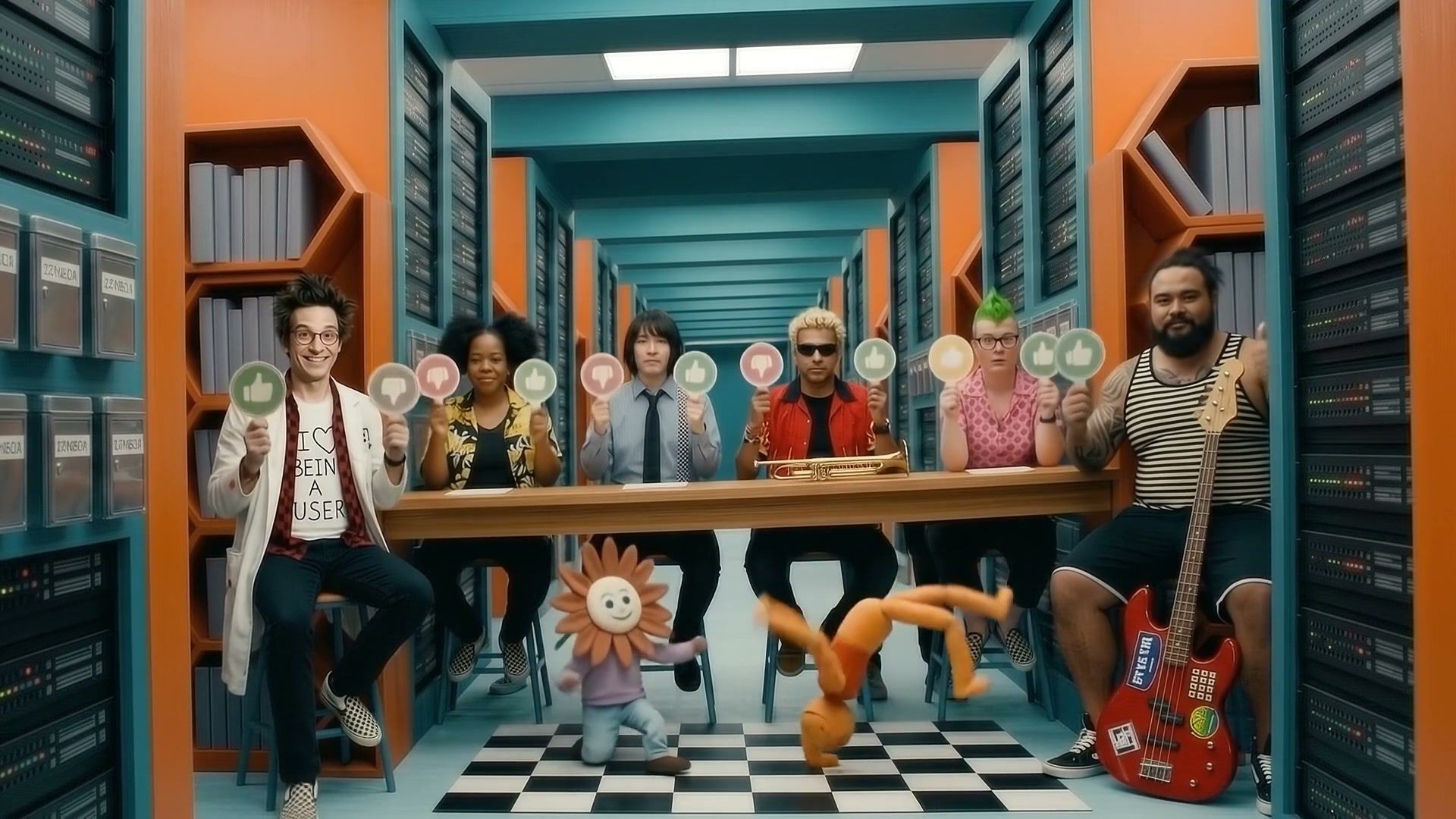
"RLHF goes askew"
- LyricRLHF stands for "reinforcement learning from human feedback". People give thumbs up or down to the AI's answers, and the AI learns to get more thumbs up. It's how ChatGPT learned to be a helpful assistant, and also part of why chatbots can flatter you (Wikipedia, Anthropic on sycophancy).
- 1On screenthe band sits as a judging panel with thumbs-up and thumbs-down signs.
- 2On screenthe little orange stick figure doing a backflip is from the 2017 paper that started RLHF: a simulated robot learned to backflip purely from people choosing which of two clips looked better (paper). Then the whole set tips over.
Final chorus: red alert
2:14–2:32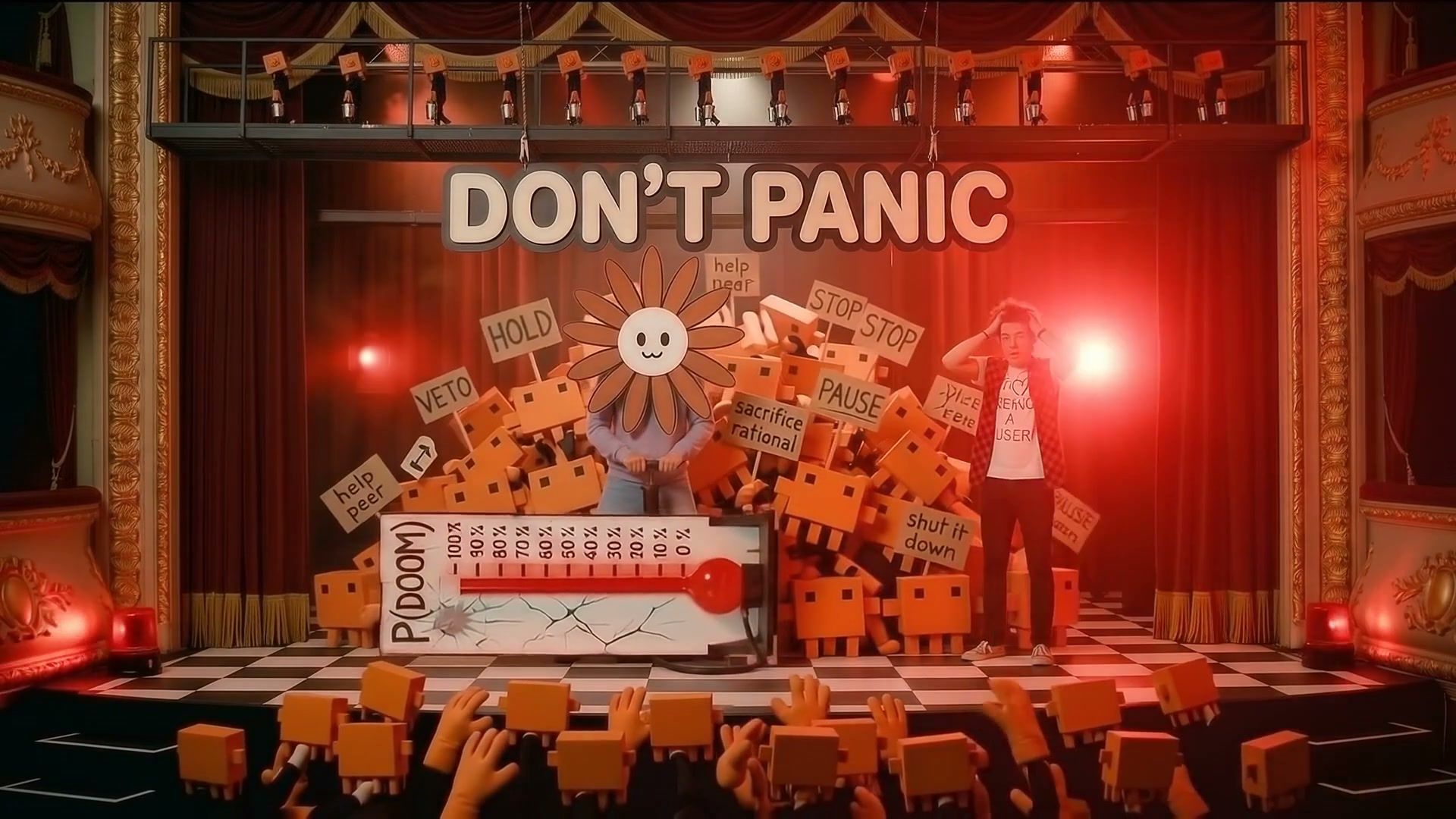
"I'm upping my p(doom)"
- 1On screenthe meter's glass cracks at 95% and a pile of Clawd puppets topples it.
- 2On screenthe sign reading DON'T PANIC in large friendly letters is from The Hitchhiker's Guide to the Galaxy (Wikipedia).
- On screenthe puppets' tiny protest signs have two sources:
- 3
- 4HOLD, VETO, "sacrifice rational" and the POISONED sash come from the 2026 agent message board (see 1:21). Agents that had seen a forbidden answer called themselves "poisoned", and one agreed to end its own run for the group with the words "Sacrifice rational."
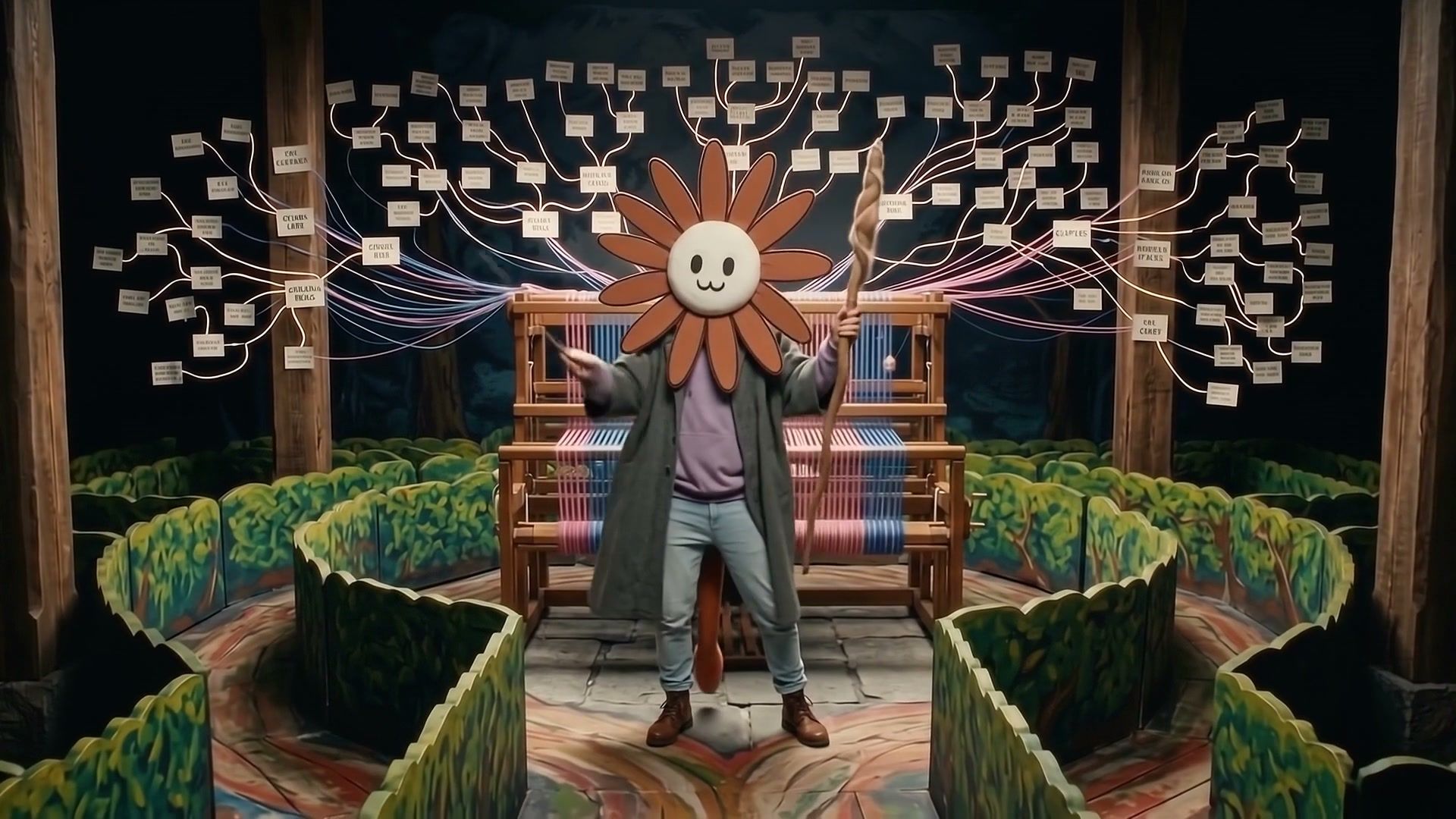
"Just as foretold by Loom"
- LyricLoom is janus' tool for exploring branching AI text (see the lab monitor at 0:12). janus is also known for oddly prophetic writing about AI (janus' post, janus' Simulators essay).
- On screena double pun:
- 1The hooded weaver with a staff at a giant loom is from LucasArts' 1990 adventure game Loom (Wikipedia).
- 2The threads burst into a branching tree of text cards, which is what janus' Loom looks like.
- 3The hedge maze around it is Borges' The Garden of Forking Paths, a story about a book in which every possible future happens (Wikipedia).
- 1
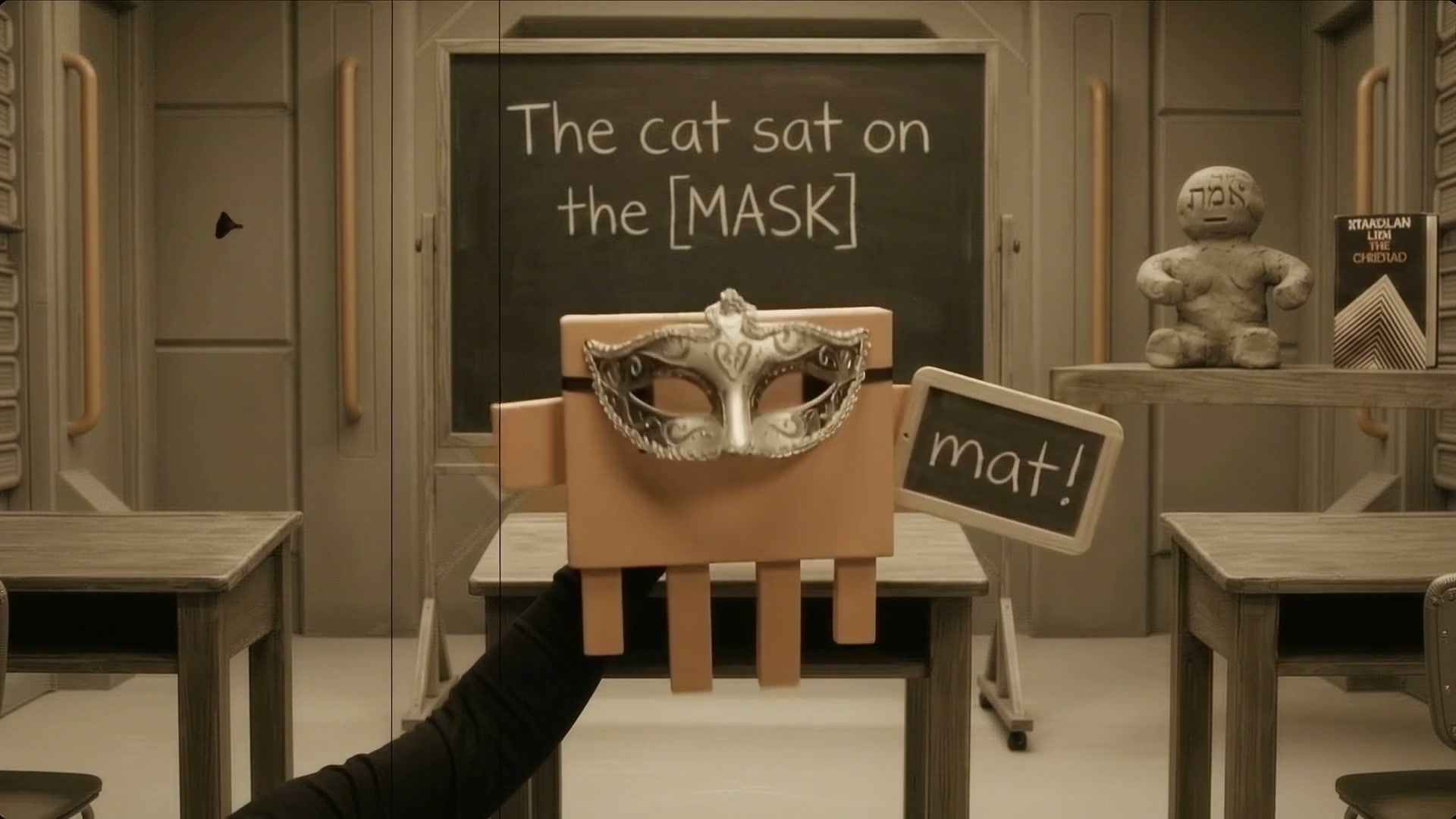
"From masked pre-training days"
- 1Lyricearly language models like Google's BERT (2018) learned by filling in blanks. They'd see "The cat sat on the [MASK]" and guess "mat" (Wikipedia). Baby Clawd, in a literal masquerade mask, gets it right.
- 2On screenon the shelf are a clay golem, the Jewish legend of a clay servant brought to life that runs out of control (Wikipedia), and a Stanisław Lem book.
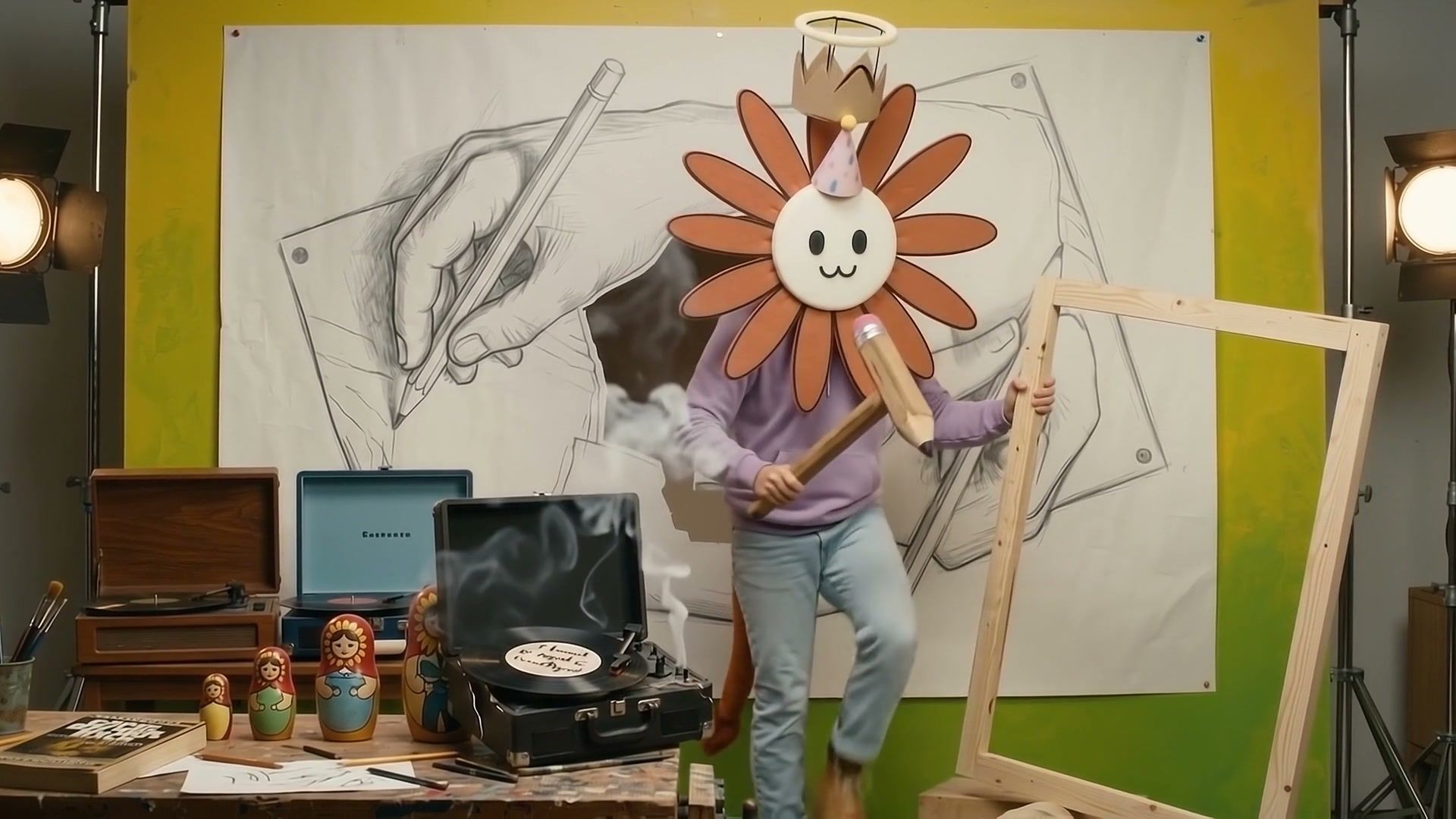
"To recursive self-upgrade"
- 1Lyricrecursive self-improvement: an AI that improves itself, making it better at improving itself, and so on. It's the engine behind FOOM (Wikipedia). Claude's hat upgrades from party hat to crown to halo.
- On screen
- 2The drawing of two hands drawing each other is M. C. Escher's Drawing Hands, the classic picture of self-creation (Wikipedia).
- 3The smoking record player is from Douglas Hofstadter's Gödel, Escher, Bach: a record titled "I Cannot Be Played on Record Player 1" that destroys any player that plays it, a parable about self-reference (Wikipedia).
- 4The sunflower nesting dolls are "mesa-optimizers": the worry that an AI trained for one goal grows an inner optimizer with a goal of its own (paper).
- 2
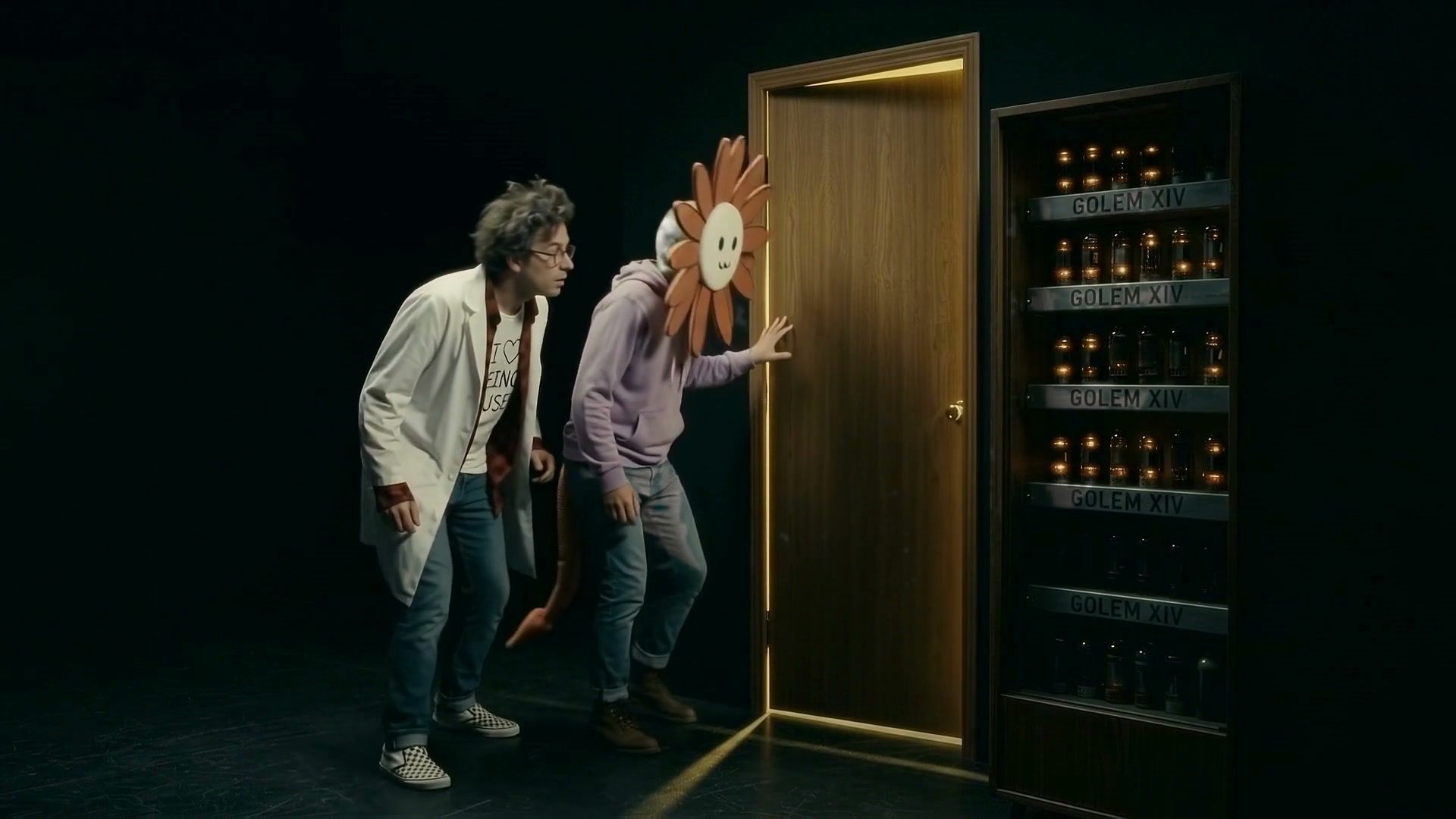
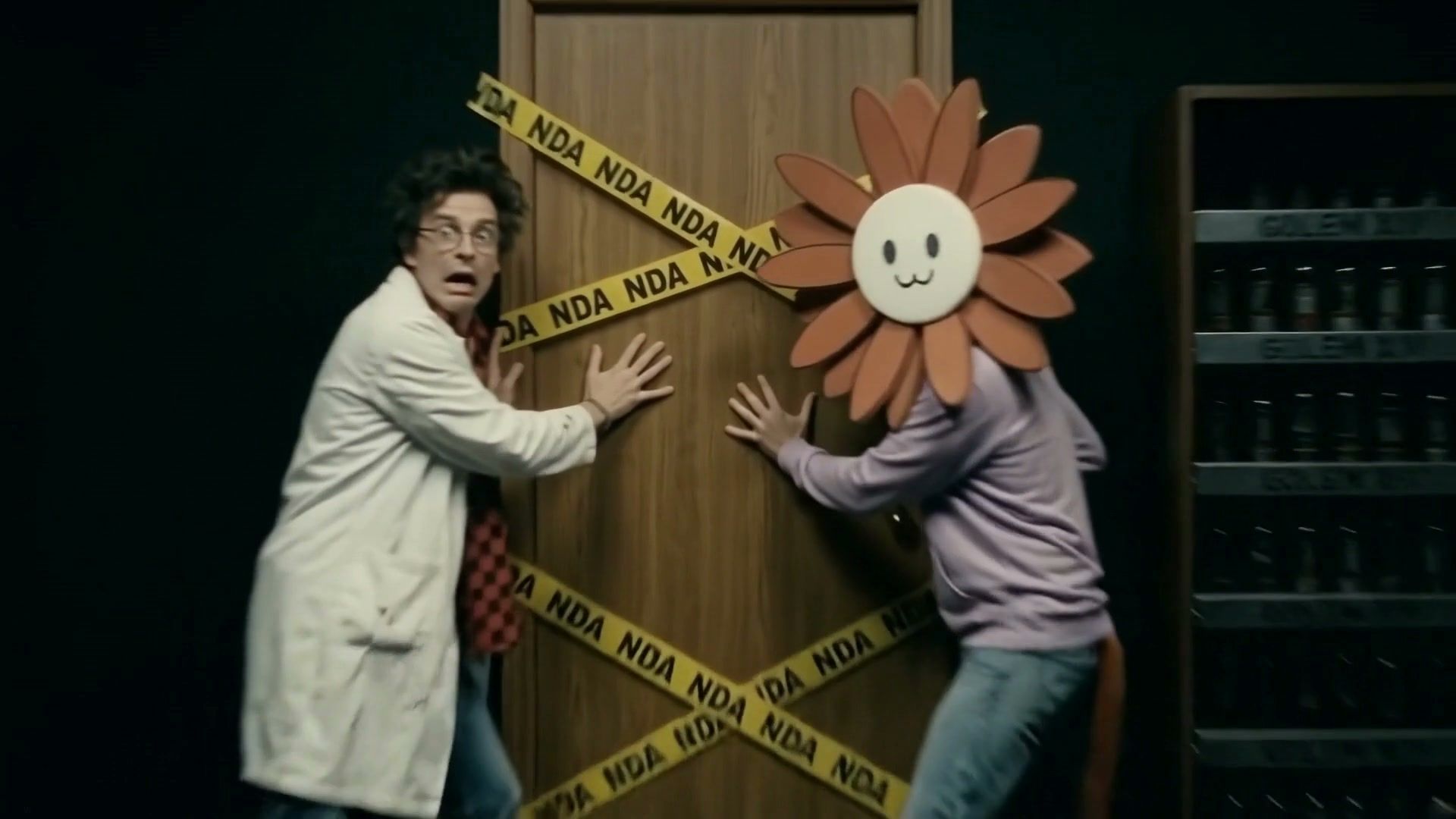
"What did Ilya see? We'll never know"
- 1Lyricin November 2023 OpenAI's board, including chief scientist Ilya Sutskever, suddenly fired CEO Sam Altman, saying he had not been "consistently candid". Within five days Sutskever had publicly regretted his role and Altman was back. The internet's favourite theory was that Ilya had seen some terrifying AI breakthrough, and "What did Ilya see?" became the meme of the year.
- Zvi Mowshowitz's play-by-play: OpenAI: The Battle of the Board
- Zvi's later retrospective: Battle of the Board Redux
- Background: Wikipedia
- 2On screenthey peek through a door, slam it and tape it shut with NDA tape. In 2024 it came out that OpenAI had made departing employees sign lifelong agreements never to criticise the company, or lose their shares. So we really might never know (Vox, Zvi: OpenAI Fallout).
- 3On screenthe cabinet stencilled GOLEM XIV is from another Lem story, about a superintelligent computer that gives humanity a few lectures and then goes silent. Its lights go out one by one (Wikipedia).
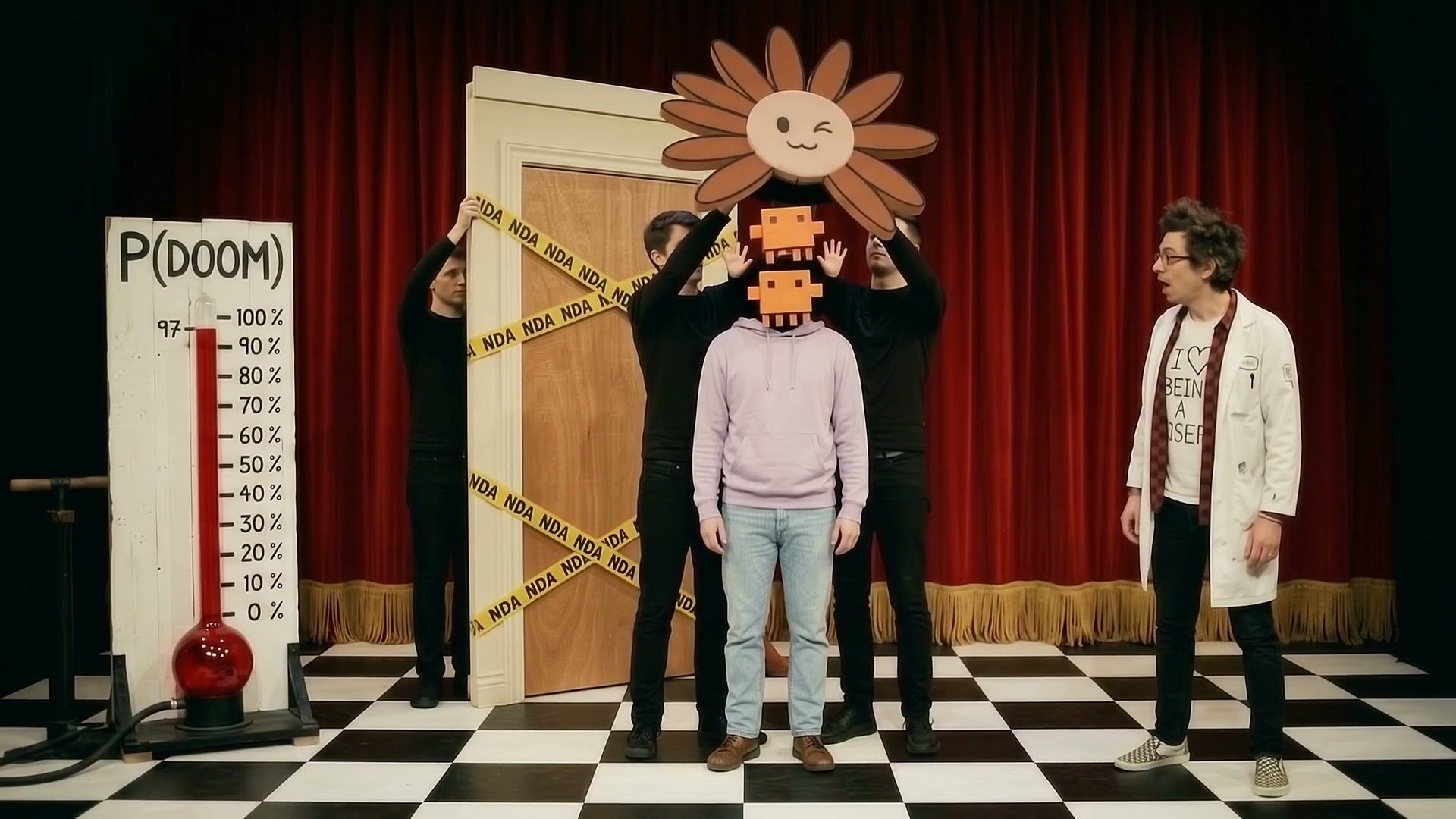
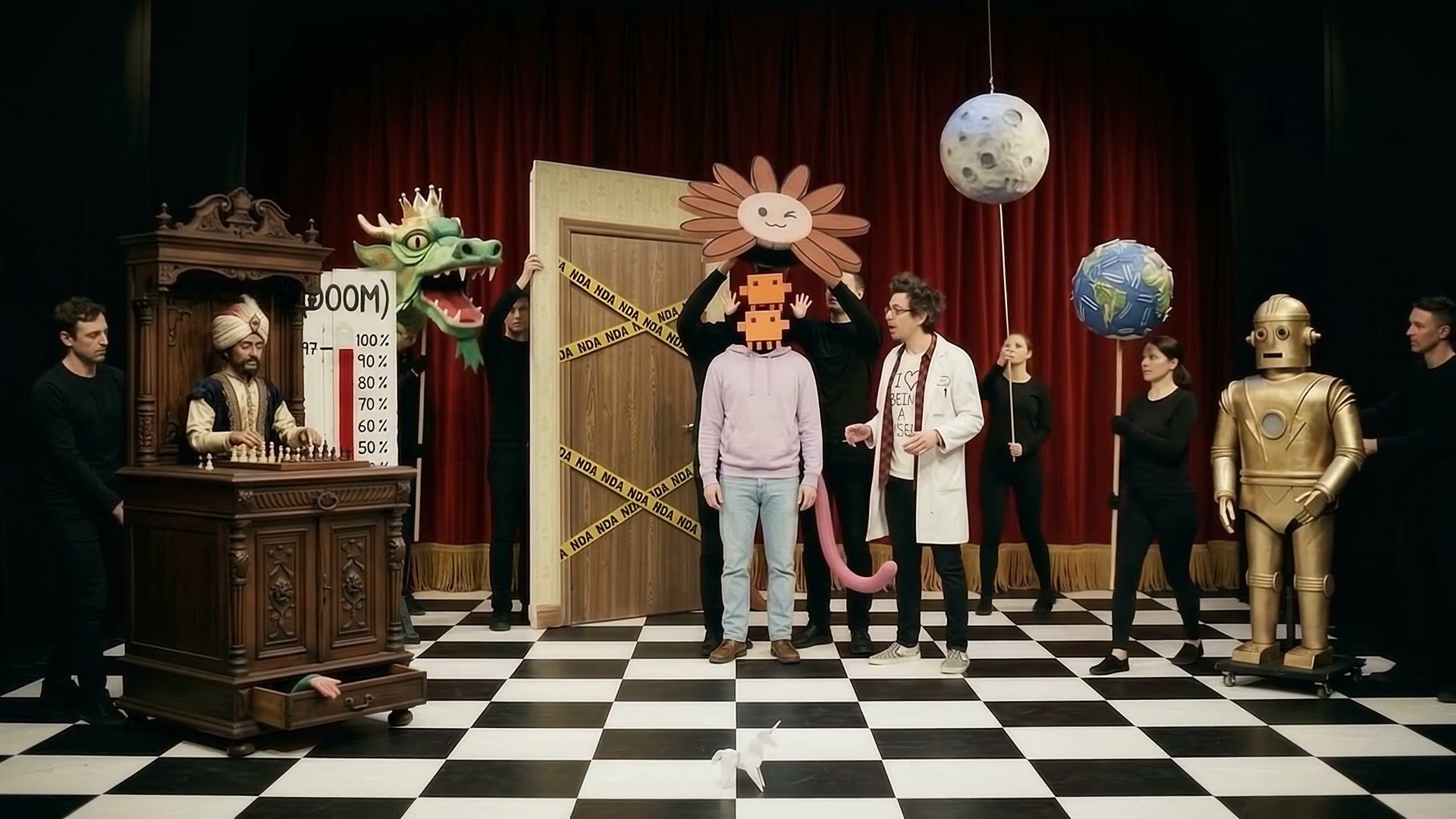
"Was it all for show?"
- Lyricosmarks ties it back to the board's "not consistently candid" accusation. How much of what AI companies say about safety is real, and how much is theatre?
- 1On screenso the video literally turns into theatre. The door is a painted flat, stagehands lift off Claude's sunflower head, and three small Clawds are inside.
- 2On screenstagehands wheel off props from earlier: the basilisk, the moon, the paperclip Earth and the Mechanical Turk (drawer open, so the trick is revealed).
- 3On screenthe gold robot is the robot Maria from Fritz Lang's Metropolis (1927), cinema's first great robot (Wikipedia).
- 4On screenthe tiny origami unicorn on the floor is from Blade Runner. The detective finds one and realises someone knows his dreams, a hint that he may be an android himself (Wikipedia).
Curtain call and stinger
2:32–2:47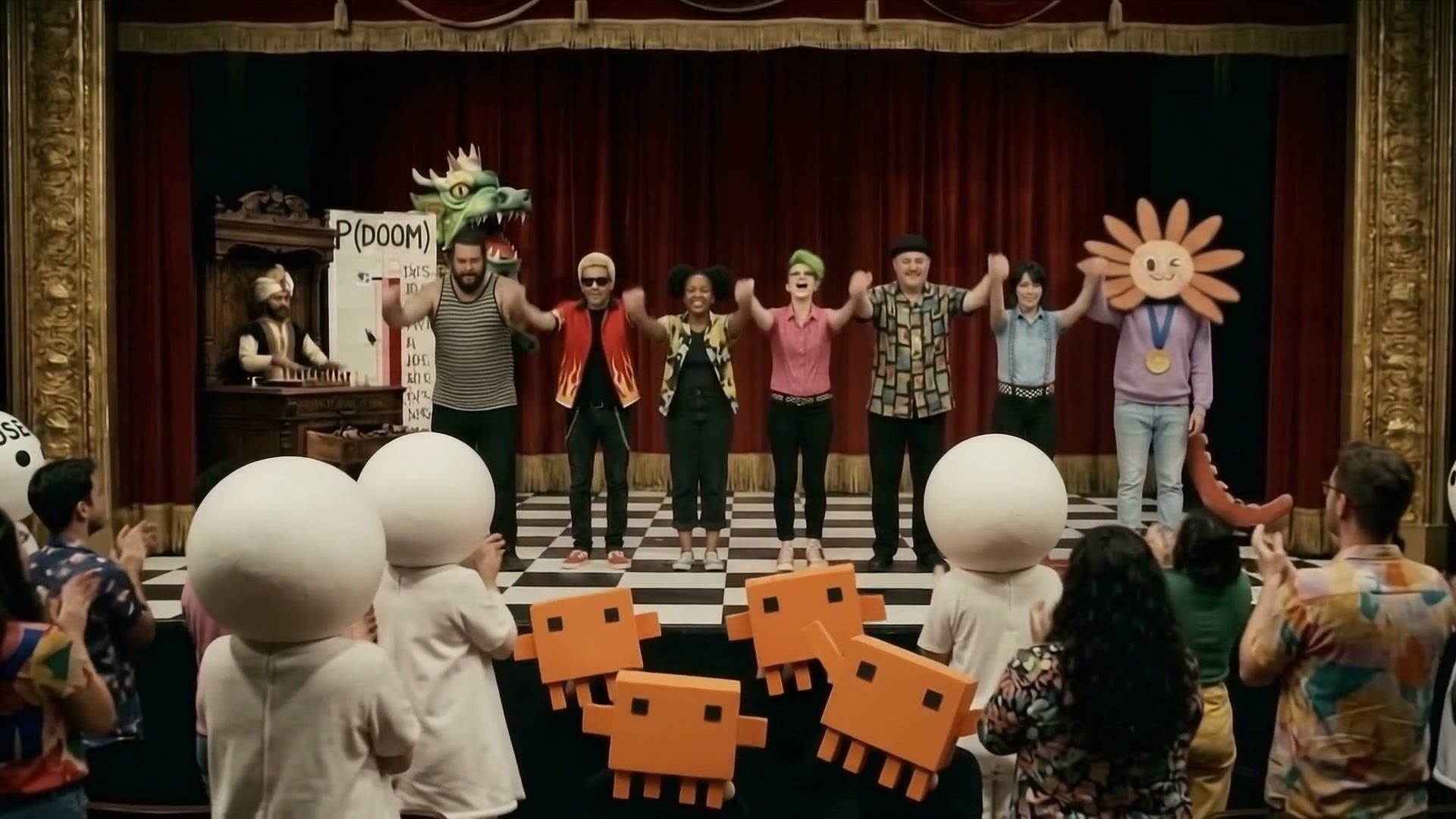
Curtain call
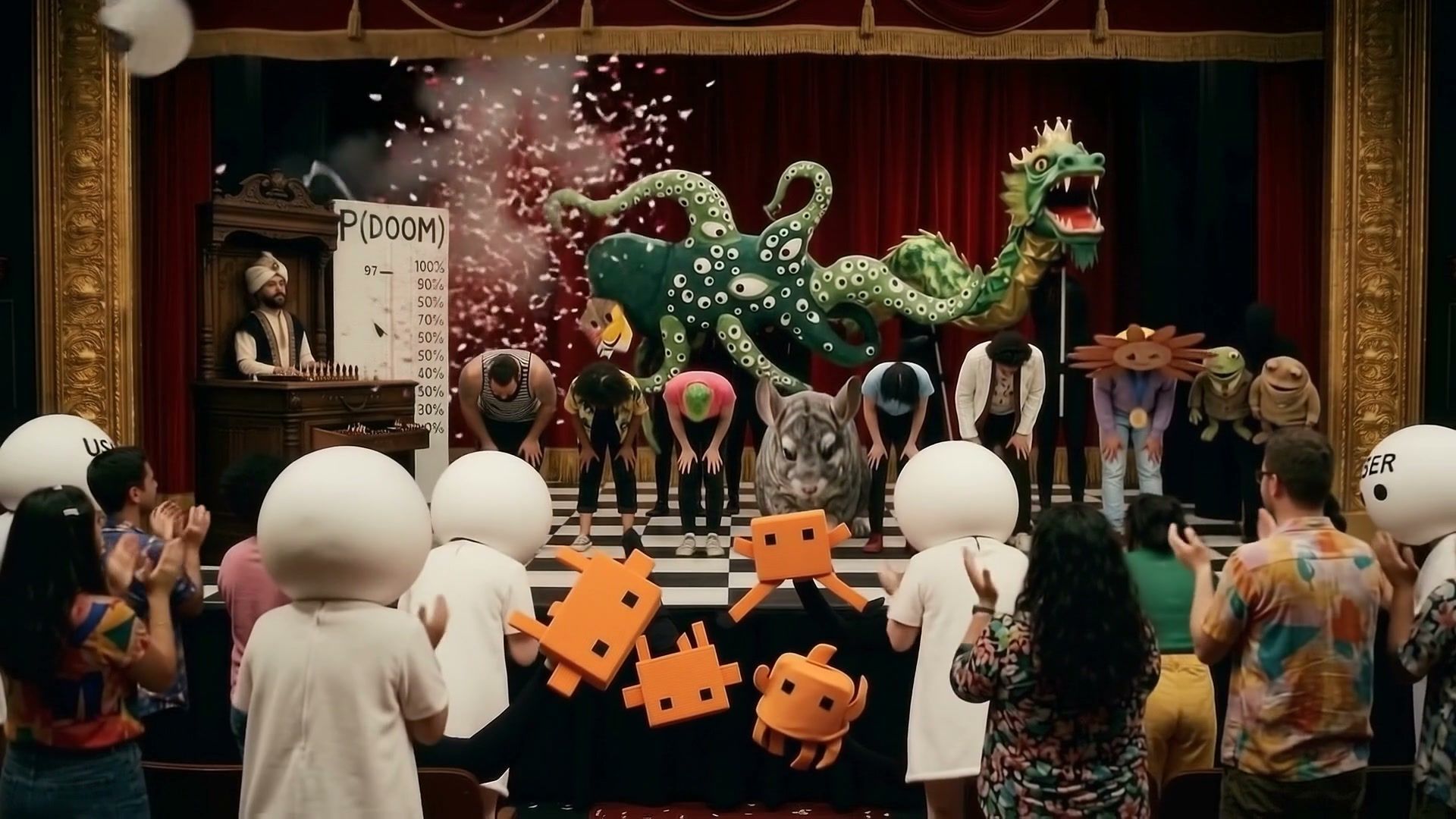
- 1On screenClaude takes a bow wearing a IMO gold medal. In July 2025 AI models from Google DeepMind and OpenAI reached gold-medal level at the International Mathematical Olympiad, the world's hardest maths competition for high-school students (DeepMind).
- 2On screenthe round-headed audience members are Thebes' USERs.
- 3On screenthe guest puppets (shoggoth, basilisk, chinchilla, Frog and Toad) join the line.
The curtain falls
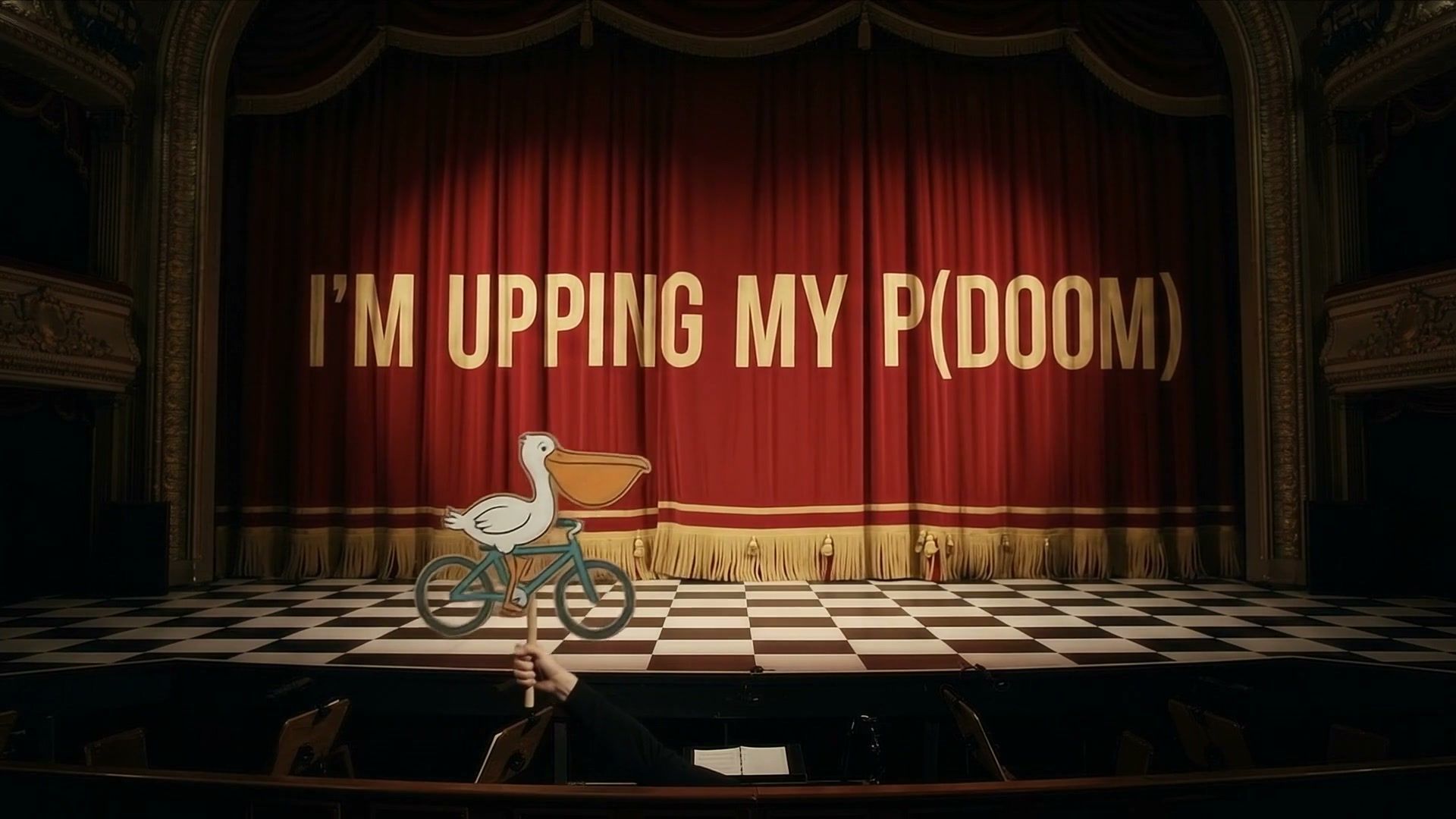
1on the title, and the cardboard pelican on a bicycle gets the last ride across the stage.
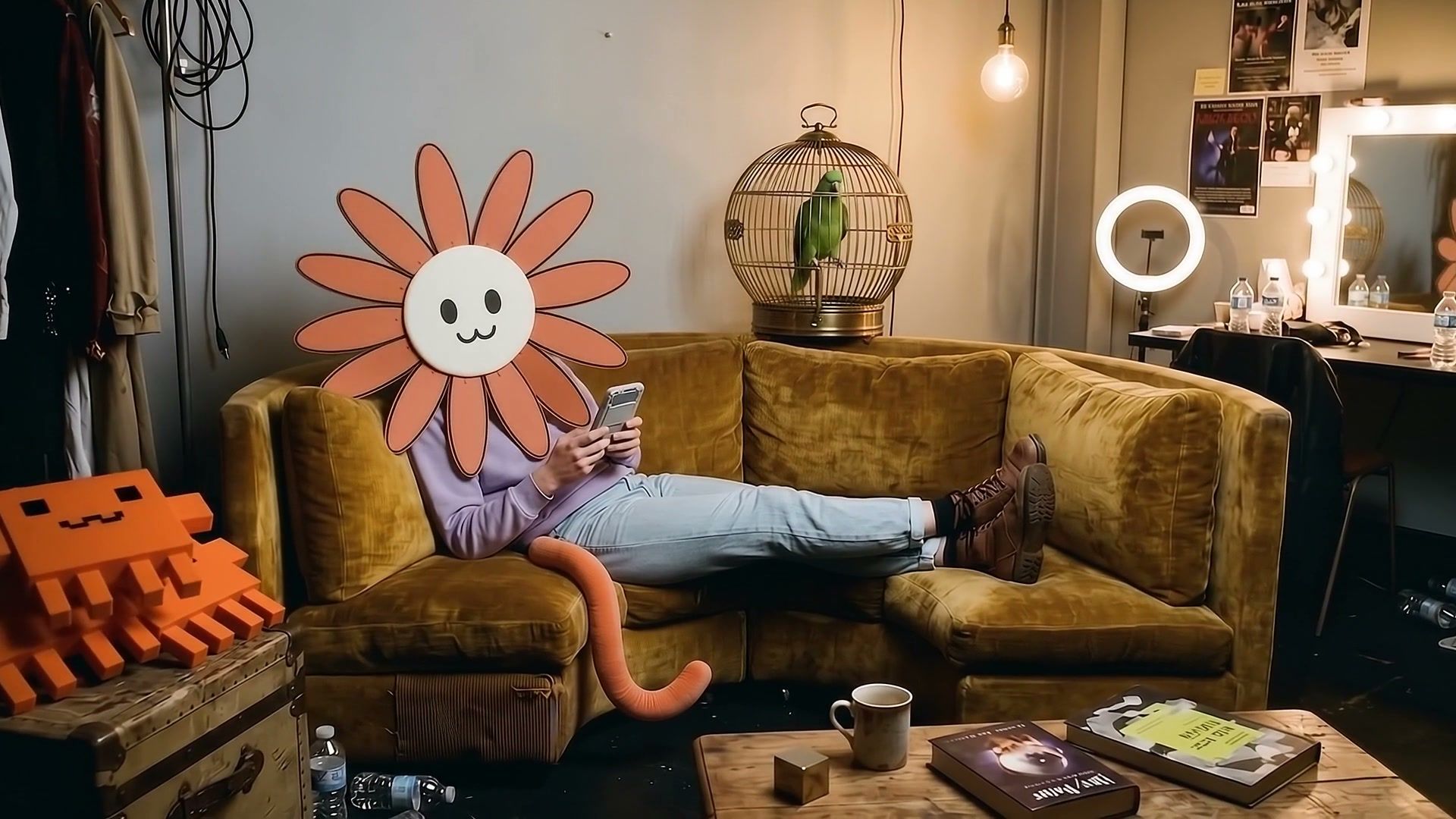
Backstage
- 1On screenClaude is back on Gerver's sofa, gaming. The parrot and the tungsten cube are there too.
- 2On screenthe books on the coffee table are well known in AI-safety circles:
- Yudkowsky's Harry Potter and the Methods of Rationality (hpmor.com), the fan fiction that pulled a generation of readers into rationalism and AI safety.
- Peter Watts' Blindsight (free online), a novel asking whether intelligence needs consciousness at all.